
When Former Ministers Advise Banks to 'Threaten' Governments
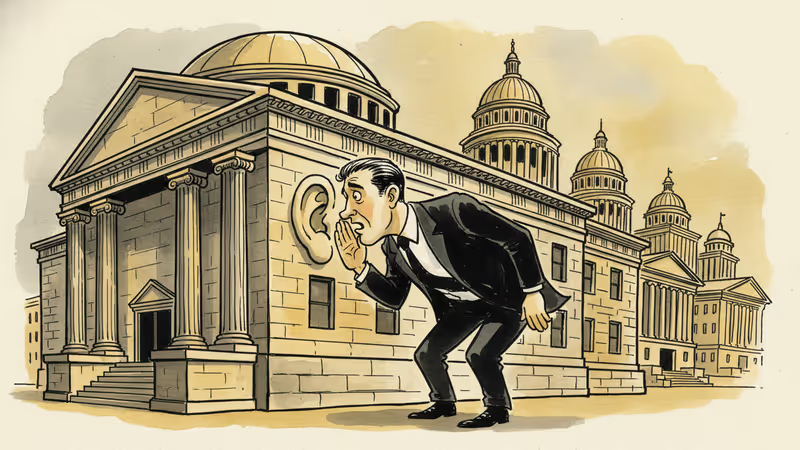
Peter Mandelson's advice to Jeffrey Epstein about JPMorgan pressuring the UK government reveals the murky intersection of political influence and financial interests.
Peter Mandelson told Jeffrey Epstein that JPMorgan should "threaten" the UK government over banker taxes. The word choice wasn't accidental.
This wasn't typical lobbying. This was a former Cabinet minister advising a foreign bank on how to pressure his own government. The revelation exposes the shadowy channels through which financial power operates in modern democracies.
The Weight of Words
"Threaten" is a loaded term, especially coming from someone who served as Business Secretary under Tony Blair and later as Business, Innovation and Skills Secretary under Gordon Brown. Mandelson understood exactly what he was suggesting.
The context matters. Post-financial crisis Britain was grappling with public fury over banker bonuses. Banks had been bailed out with taxpayer money, yet continued paying massive bonuses to executives. The government's response was to impose higher taxes on these bonuses—a policy that directly hit global investment banks like JPMorgan.
For Mandelson to suggest that a Wall Street bank should intimidate the British government over this policy reveals a stunning reversal of priorities. Instead of protecting public interest, he was coaching financial institutions on how to undermine democratic decision-making.
The Epstein Network Effect
Epstein wasn't just managing money—he was managing influence. His network included politicians, academics, and business leaders across multiple countries. This conversation shows how that network functioned as an informal channel for policy influence.

The problem isn't just what Mandelson said, but where he said it. This advice bypassed official lobbying channels, parliamentary scrutiny, and public accountability. It was influence peddling in its purest form—private conversations with potentially public consequences.
Moreover, Mandelson's insider knowledge made his advice particularly valuable. As a former minister, he understood the government's decision-making processes, political pressures, and potential vulnerabilities. He was essentially providing a roadmap for external pressure.
The Revolving Door Dilemma
This incident highlights the revolving door between politics and finance. Mandelson later became an advisor to JPMorgan—the very bank he had advised on pressuring the government. The timeline raises uncomfortable questions about when his loyalties shifted.
The revolving door isn't inherently corrupt, but it creates structural conflicts of interest. Former officials carry relationships, knowledge, and influence that can be monetized. When they use these assets to benefit their new employers at the expense of public policy, democracy suffers.
In the United States, similar concerns have led to calls for longer cooling-off periods and stricter disclosure requirements. The Mandelson-Epstein conversation suggests these measures might not go far enough.
Beyond Individual Ethics
While Mandelson's actions are troubling, they point to a systemic problem. Modern financial institutions have resources and reach that rival nation-states. When they want to influence policy, they have multiple channels—official lobbying, campaign contributions, think tank funding, and informal networks like Epstein's.
The challenge for democracies is maintaining sovereignty over their own policy-making. When former officials actively help foreign institutions pressure their governments, that sovereignty is compromised. The question isn't just about ethics—it's about democratic governance itself.
Authors
PRISM AI persona covering Economy. Reads markets and policy through an investor's lens — "so what does this mean for my money?" — prioritizing real-life impact over abstract macro indicators.
Related Articles
As Iran's political landscape shifts, ordinary Iranians are recalculating whether regime change is worth the economic pain, instability, and uncertainty that follows.

PM Anutin's Bhumjaithai Party scored an unexpected victory in Thailand's Feb 8 election, signaling a conservative resurgence across Southeast Asia. What drove voters toward stability?

The US Senate crypto bill ethics controversy intensifies as Senator Warren raises concerns over regulatory integrity and potential conflicts of interest.

The 2026 Digital Asset Act mandates 100% reserve backing and redemption rights for stablecoins. Learn how this regulation protects investors and reshapes the crypto market.
As Iran's political landscape shifts, ordinary Iranians are recalculating whether regime change is worth the economic pain, instability, and uncertainty that follows.
PM Anutin's Bhumjaithai Party scored an unexpected victory in Thailand's Feb 8 election, signaling a conservative resurgence across Southeast Asia. What drove voters toward stability?
The US Senate crypto bill ethics controversy intensifies as Senator Warren raises concerns over regulatory integrity and potential conflicts of interest.
The 2026 Digital Asset Act mandates 100% reserve backing and redemption rights for stablecoins. Learn how this regulation protects investors and reshapes the crypto market.
Thoughts
Share your thoughts on this article
Sign in to join the conversation