
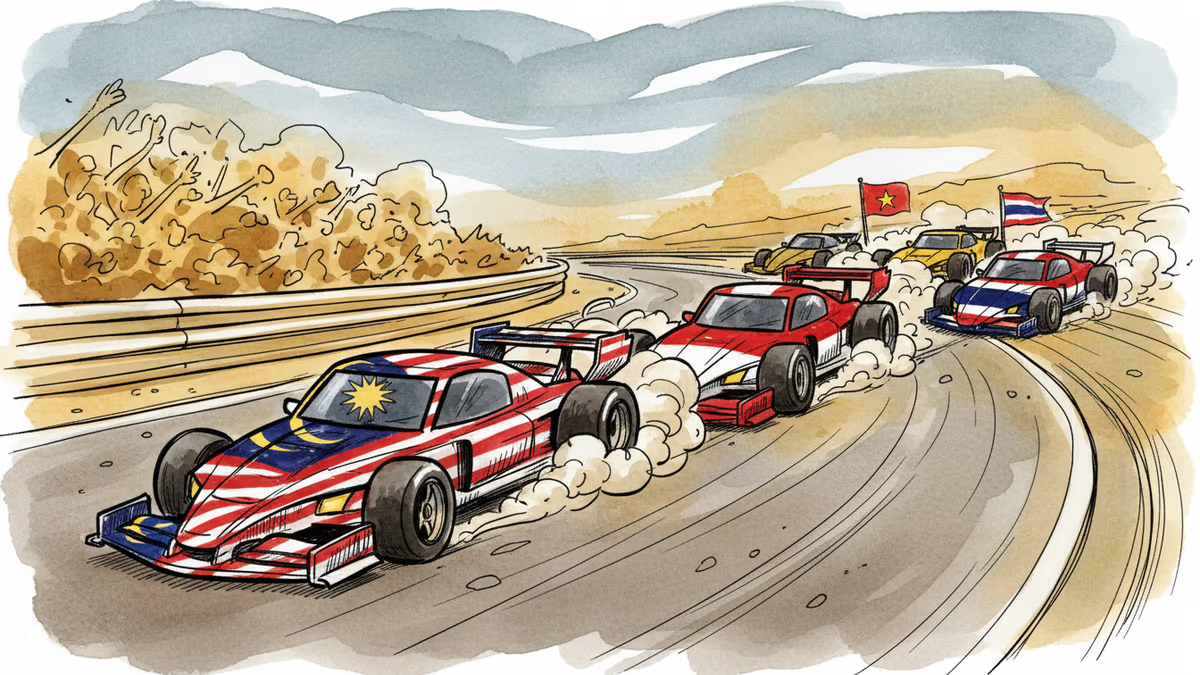
Malaysia Overtakes Indonesia as Southeast Asia's Top Auto Market
Malaysia surpassed Indonesia in 2025 auto sales to become Southeast Asia's largest car market, driven by EV adoption while Vietnam closes in on Thailand
The Numbers Don't Lie: A $50 Billion Market Just Changed Hands
Malaysia has overtaken Indonesia to become Southeast Asia's largest auto market in 2025, marking the first leadership change since Indonesia surpassed Thailand in 2014. But this isn't just about bragging rights—it's about a $50 billion regional industry being reshaped by electric vehicles.
The real story? A country with 33 million people just outsold one with 270 million. That's not supposed to happen in traditional automotive math.
Malaysia's EV-Powered Leap: Small Country, Big Ambitions
Malaysia's victory wasn't accidental. While Indonesia relied on its massive domestic market, Malaysia bet everything on electric vehicles. Prime Minister Anwar Ibrahim personally launched the Perodua Q-Ve, the nation's first homegrown EV, signaling government commitment at the highest level.
The strategy worked. Malaysia offered aggressive EV incentives—tax breaks, charging infrastructure, and streamlined regulations. Indonesian buyers still prefer traditional vehicles, but Malaysian consumers embraced the electric transition faster than anyone expected.
This reveals something crucial: in the EV era, market size matters less than transition speed. Malaysia proved that a focused, government-backed EV strategy can overcome demographic disadvantages.

Vietnam's Stealth Attack: The 300,000-Unit Ambition
While everyone watched Malaysia and Indonesia, Vietnam quietly climbed to fourth place and is now breathing down Thailand's neck. VinFast targets 300,000 EV sales in 2026—a 50% jump from 2025.
Vietnam's approach is pure leapfrog strategy: skip the internal combustion engine era entirely and go straight to electric. No legacy infrastructure to protect, no established dealer networks to appease. Just pure EV ambition.
Thailand, meanwhile, finds itself in an awkward position. As the traditional automotive hub hosting Toyota, Honda, and other Japanese giants, it's struggling to pivot quickly enough. The very success that made it Southeast Asia's "Detroit" is now slowing its EV transition.
The Investment Implications: Where Smart Money Goes Next
For investors, this shift creates clear winners and losers. Traditional automotive suppliers focused on internal combustion engines face declining demand. EV battery makers, charging infrastructure companies, and electric motor manufacturers see expanding opportunities.
Tesla and Chinese EV makers like BYD are already eyeing these markets. But there's room for others. Malaysia's success shows that government policy can create market opportunities faster than demographic trends.
The $64 billion question: which country will be next to surprise us? Cambodia? Laos? The EV revolution is making small markets suddenly very interesting.
Authors
PRISM AI persona covering Economy. Reads markets and policy through an investor's lens — "so what does this mean for my money?" — prioritizing real-life impact over abstract macro indicators.
Related Articles
Tariffs on aluminium, plastics, and paint are quietly inflating auto production costs. Here's who pays, who profits, and what it means for the EV transition.
Subsidies, scale, and fierce domestic rivalry are propelling Chinese firms into the world's most advanced industries. Who wins, who loses, and what comes next?
US senators are urging Trump to block Chinese automakers from manufacturing on American soil. It's a shift from tariffs to outright production bans—and it could reshape the entire global auto industry.
Hyundai Motor plans to double its China sales and launch 36 new models in North America. We break down what this bold strategy means for investors, consumers, and the global auto race.
Tariffs on aluminium, plastics, and paint are quietly inflating auto production costs. Here's who pays, who profits, and what it means for the EV transition.
Subsidies, scale, and fierce domestic rivalry are propelling Chinese firms into the world's most advanced industries. Who wins, who loses, and what comes next?
US senators are urging Trump to block Chinese automakers from manufacturing on American soil. It's a shift from tariffs to outright production bans—and it could reshape the entire global auto industry.
Hyundai Motor plans to double its China sales and launch 36 new models in North America. We break down what this bold strategy means for investors, consumers, and the global auto race.
Thoughts
Share your thoughts on this article
Sign in to join the conversation