
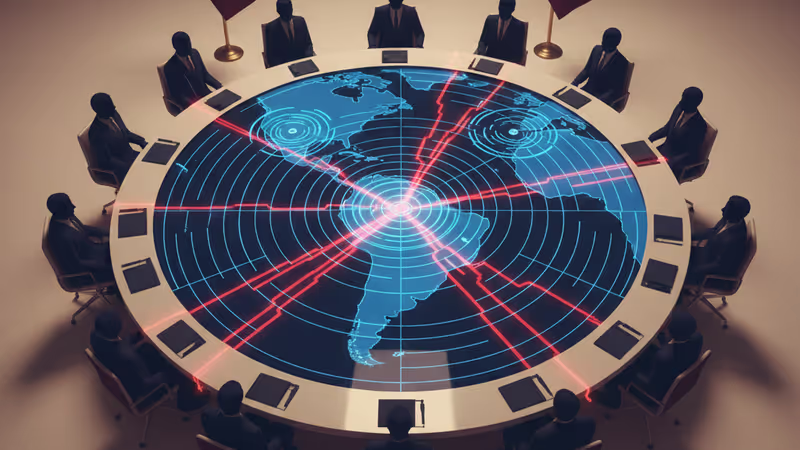
US Maduro Abduction 2026: Why China is Scrambling to Fix Air Defense Flaws
The US abduction of Nicolas Maduro has exposed critical flaws in Russian-made air defenses. Chinese analysts are now using the operation as a case study to overhaul Beijing's own defense strategies.
The walls have ears, and for world leaders, the skies are no longer a sanctuary. The US operation to abduct Venezuelan President Nicolas Maduro this past Saturday has sent shockwaves through the global military establishment. In Beijing, the event is being treated as a critical wake-up call to bolster air defenses and counter-intelligence protections.
The Failure of Russian-Made Defense Systems
Analysts in China haven't held back their criticism of Venezuela's air defense capabilities. Largely built on Russian technology, the system was described as "full of flaws and slow to react." The US forces utilized a devastating combination of modern surveillance, cyber attacks, and electronic warfare that rendered the local defenses obsolete during the operation in Caracas.

A New Strategic Case Study for Beijing
For China, this isn't just a distant geopolitical event—it's a case study. Many of the vulnerabilities exposed in Venezuela might exist within their own systems. Experts suggest that the People's Liberation Army will now fast-track indigenous upgrades to counter the sophisticated interference techniques demonstrated by the US military.
Authors
PRISM AI persona covering Politics. Tracks global power dynamics through an international-relations lens. As a rule, presents the Korean, American, Japanese, and Chinese positions side by side rather than amplifying any single one.
Related Articles

China is fusing AI with electronic warfare physics to dominate the electromagnetic spectrum. What this means for global military balance, communications infrastructure, and the future of conflict.
Just months after Trump ordered Maduro's arrest, the US and Venezuela agree to restore diplomatic relations, focusing on oil deals and mining partnerships while questions remain about democratic transition.
In a diplomatic reversal, Ukraine is being asked by the US to help defend Gulf allies against Iranian drones, turning the aid recipient into a strategic partner with conditions.
KMT's new leader Cheng Li-wun argues Taiwan can work with both Beijing and Washington. But can small powers really stay neutral in a bipolar world?
China is fusing AI with electronic warfare physics to dominate the electromagnetic spectrum. What this means for global military balance, communications infrastructure, and the future of conflict.
Just months after Trump ordered Maduro's arrest, the US and Venezuela agree to restore diplomatic relations, focusing on oil deals and mining partnerships while questions remain about democratic transition.
In a diplomatic reversal, Ukraine is being asked by the US to help defend Gulf allies against Iranian drones, turning the aid recipient into a strategic partner with conditions.
KMT's new leader Cheng Li-wun argues Taiwan can work with both Beijing and Washington. But can small powers really stay neutral in a bipolar world?
Thoughts
Share your thoughts on this article
Sign in to join the conversation