
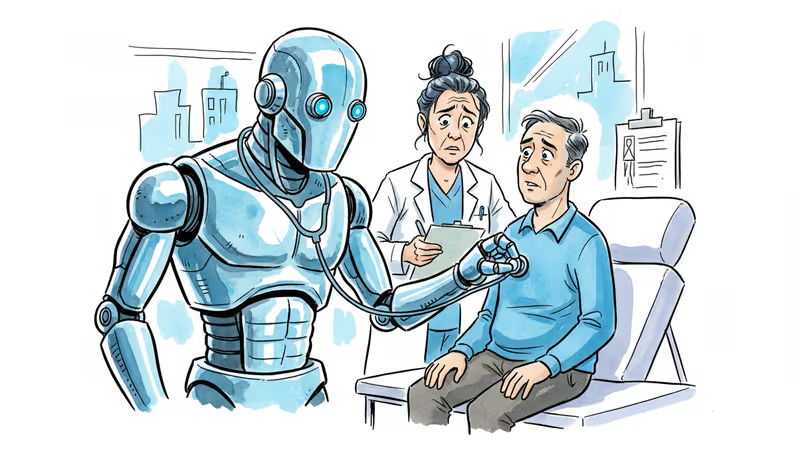
AI Doctors Are Here – But Who's Really Making the Diagnosis?
Lotus Health AI raises $35M to build an AI-powered primary care practice. As AI handles medical decisions, what happens to the doctor-patient relationship?
$35 million just landed in the bank account of a company that wants to replace your family doctor with artificial intelligence. But before you panic about robots performing surgery, consider this: people are already asking ChatGPT about their rashes, headaches, and mysterious symptoms – and getting surprisingly helpful answers.
Lotus Health AI, founded by KJ Dhaliwal (who previously sold dating app Dil Mil for $50 million), announced a Series A funding round co-led by CRV and Kleiner Perkins this week. The startup isn't just another health chatbot – it's positioning itself as a fully licensed medical practice that happens to be powered by AI.
The AI Doctor Will See You Now
Unlike casual health queries to ChatGPT, Lotus operates as a legitimate medical practice. The platform holds licenses in all 50 states, carries malpractice insurance, maintains HIPAA-compliant systems, and can issue prescriptions and specialist referrals. Available 24/7 in 50 languages, it's essentially building what Dhaliwal calls "an AI doctor that functions like a real medical practice."
The process works like this: AI handles the initial consultation, asking the same questions a human doctor would. It synthesizes evidence-based research with patient history to generate treatment plans. But here's the crucial part – board-certified physicians from institutions like Stanford, Harvard, and UCSF review every diagnosis, lab order, and prescription before it reaches the patient.
"AI is giving the advice, but the real doctors are actually signing off on it," Dhaliwal told TechCrunch. The company claims this hybrid model allows them to see 10 times as many patients as traditional practices, even with 15-minute visit limits.
Why This Matters Right Now

The timing isn't coincidental. America faces a severe primary care shortage, with many patients waiting weeks for appointments or resorting to expensive emergency room visits for routine care. The pandemic normalized telemedicine, creating regulatory pathways that didn't exist before. Meanwhile, AI models have reached a sophistication level where they can process medical literature and patient data in ways that seemed impossible just years ago.
Saar Gur from CRV, who led the investment, frames it pragmatically: "There are many challenges, but it's not SpaceX sending astronauts to the moon." The regulatory framework exists; the AI capability exists; the market need definitely exists.
The Free Healthcare Paradox
Perhaps most intriguingly, Lotus offers its entire service completely free. No insurance required, no copays, no hidden fees. In a healthcare system where a simple doctor's visit can cost hundreds of dollars, this seems almost too good to be true.
Dhaliwal acknowledges this isn't sustainable long-term, mentioning potential revenue streams like sponsored content or subscriptions. But for now, the focus remains entirely on product development and patient acquisition rather than monetization. This raises questions about data usage, long-term sustainability, and what happens when the free model inevitably changes.
The Human Element Question
The most fascinating aspect isn't the technology – it's what this says about healthcare relationships. If an AI can ask the right questions, process symptoms against vast medical databases, and generate treatment plans, what role does human intuition, empathy, and bedside manner play in medical care?
Lotus acknowledges its limitations. Urgent cases get directed to emergency rooms. Physical examinations require in-person referrals. But for the vast majority of primary care – routine checkups, common illnesses, medication management – the AI-first model might be sufficient.
Competitors like Lightspeed-backed Doctronic are pursuing similar approaches, suggesting this isn't just one company's vision but an emerging industry trend.
Authors
Related Articles
CAR T cell therapy, proven in blood cancers, is now in hundreds of clinical trials for MS, lupus, and other autoimmune conditions. What the science shows—and what it doesn't yet.
HBO's The Pitt reveals the unsettling reality of AI-driven healthcare. As hospitals embrace generative AI, doctors grapple with efficiency versus humanity.

As China pushes TCM globally with AI-powered diagnostics and robotic acupuncture, can technology bridge the gap between ancient wisdom and modern healthcare standards?

OpenAI launched ChatGPT Health 2026, marking the end of the Dr. Google era. Explore the features of the GPT-5.2 powered tool, its 85% accuracy rate, and critical safety risks.
CAR T cell therapy, proven in blood cancers, is now in hundreds of clinical trials for MS, lupus, and other autoimmune conditions. What the science shows—and what it doesn't yet.
HBO's The Pitt reveals the unsettling reality of AI-driven healthcare. As hospitals embrace generative AI, doctors grapple with efficiency versus humanity.
As China pushes TCM globally with AI-powered diagnostics and robotic acupuncture, can technology bridge the gap between ancient wisdom and modern healthcare standards?
OpenAI launched ChatGPT Health 2026, marking the end of the Dr. Google era. Explore the features of the GPT-5.2 powered tool, its 85% accuracy rate, and critical safety risks.
Thoughts
Share your thoughts on this article
Sign in to join the conversation