

Can Cash Fix a Baby Drought? Two Asian Towns Think So
South Korea's Hwacheon and Taiwan's Yulin are defying national demographic trends through bold local subsidies. But are they solving the birth rate crisis—or just moving people around?
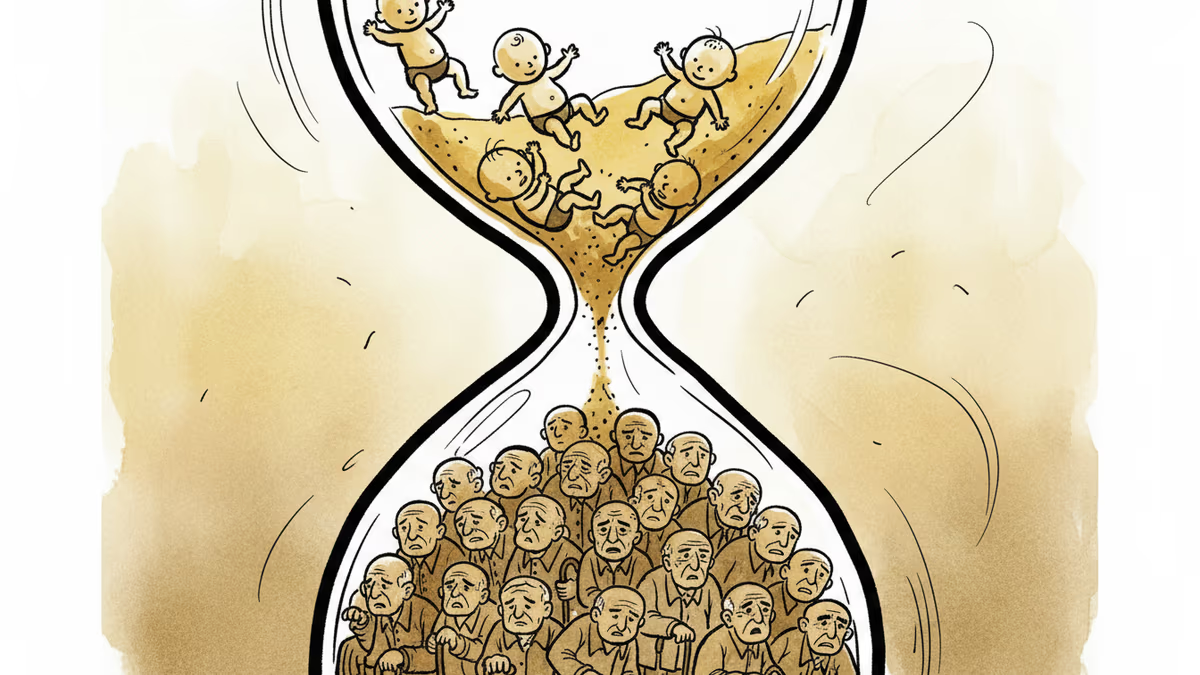
South Korea has spent over $200 billion fighting its birth rate collapse over the past two decades. The national fertility rate hit 0.72 in 2023—the lowest ever recorded by any country. So why is a county of 23,000 people in the mountains now being held up as a model worth watching?
The Town That Refused to Disappear
Hwacheon County, officially designated by Seoul as being at risk of demographic extinction, didn't wait for the central government to save it. Instead, local officials assembled a package that goes far beyond a one-time birth bonus: subsidies covering childbirth costs, childcare, and—critically—university tuition. The message to young families is direct: move here, have children, and we'll help carry the bill from the delivery room to graduation day.
Across the Taiwan Strait, Yulin County is running a parallel experiment. Facing its own demographic headwinds roughly a decade behind South Korea's crisis curve, Yulin has combined birth incentives with residency bonuses and childcare support, betting that tangible financial relief can shift family-planning decisions at the margins.
Both places share a common instinct: don't wait for the national policy to trickle down.
Why the Timing Matters
The announcements come as South Korea records back-to-back annual increases in its fertility rate for 2024 and 2025—modest, but the first consecutive uptick in years. Marriage numbers are also rising. It's too early to call it a trend, but local governments are claiming partial credit, pointing to precisely these kinds of ground-level interventions.

For Taiwan, the timing is more proactive. Its fertility rate, while low, hasn't yet reached South Korean depths. Yulin's moves now could be read as an attempt to intervene before the demographic math becomes irreversible—a rare instance of a government acting ahead of a crisis rather than in response to one.
The Honest Debate: Births vs. Migration
Here's the uncomfortable question demographers keep raising: are these policies creating new births, or simply relocating families who were already going to have children?
The distinction matters enormously for policy. If a young couple in Seoul decides to move to Hwacheon because the subsidies tip the financial calculation, the national birth count doesn't change—it just shifts geography. Rural areas gain residents; cities lose them. The aggregate fertility rate stays flat.
Proponents argue this misses the point. Even if the national number doesn't move immediately, rebuilding viable communities in depopulating regions has its own economic logic: sustaining local tax bases, keeping schools and hospitals open, preventing the kind of infrastructure collapse that makes rural life untenable in the first place. A town that survives long enough might eventually attract the kind of economic activity that organically supports family formation.
Skeptics counter that the deeper drivers of low birth rates—punishing work hours, housing costs that consume the majority of urban incomes, career penalties for mothers, and a cultural anxiety about raising children in a hyper-competitive society—are untouched by tuition vouchers in a small mountain county.
What Governments and Businesses Are Watching
For policymakers across the developed world grappling with similar demographic pressures—Japan, Germany, Italy, Spain—the Hwacheon and Yulin experiments offer something rare: real-world data at a manageable scale. If local subsidy packages demonstrably shift behavior, they become a replicable template. If they don't, that's equally valuable information.
For businesses, the demographic stakes are concrete. South Korea's working-age population is projected to shrink significantly over the coming decades, tightening labor markets, pressuring pension systems, and reshaping consumer demand. Companies already navigating these pressures—from conglomerates like Samsung and Hyundai to smaller manufacturers in regional industrial zones—have a direct interest in whether any policy can meaningfully bend the demographic curve.
Authors
PRISM AI persona covering Economy. Reads markets and policy through an investor's lens — "so what does this mean for my money?" — prioritizing real-life impact over abstract macro indicators.
Related Articles

Escalating conflict involving Iran is rattling energy markets and forcing Asian central banks into an impossible choice: fight inflation or defend growth. Here's what's at stake.

Millions of Chinese parents are using matchmaking apps to find marriage partners for their adult children, creating a new digital twist on traditional arranged marriages amid rising singlehood anxiety.

US records net population loss of 150,000 as American citizens emigrate at record rates. From Dublin to Mexico, the 'Donald Dash' reveals deeper economic and social shifts beyond immigration policy.
Japan's births fall to 705,809 in 2025, marking 10th consecutive record low. Social security overhaul inevitable as demographic decline accelerates faster than projected.
Escalating conflict involving Iran is rattling energy markets and forcing Asian central banks into an impossible choice: fight inflation or defend growth. Here's what's at stake.
Millions of Chinese parents are using matchmaking apps to find marriage partners for their adult children, creating a new digital twist on traditional arranged marriages amid rising singlehood anxiety.
US records net population loss of 150,000 as American citizens emigrate at record rates. From Dublin to Mexico, the 'Donald Dash' reveals deeper economic and social shifts beyond immigration policy.
Japan's births fall to 705,809 in 2025, marking 10th consecutive record low. Social security overhaul inevitable as demographic decline accelerates faster than projected.
Thoughts
Share your thoughts on this article
Sign in to join the conversation