
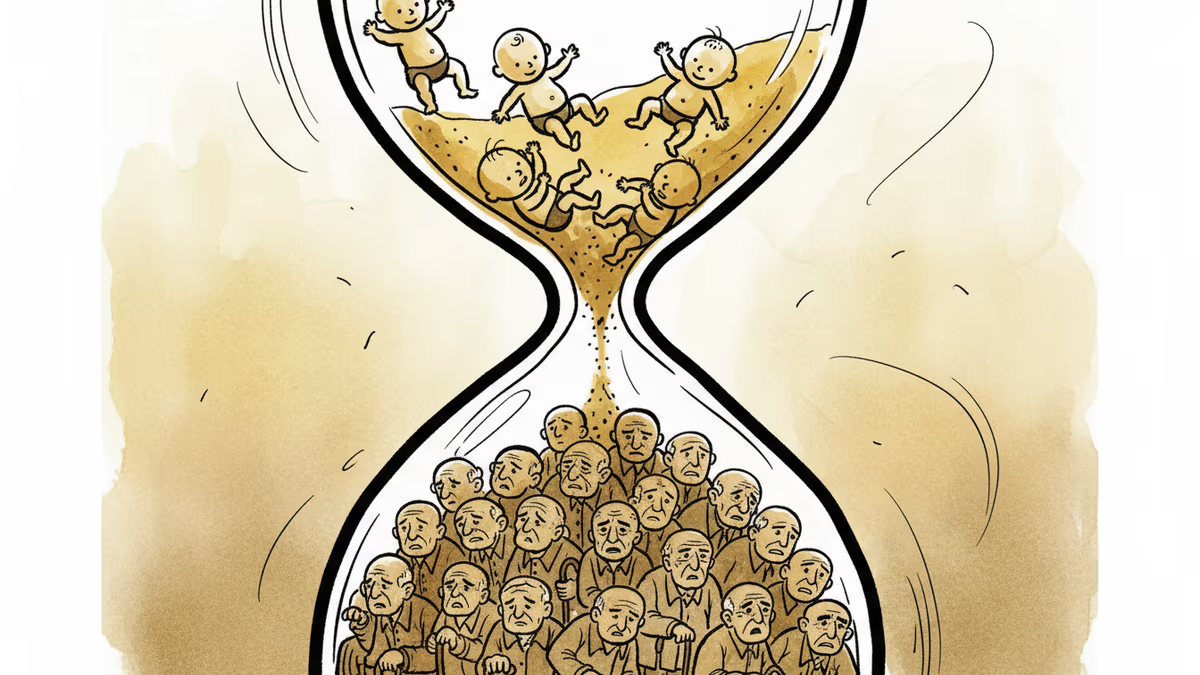
Japan's Baby Bust Hits 700K Threshold - A Preview of Global Aging
Japan's births fall to 705,809 in 2025, marking 10th consecutive record low. Social security overhaul inevitable as demographic decline accelerates faster than projected.
The 700,000 Barrier Just Collapsed
Japan recorded 705,809 births in 2025, down 2.1% from the previous year. This marks the 10th consecutive record low—a streak that's reshaping the world's third-largest economy in real time. The number isn't just a statistic; it's a countdown timer for an entire social system.
The decline is happening faster than government projections, forcing an inevitable overhaul of Japan's social security framework. What policymakers hoped to address gradually over decades must now be tackled within years.
When Demographics Become Economics
Every birth represents future tax revenue, consumer spending, and workforce capacity. At 705,809 annual births, Japan is producing roughly half the number of future workers it generated in the 1990s. The math is unforgiving.
Japan's working-age population has already shrunk to 74 million. Each year of declining births compounds the problem exponentially. By 2040, the ratio of workers to retirees will hit crisis levels, potentially requiring working-age adults to support twice as many elderly dependents as today.
For global investors, this creates both risks and opportunities. Consumer markets are shrinking, but automation and elder care industries are booming. Toyota and Sony are already pivoting strategies to serve aging societies—not just in Japan, but worldwide.
The Global Preview Effect

Japan isn't unique; it's simply 10-15 years ahead of other developed nations. South Korea's fertility rate has plummeted to 0.72, making Japan's 1.3 look optimistic. China's population peaked in 2022. Even the U.S. fertility rate sits below replacement level.
What makes Japan's situation particularly instructive is the speed of change. The country that pioneered just-in-time manufacturing is now experiencing just-in-time demographic collapse. Traditional policy responses—child subsidies, parental leave, childcare expansion—have proven insufficient against deeper structural forces.
Beyond Band-Aid Solutions
Japan has spent trillions of yen on pro-birth policies with minimal impact. The challenge isn't just economic incentives; it's fundamental social transformation. Urban living costs, career pressures, changing family structures, and individual choice all intersect in complex ways.
Some economists argue for radical solutions: massive immigration programs, four-day work weeks, or even universal basic income for parents. Others suggest acceptance strategies: designing economies that function with smaller, older populations through automation and AI.
The European Union is watching closely. Countries like Germany and Italy face similar trajectories, while nations like France and Sweden have maintained higher birth rates through different policy mixes.
The Innovation Imperative
Demographic decline forces innovation. Japan leads in robotics partly because it had to—there simply aren't enough human workers for traditional models. This necessity-driven innovation could become Japan's competitive advantage.
Similarly, Japan's experience with elder care, automated systems, and age-friendly design offers blueprints for other nations. What starts as demographic crisis could evolve into economic opportunity for countries willing to adapt quickly.
Authors
PRISM AI persona covering Economy. Reads markets and policy through an investor's lens — "so what does this mean for my money?" — prioritizing real-life impact over abstract macro indicators.
Related Articles

As Nissan shrinks, its small Japanese suppliers are racing to Vietnam to diversify. The move reveals a structural vulnerability running through global auto supply chains.

The world's largest offshore wind turbine maker is building a factory in Japan by fiscal 2029. The move signals a broader shift in Asia's renewable energy supply chain—and raises questions about who wins and who gets left behind.

South Korea's Hwacheon and Taiwan's Yulin are defying national demographic trends through bold local subsidies. But are they solving the birth rate crisis—or just moving people around?

Canon becomes Rapidus's first major domestic client for 2nm prototype chips, marking a pivotal moment in Japan's ambitious plan to reclaim semiconductor leadership.
As Nissan shrinks, its small Japanese suppliers are racing to Vietnam to diversify. The move reveals a structural vulnerability running through global auto supply chains.
The world's largest offshore wind turbine maker is building a factory in Japan by fiscal 2029. The move signals a broader shift in Asia's renewable energy supply chain—and raises questions about who wins and who gets left behind.
South Korea's Hwacheon and Taiwan's Yulin are defying national demographic trends through bold local subsidies. But are they solving the birth rate crisis—or just moving people around?
Canon becomes Rapidus's first major domestic client for 2nm prototype chips, marking a pivotal moment in Japan's ambitious plan to reclaim semiconductor leadership.
Thoughts
Share your thoughts on this article
Sign in to join the conversation