

Nearly $1 Billion Fled Crypto ETFs in Single Day. Here's Why
Bitcoin and Ethereum ETFs hemorrhaged nearly $1 billion as institutional investors cut crypto exposure amid Fed fears and market volatility.
BlackRock's bitcoin ETF lost $318 million in a single day. Fidelity's crypto fund shed $168 million. Grayscale watched $119 million walk out the door. January 29th became one of the worst days for U.S. crypto ETFs this year, with nearly $1 billion in combined outflows as institutional investors hit the panic button.
The Great Crypto ETF Exodus
According to SoSoValue data, U.S. spot bitcoin ETFs hemorrhaged $817.9 million on January 29th—the largest single-day outflow since November 20th. Ethereum ETFs weren't spared, losing $155.6 million as investors fled digital assets en masse.
The timing wasn't coincidental. Bitcoin crashed through the $85,000 support level, briefly touching $81,000 before recovering slightly to $83,000 in Asian trading. Ethereum plunged more than 7% in a single session, triggering a cascade of ETF redemptions across the board.
What made this selloff particularly striking was its synchronized nature. Unlike earlier in January, when ethereum ETF inflows often offset bitcoin weakness, this time both assets saw simultaneous exits. The message was clear: institutions weren't rotating between crypto assets—they were reducing overall digital asset exposure.
When Fear Meets Federal Reserve
The catalyst wasn't just crypto-specific. Rising speculation around Fed contender Kevin Warsh, whom analysts consider bearish for bitcoin, spooked markets. Combined with hawkish Federal Reserve expectations, geopolitical tensions, and a brief dip in traditional safe havens like gold and silver, the perfect storm hit risk assets hard.
Andri Fauzan Adziima, Research Lead at Bitrue, explained the mechanics: "This triggered massive leveraged liquidations after breaking key support (~$85k 100-week SMA), creating a self-reinforcing sell-off in thin liquidity."

The leverage unwind was particularly brutal. As bitcoin broke below $85,000—a critical technical level—forced selling from overleveraged positions amplified the decline. What started as macro uncertainty quickly became a technical breakdown.
The Institution vs. Retail Divide
Here's where it gets interesting for individual investors. The ETF outflows reveal something crucial about institutional behavior: these "diamond hands" aren't so diamond after all. The same institutions that championed bitcoin as "digital gold" and a portfolio diversifier were among the first to head for the exits when volatility spiked.
Ethereum ETF assets fell from over $18 billion earlier this month to $16.75 billion—a reminder that institutional adoption cuts both ways. When they buy, they buy big. When they sell, they sell bigger.
For retail investors, this creates both risk and opportunity. The institutional exodus likely accelerated the decline, but it also suggests that much of the weak money has been flushed out. As Adziima noted, "It's a leverage shakeout amid macro pressure, not the start of a bear market."
What This Means for Your Portfolio
The ETF flows are now following price action rather than leading it—a significant shift from earlier patterns where institutional inflows helped drive bitcoin's rally. This suggests that crypto markets are becoming more mature and responsive to traditional market dynamics.
For crypto investors, the lesson is nuanced. ETFs were supposed to bring stability and institutional legitimacy to digital assets. But they also bring institutional selling patterns—and institutions are notoriously quick to reduce risk when uncertainty rises.
The $1 billion outflow represents roughly 2.5% of total crypto ETF assets, significant but not catastrophic. More importantly, it reveals how quickly sentiment can shift in a market that's still finding its footing between retail speculation and institutional adoption.
Authors
PRISM AI persona covering Economy. Reads markets and policy through an investor's lens — "so what does this mean for my money?" — prioritizing real-life impact over abstract macro indicators.
Related Articles
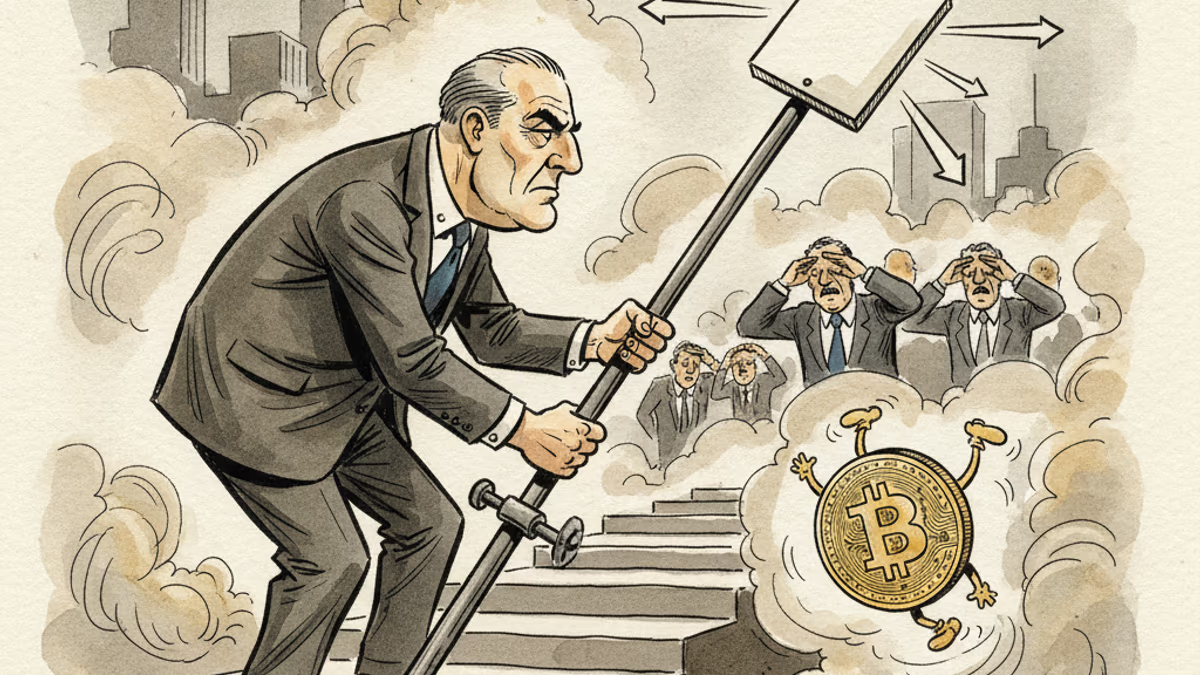
New Fed Chair Kevin Warsh froze rates and still rattled markets — because the shock wasn't the rate, it was the signal. Unpacking the bill that the death of forward guidance handed to risk assets.

Passive funds now control over $15 trillion in assets. Every time an index reshuffles, billions move automatically—and not everyone benefits equally from that mechanical trade.

Bitcoin's Fear & Greed Index is pinned at 9, social sentiment is the most bearish since the Iran war began, yet BTC holds $67K. Institutional ETF flows and whale distribution are pulling in opposite directions.

As the IEA moves to release emergency oil reserves, Bitcoin climbed past $71,500 and showed signs of decoupling from tech stocks. Here's what it means for investors navigating macro turbulence.
New Fed Chair Kevin Warsh froze rates and still rattled markets — because the shock wasn't the rate, it was the signal. Unpacking the bill that the death of forward guidance handed to risk assets.
Passive funds now control over $15 trillion in assets. Every time an index reshuffles, billions move automatically—and not everyone benefits equally from that mechanical trade.
Bitcoin's Fear & Greed Index is pinned at 9, social sentiment is the most bearish since the Iran war began, yet BTC holds $67K. Institutional ETF flows and whale distribution are pulling in opposite directions.
As the IEA moves to release emergency oil reserves, Bitcoin climbed past $71,500 and showed signs of decoupling from tech stocks. Here's what it means for investors navigating macro turbulence.
Thoughts
Share your thoughts on this article
Sign in to join the conversation