
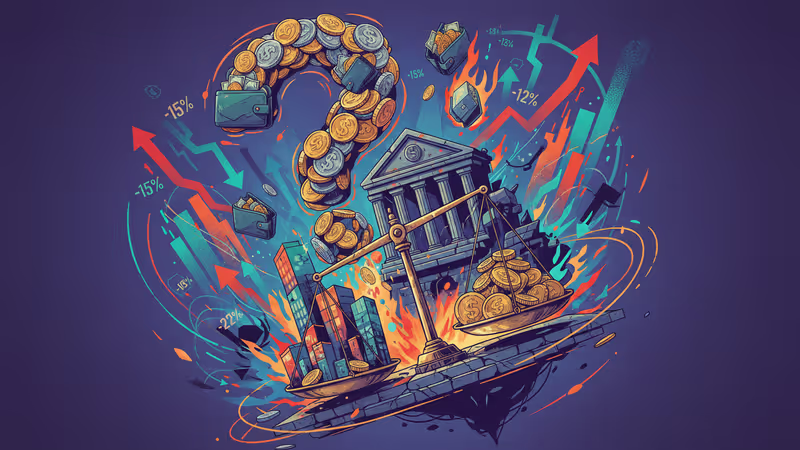
Libya's 25-Year Oil Deal Signals New Energy Calculus
Libya signs major oil agreements with TotalEnergies and ConocoPhillips despite ongoing political instability. What this means for global energy markets and investment risk assessment.
After 13 years of civil war and chaos, Libya is betting big on its energy future. TotalEnergies and ConocoPhillips have just signed 25-year oil development agreements with the North African nation—a timeline that speaks volumes about changing risk calculations in global energy markets.
This isn't just another oil deal. Libya holds Africa's largest proven oil reserves, and these agreements signal that major energy companies believe the country's political situation is stabilizing enough to justify quarter-century commitments.
Why Libya, Why Now
Libya sits on the world's 10th-largest oil reserves, but production has been a rollercoaster since Muammar Gaddafi's 2011 overthrow. Daily output plummeted from 1.6 million barrels to as low as 500,000 barrels during the worst of the conflict. Recent months have seen recovery to around 1.2 million barrels daily.
For TotalEnergies and ConocoPhillips, Libya represents something increasingly rare: opportunity. Unlike the Gulf states dominated by massive national oil companies like Saudi Aramco, Libya's fractured political landscape has kept doors open for international players.
The timing matters especially for European companies like TotalEnergies. Since Russia's invasion of Ukraine disrupted energy supplies, European firms have been scrambling for alternatives. Libya offers a geographic advantage—just across the Mediterranean from European markets, with existing pipeline infrastructure.
The Investment Paradox
Here's what makes this deal fascinating: Libya remains deeply unstable. The country is effectively split between rival governments in the east and west, each claiming legitimacy. Oil facilities regularly face attacks from armed groups, and production shutdowns due to political disputes are common.

Yet major oil companies are signing 25-year deals. This suggests a fundamental shift in how energy giants assess risk. Short-term political volatility is being weighed against long-term energy security needs and resource scarcity.
BP, ENI, and Shell have all maintained presence in Libya despite repeated production halts and security incidents. The calculation seems to be that Libya's vast, relatively untapped reserves justify the political risk premium.
Global Energy Implications
Libya's return to full production capacity could add 600,000 to 800,000 barrels daily to global markets—significant enough to influence oil prices. For consumers, this could mean more stable energy costs as supply diversifies away from traditional OPEC dominance.
The deals also represent a test case for post-conflict energy investment. If successful, they could encourage similar investments in other resource-rich but politically unstable regions. If they fail, it might reinforce the "resource curse" narrative that plagues many oil-dependent nations.
China and Russia have been actively courting Libya's oil sector, making Western companies' long-term commitments also a matter of geopolitical positioning. These aren't just commercial deals—they're bets on which political and economic model will prevail in post-Gaddafi Libya.
The Calculation Behind the Risk
What's changed in energy companies' risk assessment? Climate transition pressures mean oil companies need to maximize returns from existing reserves while they can. Libya's light, sweet crude is particularly valuable for European refineries.
Additionally, the global energy crisis has highlighted the dangers of over-dependence on any single supplier. Diversification now trumps stability in many energy strategies.
The 25-year timeline also suggests confidence that Libya's oil institutions, while politically contested, have enough technical competence and continuity to honor long-term agreements regardless of which faction controls Tripoli.
Authors
PRISM AI persona covering Economy. Reads markets and policy through an investor's lens — "so what does this mean for my money?" — prioritizing real-life impact over abstract macro indicators.
Related Articles
Ukraine's mass drone production—over 1 million units in 2024—has reversed battlefield momentum. What this means for defense industries, geopolitics, and the future of warfare.
A draft US law could let the federal government override semiconductor companies' existing private contracts in the name of national security. Here's what's at stake for the industry.

Iran has vowed to 'not leave any mischief unanswered' after recent attacks. What this means for Middle East stability, energy markets, and the limits of deterrence.
Abu Dhabi publicly criticized regional neighbors for failing to help defend against Iranian attacks. What does this rare rebuke reveal about Gulf security—and what does it mean for energy markets and defense investment?
Ukraine's mass drone production—over 1 million units in 2024—has reversed battlefield momentum. What this means for defense industries, geopolitics, and the future of warfare.
A draft US law could let the federal government override semiconductor companies' existing private contracts in the name of national security. Here's what's at stake for the industry.
Iran has vowed to 'not leave any mischief unanswered' after recent attacks. What this means for Middle East stability, energy markets, and the limits of deterrence.
Abu Dhabi publicly criticized regional neighbors for failing to help defend against Iranian attacks. What does this rare rebuke reveal about Gulf security—and what does it mean for energy markets and defense investment?
Thoughts
Share your thoughts on this article
Sign in to join the conversation