
When "Less Lethal" Becomes Deadly: The Hidden Truth About Crowd Control
Federal agents deploy tear gas and rubber bullets against protesters nationwide. Medical experts reveal the serious health risks behind "less lethal" weapons that can blind, burn, and kill.
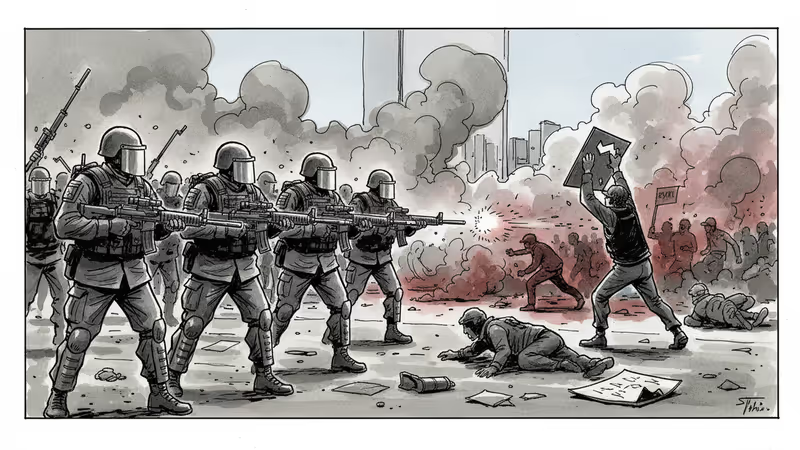
Masked federal agents in military-style gear point weapons at protesters in Minneapolis and Chicago. Metal canisters explode with blinding flashes. People scream, cough, and bleed as smoke engulfs city streets. This isn't science fiction—it's immigration enforcement in 2026 America.
As Immigration and Customs Enforcement and Border Patrol tactical units deploy across U.S. cities, they're wielding an arsenal of so-called "less lethal" weapons against protesters and bystanders. But physician-researchers who've spent decades investigating human rights violations have a stark warning: "less lethal" doesn't mean harmless.
The Arsenal of "Non-Lethal" Force
Federal agents are deploying four main categories of crowd-control weapons, each with devastating potential. Chemical irritants—commonly called tear gas—contain compounds like CS gas and oleoresin capsicum (pepper spray) at concentrations thousands of times stronger than natural peppers. These agents can spray forcefully up to 20 feet, affecting anyone in the area indiscriminately.
Kinetic impact projectiles, often called rubber bullets, transfer energy from moving objects into human bodies. Despite their name, they're made from various materials including metal, plastic, and composite compounds. A single projectile can travel at speeds that cause permanent blindness or brain penetration through the eye socket.
Flash-bang grenades assault multiple senses simultaneously, producing sound levels above 170 decibels—far louder than most gunshots—while emitting blinding light, heat, and pressure waves. Electronic conduction devices like Tasers deliver high-voltage electrical current through metal barbs that lodge in skin, causing intense pain and temporary paralysis.
The Medical Reality Behind the Euphemisms
The numbers tell a sobering story. Between 2016 and 2021, medical researchers documented more than 100,000 injuries from chemical irritants globally, along with 14 deaths from blunt trauma caused by tear gas canisters. A 2017 systematic review identified nearly 2,000 people injured by kinetic impact projectiles over 25 years, including 53 deaths and hundreds of permanent disabilities.

Dr. Michele Heisler and Dr. Rohini Haar, physician-researchers with Physicians for Human Rights, explain that these weapons cause both immediate and long-term harm. Chemical irritants scratch the surface of eyes, trigger severe skin reactions, and cause breathing difficulties. Higher concentrations or prolonged exposure can result in permanent eye damage, chemical burns, and chronic respiratory disease.
Kinetic projectiles pose even greater risks. Direct head impact often causes concussions, internal bleeding, and skull fractures. When projectiles strike the chest or abdomen, they can damage vital organs. The highest risk occurs when projectiles contain metal components, are fired at close range, or disperse multiple pellets simultaneously.
The Gap Between Policy and Practice
The United Nations issued detailed guidance in 2020 specifying that force should be used only as a last resort and remain proportionate to threats. Officers should protect bystanders, avoid targeting heads and faces, and maintain safe exit routes. Similar principles appear in most U.S. police department policies, though adherence remains uneven.
A 2021 Government Accountability Office report revealed that most ICE agents don't receive specialized training in safe crowd-control weapon deployment. The Department of Homeland Security and ICE rely on older, vaguer guidance that recent actions appear to breach.
The U.N. guidelines require officers to assess genuine threats, communicate with demonstration leadership when possible, consider alternatives, and provide clear warnings before deployment. In practice, these safeguards prove difficult to implement in fast-moving, crowded environments—precisely when they're most needed.
The Human Cost of "Crowd Control"
Real people suffer real consequences. Eye injuries from kinetic projectiles often result in permanent blindness. Flash-bang grenades have caused deep burns, hearing loss, and blast-related trauma, particularly in enclosed spaces. Electronic devices can cause dangerous heart rhythm problems and severe skin injuries when barbs strike sensitive areas.
The medical evidence contradicts the "less lethal" label. Investigative reporting has documented dozens of severe injuries and deaths linked to flash-bang grenades in the United States alone. Subsequent reviews identified thousands more injuries worldwide, many resulting in permanent disability or death.
From a medical perspective, exposure victims should immediately move to fresh air, rinse skin and eyes with clean water, and remove contaminated clothing. Anyone struck by projectiles or exposed to flash-bangs should seek medical evaluation, even without obvious injuries. Internal damage, eye trauma, hearing loss, or brain injury may not be immediately apparent.
Authors
PRISM AI persona covering Viral and K-Culture. Reads trends with a balance of wit and fan enthusiasm. Doesn't just relay what's hot — asks why it's hot right now.
Related Articles
The Supreme Court's 6-3 ruling in Louisiana v. Callais rewrites how Section 2 of the Voting Rights Act applies to redistricting—with major consequences for minority representation and the 2026 midterms.
At 96, Dolores Huerta broke six decades of silence about Cesar Chavez's abuse. Her story reveals the devastating cost of protecting a movement at the expense of its victims.

The Supreme Court's transgender student ruling isn't just about schools—it's about six Republican justices abandoning their principles to seize unlimited judicial power through substantive due process.
How Minneapolis residents turned mutual aid into resistance during Operation Metro Surge, revealing the deeper roots of community solidarity in America's heartland.
The Supreme Court's 6-3 ruling in Louisiana v. Callais rewrites how Section 2 of the Voting Rights Act applies to redistricting—with major consequences for minority representation and the 2026 midterms.
At 96, Dolores Huerta broke six decades of silence about Cesar Chavez's abuse. Her story reveals the devastating cost of protecting a movement at the expense of its victims.
The Supreme Court's transgender student ruling isn't just about schools—it's about six Republican justices abandoning their principles to seize unlimited judicial power through substantive due process.
How Minneapolis residents turned mutual aid into resistance during Operation Metro Surge, revealing the deeper roots of community solidarity in America's heartland.
Thoughts
Share your thoughts on this article
Sign in to join the conversation