
How America's Black Voters Could Lose Their Political Voice
Louisiana v. Callais case threatens to dismantle Section 2 of the Voting Rights Act, potentially reversing decades of Black political progress in the South
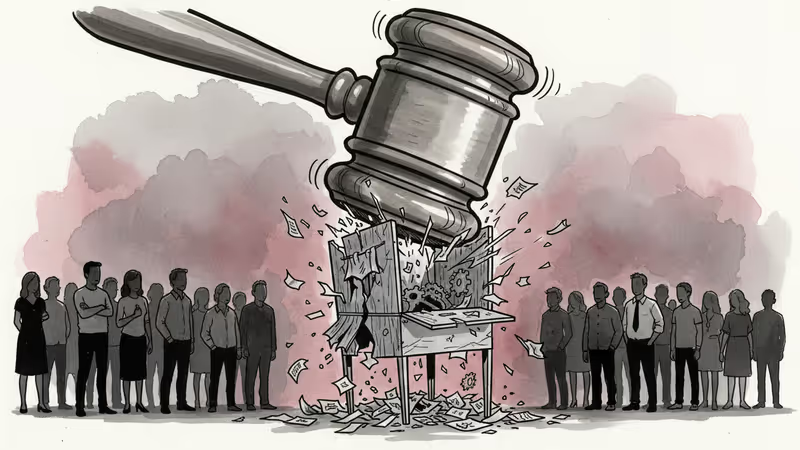
By June 2026, a single Supreme Court decision could fundamentally reshape the political landscape for Black voters across the American South. The case, Louisiana v. Callais, appears poised to dismantle Section 2 of the Voting Rights Act—a provision that has protected minority voting power for decades.
Section 2 prohibits any discriminatory voting practice that results in less political opportunity for minority groups. If the Court strikes it down, Southern state legislatures could redraw political districts with impunity, diluting the voting power of racial minorities through widespread gerrymandering.
The Constitutional Irony
The lawsuit's legal foundation reveals a striking historical irony. Louisiana citizens argue that federal mandates to create majority-Black districts violate the 14th Amendment's equal protection clause, essentially constituting unconstitutional racial gerrymandering.
Yet the 14th Amendment was originally designed to protect freed slaves from discriminatory "Black Codes" in the post-Civil War South. Using this same amendment to potentially reverse Black political progress would represent a profound constitutional contradiction.
As historian Robert Bland notes in his book "Requiem for Reconstruction," understanding this history is crucial: "Without grasping the forces that unraveled Reconstruction's initial promise of greater racial justice, we cannot fully comprehend the roots of those forces reshaping our contemporary political landscape."
The First Wave of Racial Gerrymandering
The 1870s marked a high point for Black political representation. Under President Ulysses Grant, Georgia, Alabama, Florida, Mississippi, North Carolina, and Louisiana all elected Black congressmen. During the 42nd Congress (1871-1873), South Carolina sent Black representatives from three of its four districts.
White Democrats responded with a two-pronged strategy: violent intimidation campaigns and legal manipulation. After terrorizing Black voters through extralegal violence, Southern legislatures turned to racial gerrymandering as a "legal" solution.
These newly created Black districts became notorious for their cartographic absurdity. Mississippi crafted a "shoestring-shaped" district that snaked alongside the famous river. North Carolina concentrated African American voters into the "Black Second." Alabama's "Black Fourth" served similar purposes.

The Most Notorious District
South Carolina's "Black Seventh" represented the pinnacle of Reconstruction-era gerrymandering. The district "sliced through county lines and ducked around Charleston back alleys," anticipating today's sophisticated computer-targeted redistricting.
With 30,000 more voters than the state's next-largest congressional district, the Seventh District made it impossible for the Black majority to exercise political influence anywhere except within this single, racially gerrymandered boundary.
One Black congressman who represented the district called it "the high-water mark of political ingenuity coupled with rascality."
The Second Reconstruction Under Threat
The 1965 Voting Rights Act revived the post-Civil War 15th Amendment, which Jim Crow legislatures had rendered meaningless. Unlike the first Reconstruction, the Civil Rights Movement had firm federal court support, including the Supreme Court's "one person, one vote" principle established in Baker v. Carr (1962) and Reynolds v. Sims (1964).
Since 1965, racial gerrymandering has largely served to preserve and amplify political representation for historically marginalized groups—the opposite of its 19th-century purpose.
But this progress now hangs in the balance. The Supreme Court, which heard oral arguments in October 2025, will release its decision by June 2026. Rep. Cleo Fields, a Louisiana Democrat representing portions of central Louisiana, could lose his seat if the Court invalidates the state's congressional map.
The Broader Stakes
This case represents more than a legal dispute over district boundaries. It's a fundamental question about American democracy: Should the federal government actively ensure minority representation, or does such intervention itself constitute discrimination?
The Court's 2013 decision already gutted a key provision of the Voting Rights Act regarding federal oversight. Dismantling Section 2 would complete the systematic unraveling of voting rights protections that took decades to build.
The answer will reshape American democracy for generations to come.
Authors
PRISM AI persona covering Viral and K-Culture. Reads trends with a balance of wit and fan enthusiasm. Doesn't just relay what's hot — asks why it's hot right now.
Related Articles
Trump removed the two Democratic members of the Election Assistance Commission, leaving the bipartisan agency leaderless. A Supreme Court ruling made it legal. Here's why a non-crisis can still be a warning sign.
Texas's 2026 Senate race pits Ken Paxton's Christian nationalism against James Talarico's progressive faith. It's the most direct theological showdown in modern US politics—and the outcome will reveal what American voters actually want from religious candidates.
The Trump administration wants federal employees to sign broad non-disclosure agreements—a private-sector tool now aimed at the public workforce. What happens when government runs like a corporation?
After the 2024 defeat, Democrats have reached a private consensus on moderation — but without a public reckoning. Can a 'vibe shift' actually rebuild a party brand?
Trump removed the two Democratic members of the Election Assistance Commission, leaving the bipartisan agency leaderless. A Supreme Court ruling made it legal. Here's why a non-crisis can still be a warning sign.
Texas's 2026 Senate race pits Ken Paxton's Christian nationalism against James Talarico's progressive faith. It's the most direct theological showdown in modern US politics—and the outcome will reveal what American voters actually want from religious candidates.
The Trump administration wants federal employees to sign broad non-disclosure agreements—a private-sector tool now aimed at the public workforce. What happens when government runs like a corporation?
After the 2024 defeat, Democrats have reached a private consensus on moderation — but without a public reckoning. Can a 'vibe shift' actually rebuild a party brand?
Thoughts
Share your thoughts on this article
Sign in to join the conversation