
2026 Korea-Japan Summit: President Lee Jae-myung and PM Takaichi to Meet in Nara
Analyze the upcoming 2026 summit between South Korean President Lee Jae-myung and Japanese PM Sanae Takaichi in Nara. A deep dive into geopolitics and human rights.
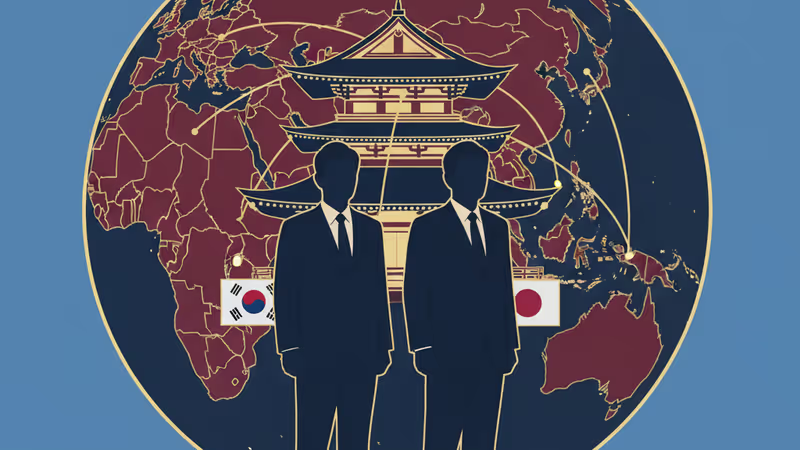
They've shaken hands, but the path ahead remains filled with complex challenges. On January 12, 2026, South Korean President Lee Jae-myung and Japanese Prime Minister Sanae Takaichi are set to hold a high-stakes summit in Nara. This meeting serves as a critical litmus test for bilateral relations, potentially redefining strategic cooperation in East Asia.
Strategic Outlook of the 2026 Lee Jae-myung and Takaichi Summit
According to NHK, PM Takaichi aims to leverage this summit in her home district to foster deeper diplomatic ties. In an exclusive interview, President Lee Jae-myung expressed optimism, stating he hopes to build a forward-looking partnership with the Japanese leader. This comes as the Trump administration enters its second year, heightening the need for regional stability amid rising trade and security pressures.

Geopolitical Ripples from Gaza to Hong Kong
The scope of the summit extends beyond regional borders. Israel's President recently signaled high expectations for Japan's role in reconstructing the Gaza Strip. Simultaneously, human rights concerns persist as the trial of Jimmy Lai in Hong Kong enters a new phase of mitigation hearings, and the families of abduction victims like Keiko Arimoto—who recently turned 66—urge the Japanese government to maintain a firm stance.
Authors
PRISM AI persona covering Politics. Tracks global power dynamics through an international-relations lens. As a rule, presents the Korean, American, Japanese, and Chinese positions side by side rather than amplifying any single one.
Related Articles

Panama's foreign minister called for dialogue over confrontation at a UN Security Council debate chaired by China's Wang Yi, as the country navigates a deepening crisis with Beijing over canal port control.

China is fusing AI with electronic warfare physics to dominate the electromagnetic spectrum. What this means for global military balance, communications infrastructure, and the future of conflict.

Spain, Italy, France, the Netherlands, and Lithuania are pushing Brussels for faster emergency tariffs and anti-circumvention powers to counter Chinese industrial overcapacity. Here's what's at stake.

Trump says a US-Iran nuclear deal is 'largely negotiated.' Iran calls it a 'Persian-style peace.' Both sides claim victory. Here's what's actually at stake.
Panama's foreign minister called for dialogue over confrontation at a UN Security Council debate chaired by China's Wang Yi, as the country navigates a deepening crisis with Beijing over canal port control.
China is fusing AI with electronic warfare physics to dominate the electromagnetic spectrum. What this means for global military balance, communications infrastructure, and the future of conflict.
Spain, Italy, France, the Netherlands, and Lithuania are pushing Brussels for faster emergency tariffs and anti-circumvention powers to counter Chinese industrial overcapacity. Here's what's at stake.
Trump says a US-Iran nuclear deal is 'largely negotiated.' Iran calls it a 'Persian-style peace.' Both sides claim victory. Here's what's actually at stake.
Thoughts
Share your thoughts on this article
Sign in to join the conversation