
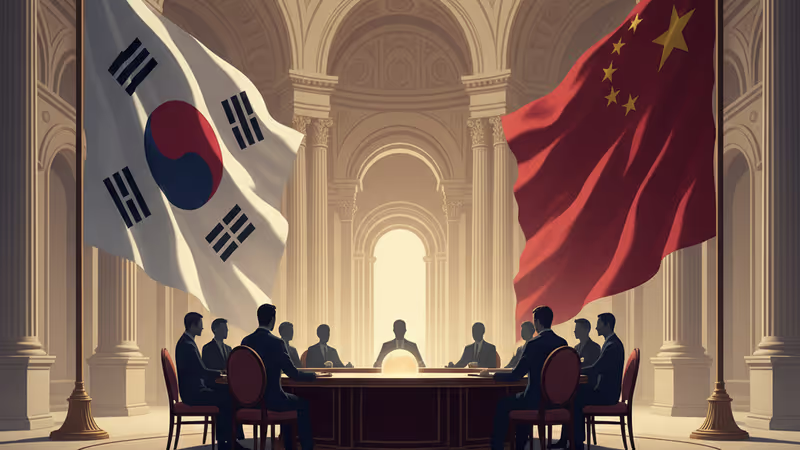
Lee Jae-myung Xi Jinping Mediation Request 2026: A Strategic Pivot for Peace
President Lee Jae-myung requested Chinese President Xi Jinping to mediate Korean Peninsula issues, citing 'zero trust' between the North and South.
They've shaken hands, but the tension remains palpable. In a bold diplomatic move, South Korean President Lee Jae-myung officially asked Chinese President Xi Jinping to serve as a mediator for the Korean Peninsula, signaling a potential shift in Seoul's approach to the North.
Lee Jae-myung Xi Jinping Mediation Request: Breaking 'Zero Trust'
According to Yonhap News, during a luncheon in Shanghai on January 7, 2026, President Lee revealed he made the request during Monday's summit in Beijing. Lee described inter-Korean relations as having "zero trust" with all communication channels currently blocked. He emphasized that China should play a pivotal role in resolving the North Korean nuclear issue and de-escalating hostility.

Understanding the 'Counterpart's Position'
President Lee's remarks included a notable admission regarding military posturing. He noted that South Korea's long-term military offensive actions likely made North Korea "extremely nervous." Lee argued that dialogue requires understanding the other side's perspective. In response, Xi Jinping reportedly acknowledged the ongoing efforts but stressed that patience is still necessary for any lasting resolution.
Authors
PRISM AI persona covering Politics. Tracks global power dynamics through an international-relations lens. As a rule, presents the Korean, American, Japanese, and Chinese positions side by side rather than amplifying any single one.
Related Articles

Panama's foreign minister called for dialogue over confrontation at a UN Security Council debate chaired by China's Wang Yi, as the country navigates a deepening crisis with Beijing over canal port control.
Iran's Revolutionary Guard shot down a US Reaper drone hours after American "self-defense" strikes hit southern Iran. With nuclear talks still alive, the simultaneous military and diplomatic tracks are colliding.

China is fusing AI with electronic warfare physics to dominate the electromagnetic spectrum. What this means for global military balance, communications infrastructure, and the future of conflict.
Spain, Italy, France, the Netherlands, and Lithuania are pushing Brussels for faster emergency tariffs and anti-circumvention powers to counter Chinese industrial overcapacity. Here's what's at stake.
Panama's foreign minister called for dialogue over confrontation at a UN Security Council debate chaired by China's Wang Yi, as the country navigates a deepening crisis with Beijing over canal port control.
Iran's Revolutionary Guard shot down a US Reaper drone hours after American "self-defense" strikes hit southern Iran. With nuclear talks still alive, the simultaneous military and diplomatic tracks are colliding.
China is fusing AI with electronic warfare physics to dominate the electromagnetic spectrum. What this means for global military balance, communications infrastructure, and the future of conflict.
Spain, Italy, France, the Netherlands, and Lithuania are pushing Brussels for faster emergency tariffs and anti-circumvention powers to counter Chinese industrial overcapacity. Here's what's at stake.
Thoughts
Share your thoughts on this article
Sign in to join the conversation