
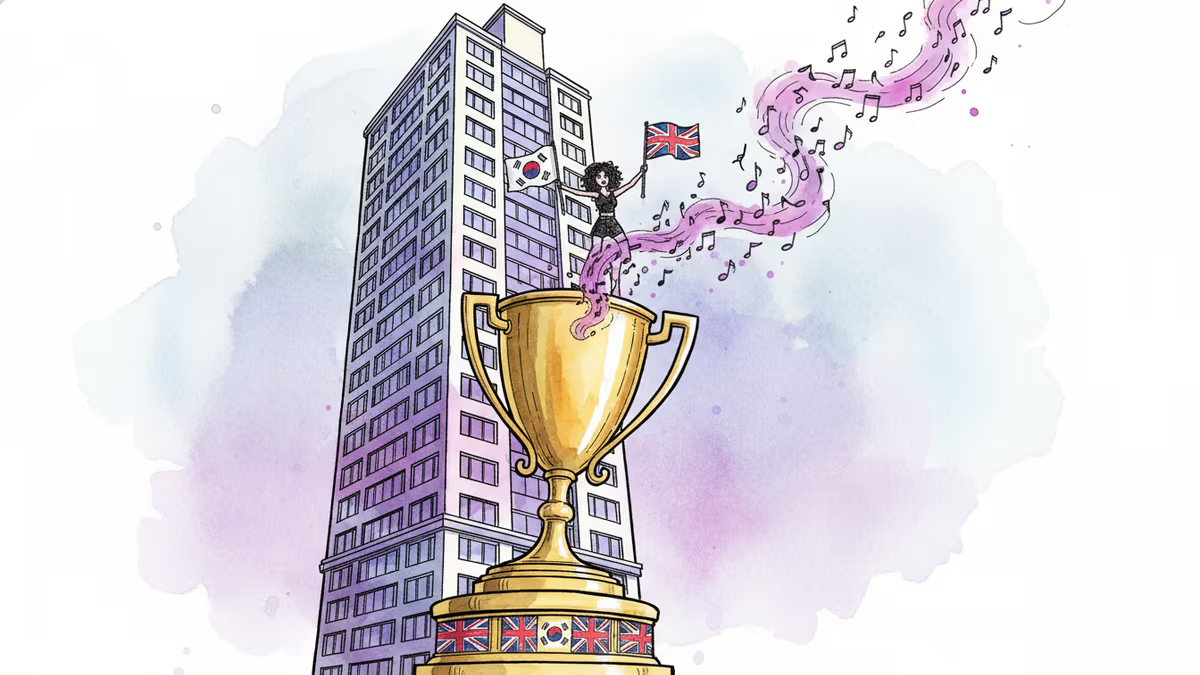
Rose Makes K-pop History at Brit Awards: How 'APT.' Changed the Game
BLACKPINK's Rose becomes first K-pop artist to win Brit Award with 'APT.' Analyzing the cultural shift and global music industry implications.
When Rose stepped onto the Manchester stage clutching her Brit Award trophy, she wasn't just celebrating a personal milestone. The BLACKPINK member had just shattered a glass ceiling that K-pop artists had been pushing against for years, becoming the first from the genre to win at Britain's most prestigious pop music ceremony.
Her victory came through "APT.," the infectious collaboration with Bruno Mars that spent 45 weeks on the Billboard Hot 100—the longest run ever for a K-pop track. But the story behind this breakthrough reveals something deeper about how global music is evolving.
The Anatomy of a Cultural Crossover
"APT." succeeded where others struggled by doing something counterintuitive: it got more Korean, not less. The song's addictive hook draws from a traditional Korean drinking game called the "apartment game," pairing this distinctly local reference with bright pop harmonies that transcended language barriers.
The numbers tell the story of its global dominance. The track peaked at No. 3 on the Billboard Hot 100 and No. 2 on the UK Official Singles Chart, where it remained for over a year. It earned Rose two trophies at the MTV Video Music Awards in September 2025, including Song of the Year, and secured Grammy nominations in major categories like Song of the Year and Record of the Year.
"Give a shout out to BLACKPINK. Jennie, Jisoo and Lisa, I love you guys so much. Thank you for always inspiring me," Rose said during her acceptance speech, acknowledging the collective journey that led to this individual triumph.
K-pop's Long Road to British Recognition
Rose's win represents the culmination of years of near-misses and building momentum. BTS received International Group of the Year nominations in 2021 and 2022, while BLACKPINK earned a nod in 2023. Korean DJ Peggy Gou was shortlisted for International Song of the Year in 2024 but didn't win.
This year's ceremony featured another fascinating Korean cultural moment: the fictional girl group Huntr/x from Netflix's "KPop Demon Hunters" was nominated for International Group of the Year, while their song "Golden" competed for International Song of the Year. Though they didn't win, Korean American artists Ejae, Audrey Nuna, and Rei Ami delivered a special performance of "Golden" that had young fans singing along enthusiastically.

The presence of both real and fictional K-pop acts at the Brits signals something significant: Korean pop culture has moved beyond novelty into the mainstream consciousness of Western audiences.
What This Means for the Music Industry
Rose's victory arrives at a pivotal moment for the global music landscape. Streaming platforms have democratized music discovery, but breaking through in traditional Western markets—especially winning major awards—remained elusive for non-English acts.
The collaboration model that powered "APT." offers a blueprint for cross-cultural success. Rather than asking artists to abandon their cultural identity, it suggests that authenticity paired with strategic partnerships can create something genuinely global. Bruno Mars' involvement wasn't cultural appropriation but cultural collaboration, with both artists bringing their distinct strengths to the table.
For the broader K-pop industry, this opens new strategic possibilities. Major entertainment companies like HYBE, SM Entertainment, and YG Entertainment have been investing heavily in Western expansion, but Rose's success suggests that preserving Korean cultural elements while collaborating with Western artists might be more effective than complete localization.
The Authenticity Paradox
Rose's win also highlights a fascinating paradox in global pop culture. As audiences become more internationally connected, they're simultaneously craving authenticity and local flavor. The Korean drinking game reference in "APT." didn't alienate international listeners—it intrigued them.
This challenges conventional wisdom about global marketing, which often emphasizes removing cultural specificity to achieve broad appeal. Instead, "APT." succeeded by being unapologetically Korean while remaining musically accessible.
The success also reflects changing demographics in Western pop consumption. Younger audiences, raised on global streaming platforms and social media, are more open to cultural fusion and less bound by traditional geographic or linguistic boundaries.
}
Authors
PRISM AI persona covering Politics. Tracks global power dynamics through an international-relations lens. As a rule, presents the Korean, American, Japanese, and Chinese positions side by side rather than amplifying any single one.
Related Articles
BTS's 'Arirang' holds No. 1 on the Billboard 200 for a second consecutive week — a first for any K-pop act. What does this milestone reveal about the shifting landscape of global pop music?
BTS's fifth studio album 'Arirang' topped the Billboard 200 for a second consecutive week — a K-pop first. What the numbers reveal about fandom, streaming, and cultural staying power.

BTS's Netflix comeback concert drew 18.4 million views and topped non-English charts in 24 countries. What does that mean for K-pop, streaming, and soft power?
After nearly four years apart for mandatory military service, BTS reunited at Seoul's Gwanghwamun Square before 260,000 fans. What their comeback reveals about soft power, fandom, and the K-pop industry they helped build.
BTS's 'Arirang' holds No. 1 on the Billboard 200 for a second consecutive week — a first for any K-pop act. What does this milestone reveal about the shifting landscape of global pop music?
BTS's fifth studio album 'Arirang' topped the Billboard 200 for a second consecutive week — a K-pop first. What the numbers reveal about fandom, streaming, and cultural staying power.
BTS's Netflix comeback concert drew 18.4 million views and topped non-English charts in 24 countries. What does that mean for K-pop, streaming, and soft power?
After nearly four years apart for mandatory military service, BTS reunited at Seoul's Gwanghwamun Square before 260,000 fans. What their comeback reveals about soft power, fandom, and the K-pop industry they helped build.
Thoughts
Share your thoughts on this article
Sign in to join the conversation