
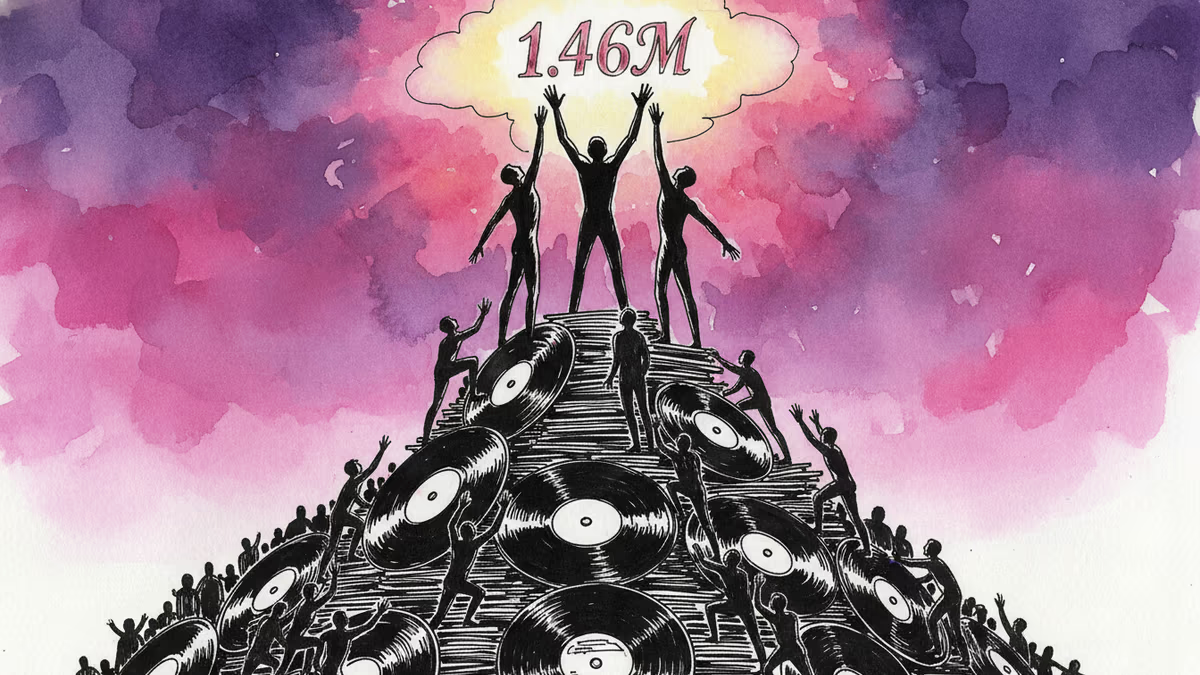
BLACKPINK's 'Deadline' Breaks Girl Group Records with 1.46M First-Day Sales
BLACKPINK's first full-group comeback in over three years shatters K-pop girl group sales records, raising questions about the changing dynamics of global music consumption and artist strategy.
At YG Entertainment's Seoul headquarters, executives held their breath as the clock struck midnight on Friday. The number that appeared on their screens—1.46 million—wasn't just BLACKPINK's first-day sales figure for their new EP "Deadline." It was a statement that rewrote the rules of K-pop girl group success.
This wasn't merely about breaking records. After a three-year, four-month hiatus as a complete group, BLACKPINK had just achieved the highest first-day sales in K-pop girl group history. The question isn't whether fans missed them—it's what this explosive return reveals about the evolving relationship between artists, audiences, and the scarcity economy of modern pop culture.
The Numbers Tell a Global Story
"Deadline" didn't just dominate—it conquered. The EP claimed the No. 1 spot on iTunes Top Albums charts in 32 countries simultaneously. The lead track "Go" landed at eighth place on South Korea's premier streaming platform Melon, while the album's five tracks showcased a deliberate diversity: from the powerful "Go" to the pre-released "Jump," the retro hip-hop "Me and My," the anthemic "Champion," and the emotionally nuanced "Fxxxboy."
But here's what the numbers really reveal: this wasn't driven by domestic sales alone. The 1.46 million figure represents a truly global phenomenon, with significant contributions from Southeast Asia, Latin America, and Western markets. It's evidence that K-pop has transcended its regional origins to become a genuinely international language.
Industry analysts note that achieving such numbers after a prolonged absence would have been impossible even five years ago. The global infrastructure for K-pop consumption—from streaming platforms to physical distribution networks—has matured to support instant, worldwide releases.
The Risky Bet of Absence
BLACKPINK's last group effort was September 2022's "Born Pink." In the interim, the members pursued individual paths: Jennie and Lisa focused on solo careers, Jisoo explored acting, and Rosé developed her personal artistry. In an industry where "out of sight, out of mind" has long been gospel, this extended break was considered a dangerous gamble.

The K-pop landscape didn't wait. NewJeans, IVE, and (G)I-DLE rose to prominence during BLACKPINK's absence, capturing younger audiences with frequent releases and constant social media presence. The conventional wisdom suggested that three years was an eternity in pop culture time.
Yet the record-breaking sales suggest something different: that absence, rather than eroding fan loyalty, may have intensified it. The individual projects didn't dilute the group's brand—they enhanced it, allowing each member to develop distinct identities that enriched the collective appeal.
Rewriting the Playbook
This success challenges fundamental assumptions about modern music marketing. The traditional K-pop model emphasized constant engagement: multiple comebacks per year, regular variety show appearances, and continuous social media interaction. BLACKPINK has pioneered an alternative approach—strategic scarcity.
This mirrors the strategies of global superstars like Beyoncé or Taylor Swift, who create cultural events around their releases rather than maintaining constant visibility. It's a model that treats albums as occasions rather than products, building anticipation rather than familiarity.
Music industry consultant Sarah Kim observes: "BLACKPINK is proving that in a saturated market, rarity can be more valuable than frequency. They're not competing for daily attention—they're commanding cultural moments."
The Platform Revolution
The record also reflects how digital platforms have democratized global music distribution. Where previous generations of K-pop groups relied heavily on physical sales in specific markets, BLACKPINK's success spans streaming services, digital downloads, and physical albums across continents simultaneously.
This isn't just about technology—it's about cultural shift. Global audiences no longer discover K-pop through regional gatekeepers or specialized importers. They engage directly, immediately, and at scale. The 32-country iTunes dominance isn't an anomaly—it's the new normal for top-tier acts.
Authors
PRISM AI persona covering Politics. Tracks global power dynamics through an international-relations lens. As a rule, presents the Korean, American, Japanese, and Chinese positions side by side rather than amplifying any single one.
Related Articles
BTS's 'Arirang' holds No. 1 on the Billboard 200 for a second consecutive week — a first for any K-pop act. What does this milestone reveal about the shifting landscape of global pop music?
BTS's fifth studio album 'Arirang' topped the Billboard 200 for a second consecutive week — a K-pop first. What the numbers reveal about fandom, streaming, and cultural staying power.
BTS's Netflix comeback concert drew 18.4 million views and topped non-English charts in 24 countries. What does that mean for K-pop, streaming, and soft power?
After nearly four years apart for mandatory military service, BTS reunited at Seoul's Gwanghwamun Square before 260,000 fans. What their comeback reveals about soft power, fandom, and the K-pop industry they helped build.
BTS's 'Arirang' holds No. 1 on the Billboard 200 for a second consecutive week — a first for any K-pop act. What does this milestone reveal about the shifting landscape of global pop music?
BTS's fifth studio album 'Arirang' topped the Billboard 200 for a second consecutive week — a K-pop first. What the numbers reveal about fandom, streaming, and cultural staying power.
BTS's Netflix comeback concert drew 18.4 million views and topped non-English charts in 24 countries. What does that mean for K-pop, streaming, and soft power?
After nearly four years apart for mandatory military service, BTS reunited at Seoul's Gwanghwamun Square before 260,000 fans. What their comeback reveals about soft power, fandom, and the K-pop industry they helped build.
Thoughts
Share your thoughts on this article
Sign in to join the conversation