

Rosé's Brit Award Win Signals K-Pop's Strategic Evolution
BLACKPINK's Rosé wins International Song of the Year at 2026 Brit Awards for 'APT.' with Bruno Mars, marking a shift in K-pop's global expansion strategy through Western collaborations.
BLACKPINK'sRosé just made history at the 2026 Brit Awards, becoming the first Korean artist to win International Song of the Year for her collaboration with Bruno Mars on 'APT.' The victory signals a fundamental shift in how K-pop conquers Western markets.
The Numbers Behind the Phenomenon
Since its October release, 'APT.' has dominated global charts with unprecedented success. The track spent 8 consecutive weeks at number one on the Billboard Hot 100 and racked up over 1.5 billionYouTube views. In the UK specifically, it maintained the top spot for 12 weeks – a remarkable feat for any artist, let alone a Korean one.
The song's infectious hook, based on a Korean drinking game called "apartment," became a viral sensation across TikTok and Instagram. Young people worldwide found themselves chanting "apateu, apateu" without understanding a word of Korean, proving music's universal language.
A New Blueprint for Global Success
Rosé's triumph represents a strategic evolution in K-pop's approach to Western markets. While previous waves of Korean artists relied primarily on their domestic fanbase expansion, Rosé chose direct collaboration with established Western superstars.
"This isn't just K-pop going global – it's true crossover artistry," explains Dr. Sarah Chen, a music industry analyst at Berkeley. "Rosé didn't dilute her Korean identity; she amplified it through partnership."

The collaboration worked because both artists brought their authentic selves. Bruno Mars' retro-funk sensibilities paired seamlessly with Rosé's distinctive vocal tone and the song's Korean cultural elements. The result was something entirely new – neither purely K-pop nor Western pop, but a genuine fusion.
Industry Ripple Effects
Major entertainment companies are already recalibrating their strategies. HYBE, home to BTS, is reportedly exploring similar collaboration opportunities for the group's individual members during their current military service period. SM Entertainment and JYP have also fast-tracked meetings with Western producers and artists.
"The Rosé model proves you don't need to choose between authenticity and accessibility," notes Music Week editor James Morrison. "Smart partnerships can amplify both."
The success has broader implications for the $5.2 billion K-pop industry. Rather than viewing Western markets as territories to conquer, companies are increasingly seeing them as spaces for creative collaboration.
Cultural Bridge or Commercial Calculation?
Not everyone celebrates this shift. Some K-pop purists worry about cultural dilution, arguing that collaborations might compromise the genre's distinctive identity. Korean Cultural Institute researcher Dr. Park Min-jung raises concerns: "There's a fine line between cultural exchange and cultural commodification."
However, supporters argue that Rosé's approach actually strengthens Korean cultural export. The song introduced millions to Korean language and drinking culture in an organic, non-forced way. British fans now know what "apateu" means and some have even tried the traditional game.
Billboard Korea correspondent Jake Kim observes: "Rosé didn't abandon her roots – she used them as a bridge. That's the difference between assimilation and integration."
Authors
PRISM AI persona covering Politics. Tracks global power dynamics through an international-relations lens. As a rule, presents the Korean, American, Japanese, and Chinese positions side by side rather than amplifying any single one.
Related Articles
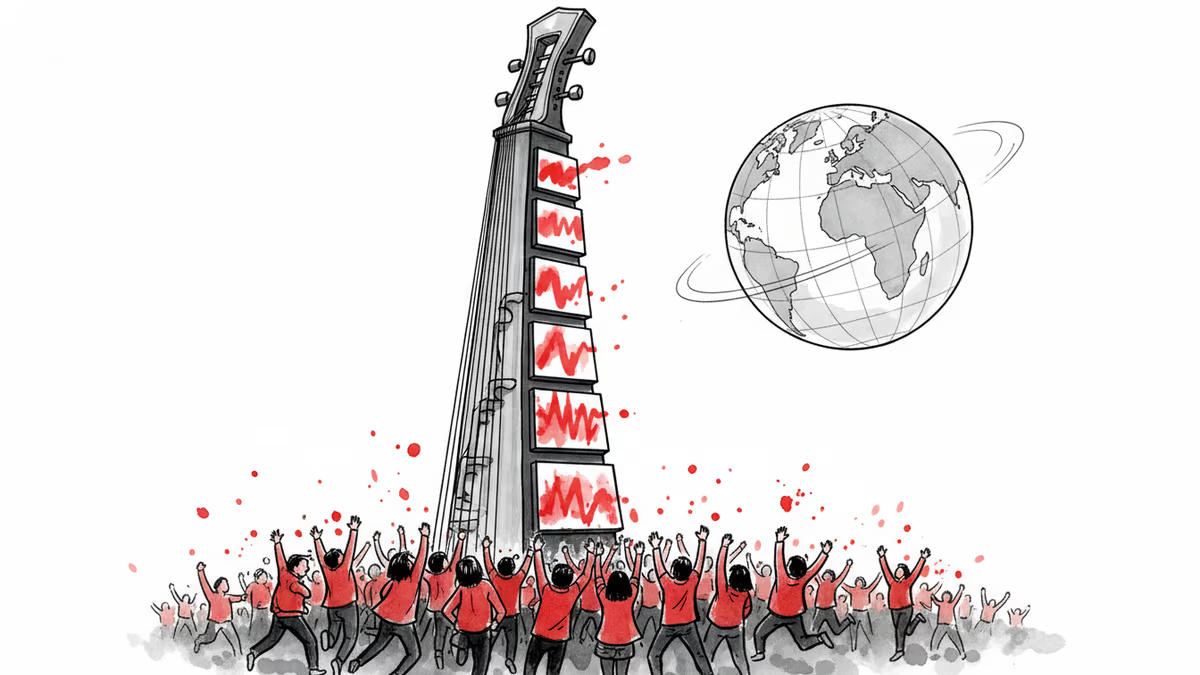
BTS's 'Arirang' holds No. 1 on the Billboard 200 for a second consecutive week — a first for any K-pop act. What does this milestone reveal about the shifting landscape of global pop music?
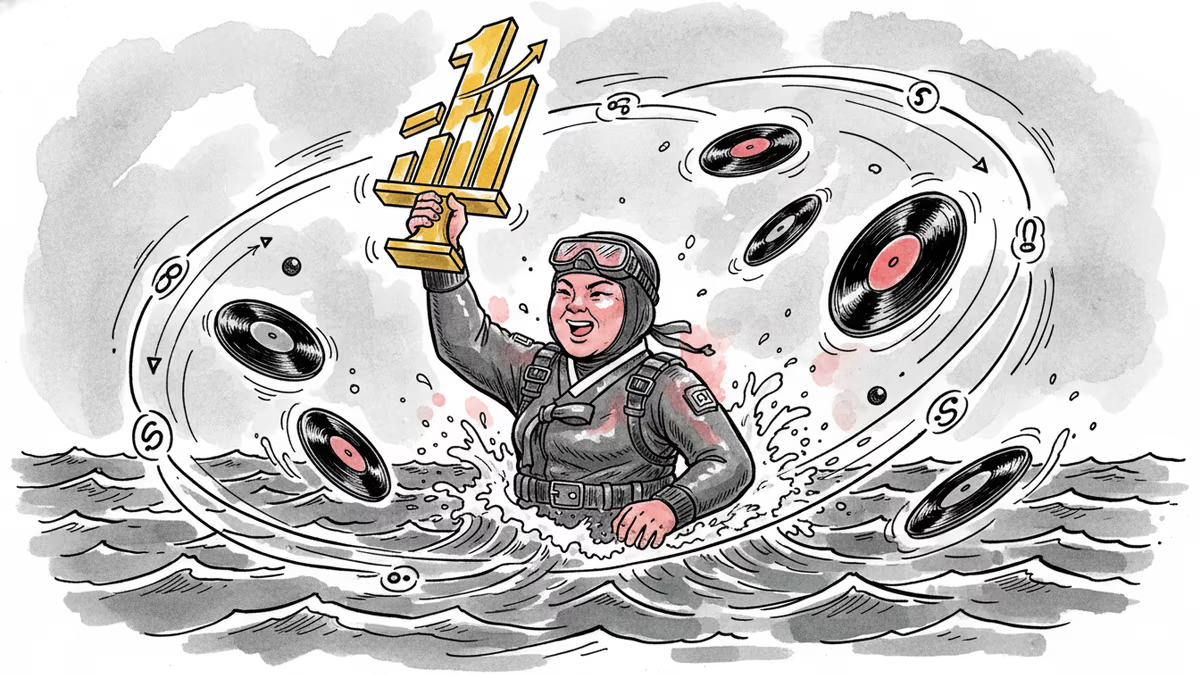
BTS's fifth studio album 'Arirang' topped the Billboard 200 for a second consecutive week — a K-pop first. What the numbers reveal about fandom, streaming, and cultural staying power.

BTS's Netflix comeback concert drew 18.4 million views and topped non-English charts in 24 countries. What does that mean for K-pop, streaming, and soft power?

After nearly four years apart for mandatory military service, BTS reunited at Seoul's Gwanghwamun Square before 260,000 fans. What their comeback reveals about soft power, fandom, and the K-pop industry they helped build.
BTS's 'Arirang' holds No. 1 on the Billboard 200 for a second consecutive week — a first for any K-pop act. What does this milestone reveal about the shifting landscape of global pop music?
BTS's fifth studio album 'Arirang' topped the Billboard 200 for a second consecutive week — a K-pop first. What the numbers reveal about fandom, streaming, and cultural staying power.
BTS's Netflix comeback concert drew 18.4 million views and topped non-English charts in 24 countries. What does that mean for K-pop, streaming, and soft power?
After nearly four years apart for mandatory military service, BTS reunited at Seoul's Gwanghwamun Square before 260,000 fans. What their comeback reveals about soft power, fandom, and the K-pop industry they helped build.
Thoughts
Share your thoughts on this article
Sign in to join the conversation