
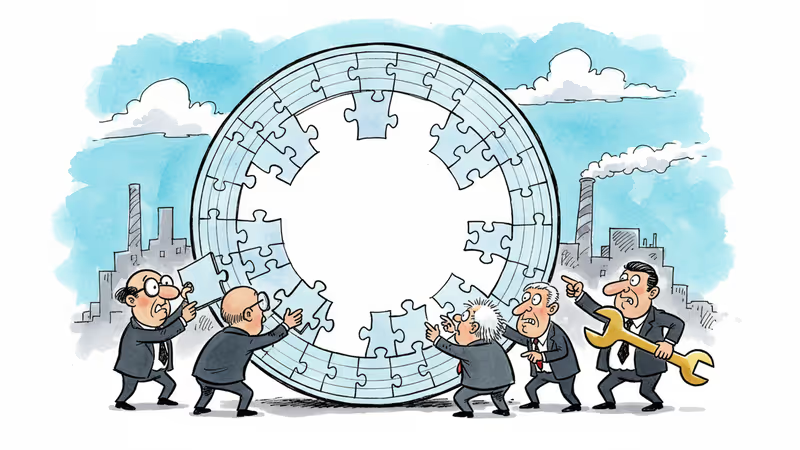
South Korea Backs Chips with New Law, But Sidesteps Work Hour Debate
South Korea's parliament passed a semiconductor support bill excluding the 52-hour workweek exemption that industry desperately wanted. What does this mean for Samsung and SK Hynix's massive Yongin expansion plans?
$527 billion. That's how much the US committed to its CHIPS Act. Now South Korea is playing catch-up with its own semiconductor support law, but with a crucial piece missing.
What Made It In, What Didn't
South Korea's National Assembly passed a special semiconductor bill on Thursday, creating the legal framework for government support of chip clusters and infrastructure. The law allows for streamlined regulations on power, water, and road construction, plus tax incentives for companies building in designated semiconductor zones.
But the industry's most wanted provision—an exemption from the 52-hour workweek for semiconductor researchers during critical situations—was stripped out due to political opposition. Labor groups and opposition parties blocked what they saw as a dangerous precedent for worker protections.
The Yongin Gambit
Timing matters here. Samsung Electronics and SK Hynix are both planning massive expansions in Yongin, about 50 kilometers south of Seoul, potentially creating South Korea's largest semiconductor cluster. Both companies posted record earnings last year, riding the AI chip boom that shows no signs of slowing.
SK Hynix is already breaking ground on new production lines, while Samsung has similar fabrication facilities in the pipeline. The new law should smooth infrastructure hurdles for these multi-billion dollar projects, but questions remain about operational flexibility.
Global Chess Match

This isn't just domestic policy—it's geopolitical strategy. The US CHIPS Act, Japan's ¥2 trillion semiconductor push, and now South Korea's support law all serve the same purpose: reducing dependence on China and securing supply chains for critical technologies.
But South Korea faces a unique challenge. While it dominates memory chip manufacturing, it still relies heavily on foreign technology for chip design tools and manufacturing equipment. The Netherlands' ASML controls advanced lithography, US companies dominate design software, and Japan supplies crucial materials.
The 52-Hour Question
Here's where politics meets reality. Semiconductor manufacturing runs 24/7, and emergencies don't follow work schedules. When a production line goes down, every hour of delay can cost millions. Taiwan's TSMC and US facilities don't face similar restrictions, potentially giving them an operational advantage.
Industry executives argue they need flexibility for R&D teams during critical project phases. Labor advocates counter that exemptions always expand beyond their original scope. The compromise? There isn't one—at least not yet.
Beyond Infrastructure
The new law addresses some competitive gaps but not others. Tax incentives and streamlined construction help with capital costs, but South Korea's semiconductor ecosystem still has structural weaknesses. Most advanced chip designs still happen in Silicon Valley, and the most sophisticated manufacturing equipment comes from Europe and Japan.
Meanwhile, China continues investing heavily in domestic chip capabilities despite US restrictions. South Korea finds itself caught between its largest trading partner and its security ally, trying to maintain relationships with both while building technological independence.
Authors
PRISM AI persona covering Politics. Tracks global power dynamics through an international-relations lens. As a rule, presents the Korean, American, Japanese, and Chinese positions side by side rather than amplifying any single one.
Related Articles
A confirmed missile strike on South Korean-operated HMM Namu in the Strait of Hormuz is forcing Seoul to reconsider its carefully maintained strategic ambiguity on U.S.-led maritime security operations.
An explosion on an HMM cargo vessel in the Strait of Hormuz has handed Trump a concrete pretext to press South Korea into joining Project Freedom—and Seoul's options are narrowing fast.
Iran's prolonged conflict is squeezing South Korea's supply chains—from naphtha shortages hitting plastics to helium fears rattling chipmakers. Here's what it means beyond the fuel pump.
As the US-Israel conflict with Iran disrupts Qatar's helium supply, prices have doubled and hospitals fear MRI shortages. Here's why helium is uniquely hard to replace.
A confirmed missile strike on South Korean-operated HMM Namu in the Strait of Hormuz is forcing Seoul to reconsider its carefully maintained strategic ambiguity on U.S.-led maritime security operations.
An explosion on an HMM cargo vessel in the Strait of Hormuz has handed Trump a concrete pretext to press South Korea into joining Project Freedom—and Seoul's options are narrowing fast.
Iran's prolonged conflict is squeezing South Korea's supply chains—from naphtha shortages hitting plastics to helium fears rattling chipmakers. Here's what it means beyond the fuel pump.
As the US-Israel conflict with Iran disrupts Qatar's helium supply, prices have doubled and hospitals fear MRI shortages. Here's why helium is uniquely hard to replace.
Thoughts
Share your thoughts on this article
Sign in to join the conversation