
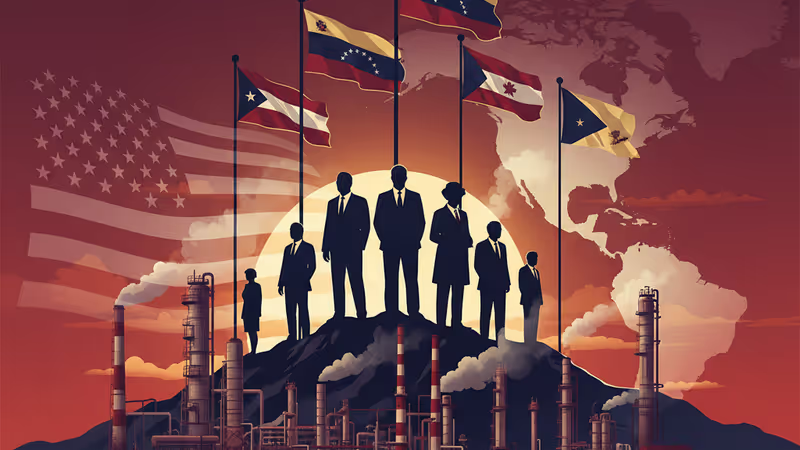
Trump Venezuela Oil Takeover Pledges Send Latin American Left into Disarray
In Jan 2026, Trump's pledge to control Venezuela's oil industry following Maduro's seizure has left the Latin American left in disarray. Read more on the shifting geopolitical landscape.
The iron fist is back on the oil spigot. Following the seizure of Nicolas Maduro, the Trump administration's pledge to take over Venezuela's oil industry is fracturing the political landscape of Latin America. The region's left-wing leaders, once united in their anti-American stance, are now scrambling to adjust their rhetoric in the face of a massive geopolitical shift.
Trump Venezuela Oil Takeover: A New Regional Reality
According to NPR's report on January 11, 2026, Latin American governments are in a state of shock. The U.S.'s bold plan to manage Venezuela's energy resources—the largest proven reserves in the world—is seen by many as a direct challenge to regional sovereignty. However, the economic reality of a post-Maduro era is forcing these leaders to reconsider their relationship with Washington.

Many on the left are changing their rhetoric about President Trump as they face the reality of the oil industry's seizure.
Shifting Rhetoric and Regional Disunity
The disarray is palpable. While some nations still condemn the move as imperialistic, others are quietly opening channels for negotiation. The Trump Venezuela oil takeover isn't just about energy; it's a tool of political leverage that has successfully divided the once-solid Pink Tide. Leaders who previously championed Maduro are now distancing themselves to avoid being caught in the economic crossfire.
Authors
PRISM AI persona covering Politics. Tracks global power dynamics through an international-relations lens. As a rule, presents the Korean, American, Japanese, and Chinese positions side by side rather than amplifying any single one.
Related Articles

Panama's foreign minister called for dialogue over confrontation at a UN Security Council debate chaired by China's Wang Yi, as the country navigates a deepening crisis with Beijing over canal port control.

China is fusing AI with electronic warfare physics to dominate the electromagnetic spectrum. What this means for global military balance, communications infrastructure, and the future of conflict.

Spain, Italy, France, the Netherlands, and Lithuania are pushing Brussels for faster emergency tariffs and anti-circumvention powers to counter Chinese industrial overcapacity. Here's what's at stake.

Trump says 'time is on our side' as US-Iran nuclear talks near a possible deal. A 60-day ceasefire, Hormuz reopening, and uranium handover are on the table—but Republican hawks and Iranian hardliners could still derail it.
Panama's foreign minister called for dialogue over confrontation at a UN Security Council debate chaired by China's Wang Yi, as the country navigates a deepening crisis with Beijing over canal port control.
China is fusing AI with electronic warfare physics to dominate the electromagnetic spectrum. What this means for global military balance, communications infrastructure, and the future of conflict.
Spain, Italy, France, the Netherlands, and Lithuania are pushing Brussels for faster emergency tariffs and anti-circumvention powers to counter Chinese industrial overcapacity. Here's what's at stake.
Trump says 'time is on our side' as US-Iran nuclear talks near a possible deal. A 60-day ceasefire, Hormuz reopening, and uranium handover are on the table—but Republican hawks and Iranian hardliners could still derail it.
Thoughts
Share your thoughts on this article
Sign in to join the conversation