
Oracle Said No: What a $1M Lost in Stock Reveals
Oracle laid off up to 30,000 workers via email, denied RSU acceleration, and refused to negotiate. What this tells us about tech compensation's hidden power imbalance.
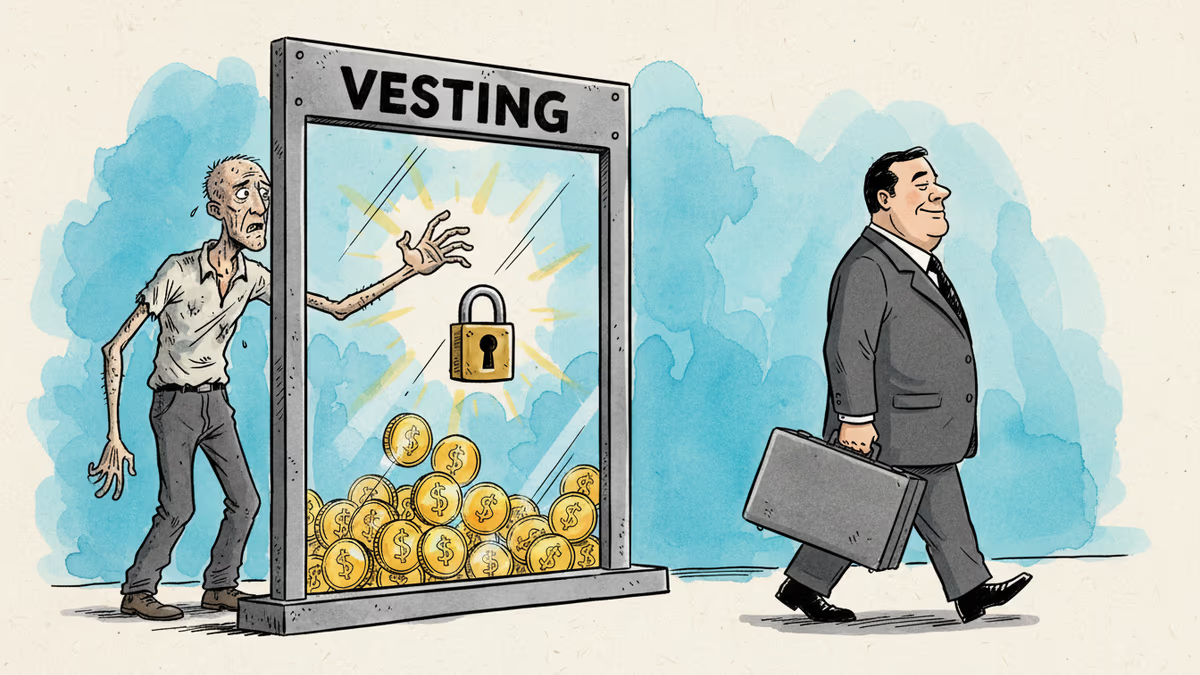
One morning, a long-tenured Oracle employee tried to log into the VPN. The system told him he didn't exist. His Slack account was already gone. An email arrived shortly after: your role is terminated, effective immediately. The severance offer came a few days later. Buried inside it was the news that $1 million in stock — just four months from vesting — was forfeit.
This is how Oracle ended the employment of an estimated 20,000 to 30,000 people on March 31.
The Severance Math That Doesn't Add Up
On paper, Oracle's offer looked like standard Corporate America: four weeks of pay for the first year, plus one additional week per year of service, capped at 26 weeks, with one month of COBRA health coverage. For workers used to seeing tech companies compete on benefits, the terms were underwhelming. But the real sting was in what wasn't offered.
Oracle declined to accelerate unvested RSUs — restricted stock units that often make up the majority of a tech worker's total compensation. For the employee who lost $1 million, RSUs represented roughly 70% of his pay package. Some of that stock had been granted as a retention incentive. Some replaced salary increases tied to promotions. None of it mattered once the termination date passed.
A second fault line ran through the WARN Act question. The federal law requires companies to give 60 days' notice before mass layoffs affecting 50 or more people at a single location. Oracle classified a portion of its workforce as remote employees, effectively bypassing the location threshold. Some of those workers didn't know they held that classification — they lived near an office and worked hybrid schedules. And for those in states without stronger worker protections, like California or New York, there was no backstop. Even where WARN Act coverage did apply, Oracle folded the two-month notice pay into its existing severance calculation rather than adding it on top.
90 Signatures. One Answer.

At least 90 laid-off employees signed a public petition asking Oracle to match the terms competitors had offered during their own recent cuts. The comparisons were pointed.
Meta provided 16 weeks of base pay as a starting point, plus two weeks per year of service, and covered COBRA for 18 months. Microsoft, running voluntary retirement offers for long-tenured staff, included accelerated stock vesting alongside a minimum of eight weeks' pay. Cloudflare, which cut 20% of its workforce, paid a lump sum equivalent to base salary through the end of 2026, covered healthcare through year-end, and accelerated any RSU tranche vesting before August 15 — meaning workers close to a payout actually received it.
Oracle's response, per an email seen by TechCrunch: no. The company declined to negotiate and did not respond to requests for comment.
The Asymmetry Built Into Tech Compensation
The Oracle situation didn't create a new problem. It exposed one that's been structural for years.
The dominant compensation model in big tech — lower base salary, higher equity — was sold to workers as alignment: your interests and the company's interests move together. When stock prices rose and layoffs were rare, that framing held. But the model contains a quiet asymmetry. The company controls the vesting schedule. The company controls the termination date. When those two things converge at the wrong moment, the worker absorbs the loss.
This is not unique to Oracle. It's a feature of how the industry compensates knowledge workers, and it becomes most visible precisely when the labor market shifts in the employer's direction. The current wave of AI-driven restructuring — where companies are simultaneously reducing headcount and increasing capital investment in automation — is generating exactly those conditions at scale.
For HR leaders and employment attorneys, the Oracle case is already being cited as a reference point: what happens when a company with significant legal and financial resources decides the cost of better terms is lower than the reputational cost of offering them. The answer, apparently, is nothing happens — at least in the short term.
This content is AI-generated based on source articles. While we strive for accuracy, errors may occur. We recommend verifying with the original source.
Related Articles

As the Strait of Hormuz closure traps 1,900 vessels, abandoned seafarers reveal a structural flaw at the heart of global trade—no single authority is responsible when things go wrong.

Second major TikTok outage in two months due to Oracle data center issues raises questions about cloud dependency and digital sovereignty in the post-divestiture era.
Just a month after the last outage, TikTok US faces another service disruption due to Oracle's data center issues. The incident highlights the risks of regulatory compliance creating single points of failure.
TikTok blamed a power outage for weekend technical issues, but the timing coincided with its controversial ownership restructure involving Oracle and US investors.
As the Strait of Hormuz closure traps 1,900 vessels, abandoned seafarers reveal a structural flaw at the heart of global trade—no single authority is responsible when things go wrong.
Second major TikTok outage in two months due to Oracle data center issues raises questions about cloud dependency and digital sovereignty in the post-divestiture era.
Just a month after the last outage, TikTok US faces another service disruption due to Oracle's data center issues. The incident highlights the risks of regulatory compliance creating single points of failure.
TikTok blamed a power outage for weekend technical issues, but the timing coincided with its controversial ownership restructure involving Oracle and US investors.
Thoughts
Share your thoughts on this article
Sign in to join the conversation