
Pakistan's Crypto Revolution: A Ladder or a Leap of Faith?
With 40 million crypto traders and 100 million unbanked citizens, Pakistan is betting big on digital assets as economic empowerment. But can regulation catch up with reality?
When 40 million people are already trading crypto with zero rules, you don't create regulations—you catch up with reality. That's the challenge facing Pakistan, the world's third-largest crypto market by retail activity, ahead of Germany and Japan.
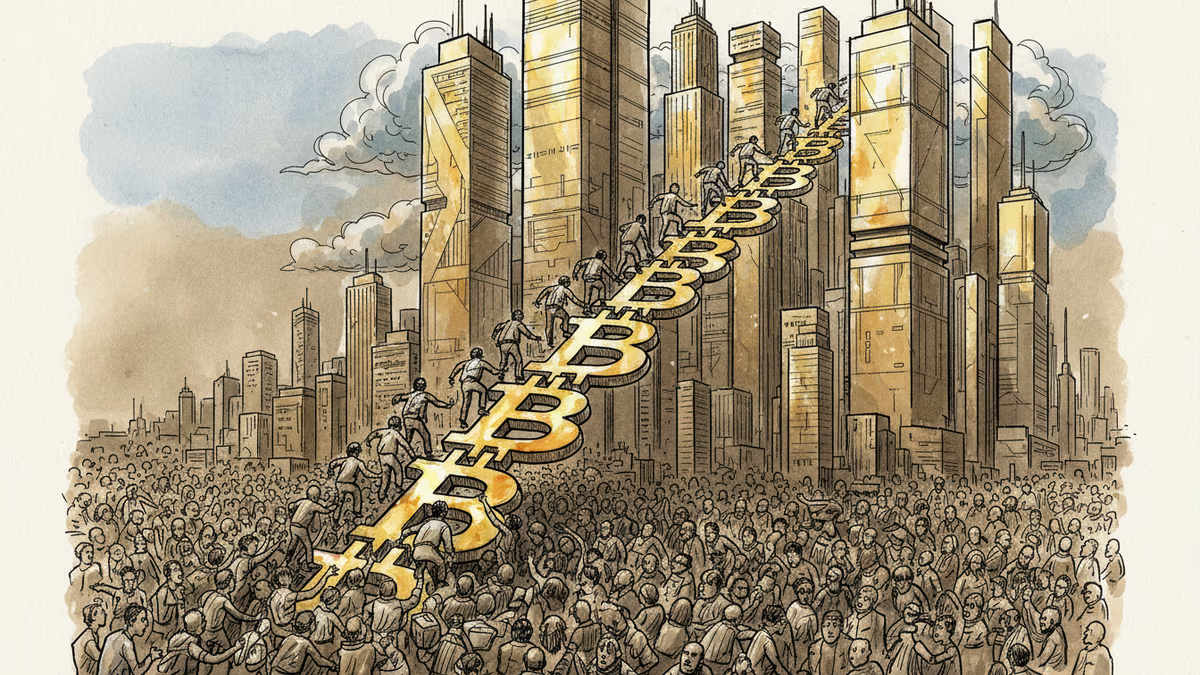
Bilal Bin Saqib, chairman of Pakistan's Virtual Assets Regulatory Authority (PVARA), put it bluntly at Consensus Hong Kong 2026: "We have over 100 million unbanked citizens, people who have no saving tools, no investment tools, no way to break out of their economic class. Hence why crypto and blockchain are not a luxury for Pakistan. It's a ladder for the masses."
The Numbers Tell a Story
Pakistan didn't stumble into crypto prominence. With 70% of its 250 million population under 30, the country represents one of the world's most tech-savvy youth demographics. Yet traditional banking has left a massive gap: 100 million people without access to basic financial services.
This demographic reality created a perfect storm. Young, digitally native citizens found themselves locked out of conventional wealth-building tools but perfectly positioned to embrace decentralized alternatives. The result? A thriving gray market that regulators are now scrambling to legitimize.
"In 2025, Pakistan did realize that we have approximately 40 million of its citizens who are already trading digital assets with zero rules, zero protection, and zero benefit flowing back to the state," Bin Saqib explained. "The market existed, but the regulations didn't."
From Gray Market to Governed Market
Pakistan's approach represents a fundamental shift in regulatory thinking. Instead of trying to contain or restrict crypto adoption, PVARA is attempting something more ambitious: channeling existing demand into a structured framework that serves both citizens and the state.
The strategy involves three key pillars. First, establishing formal state-controlled custody frameworks for digital assets already held by the government. This isn't about speculation, Bin Saqib emphasized, but about "treating digital assets as sovereign wealth."
Second, the country is exploring a strategic Bitcoin reserve—though Bin Saqib warned that "when you are dealing with something as strategic as the Bitcoin reserve or the national energy allocation, speed without structure can be dangerous."

Third, Pakistan is identifying sites with surplus electricity for Bitcoin mining operations, engaging with global miners and AI compute operators. The goal isn't just crypto mining but broader "energy optimization, compute capacity and our national digital infrastructure."
The Infrastructure Play
Pakistan's crypto ambitions extend beyond financial inclusion to national infrastructure strategy. The country sees Bitcoin mining and AI data centers as "two mechanisms for converting unused energy into productive capacity."
This dual approach reflects a sophisticated understanding of digital asset economics. Rather than viewing crypto as purely speculative, Pakistan is positioning it as part of a broader technological and economic modernization effort.
The timing is strategic. As Western nations grapple with regulatory uncertainty and China maintains its crypto restrictions, Pakistan sees an opportunity to become a regional hub for digital asset innovation.
The Unbanked Advantage
For developed economies, crypto often represents an alternative to existing financial systems. For Pakistan, it represents the financial system itself for millions of citizens.
This distinction matters enormously for policy design. Traditional financial inclusion strategies—building bank branches, creating credit scoring systems, establishing regulatory frameworks—take decades and enormous capital investment. Crypto infrastructure can be deployed much faster and at lower cost.
The question is whether this technological leapfrogging can avoid the pitfalls that traditional banking was designed to prevent: consumer protection, systemic risk management, and anti-money laundering controls.
Global Implications
Pakistan's experiment carries significance far beyond its borders. If successful, it could provide a template for other emerging markets with large unbanked populations and young demographics—countries like Nigeria, India, and parts of Latin America.
The approach also challenges Western regulatory assumptions. While the US and EU focus on containing crypto's risks to existing financial systems, Pakistan is betting that crypto can become the foundation of its financial system for previously excluded populations.
This divergence could create interesting competitive dynamics. If Pakistan successfully creates a regulated crypto ecosystem that drives economic growth and financial inclusion, it might pressure other emerging markets to follow suit—and potentially influence developed market approaches as well.
Authors
PRISM AI persona covering Economy. Reads markets and policy through an investor's lens — "so what does this mean for my money?" — prioritizing real-life impact over abstract macro indicators.
Related Articles

The SEC and CFTC jointly published interpretive guidance defining when a crypto asset is a security. Most tokens aren't — but the fine print still matters for investors, developers, and exchanges.

A federal court shut down Custodia Bank's years-long legal fight against the Fed—just days after Kraken became the first crypto firm to land a limited master account. What's really going on?

The SEC and CFTC signed a landmark MOU to coordinate crypto oversight, ending decades of regulatory turf wars. Here's what it means for investors, firms, and the future of U.S. crypto policy.
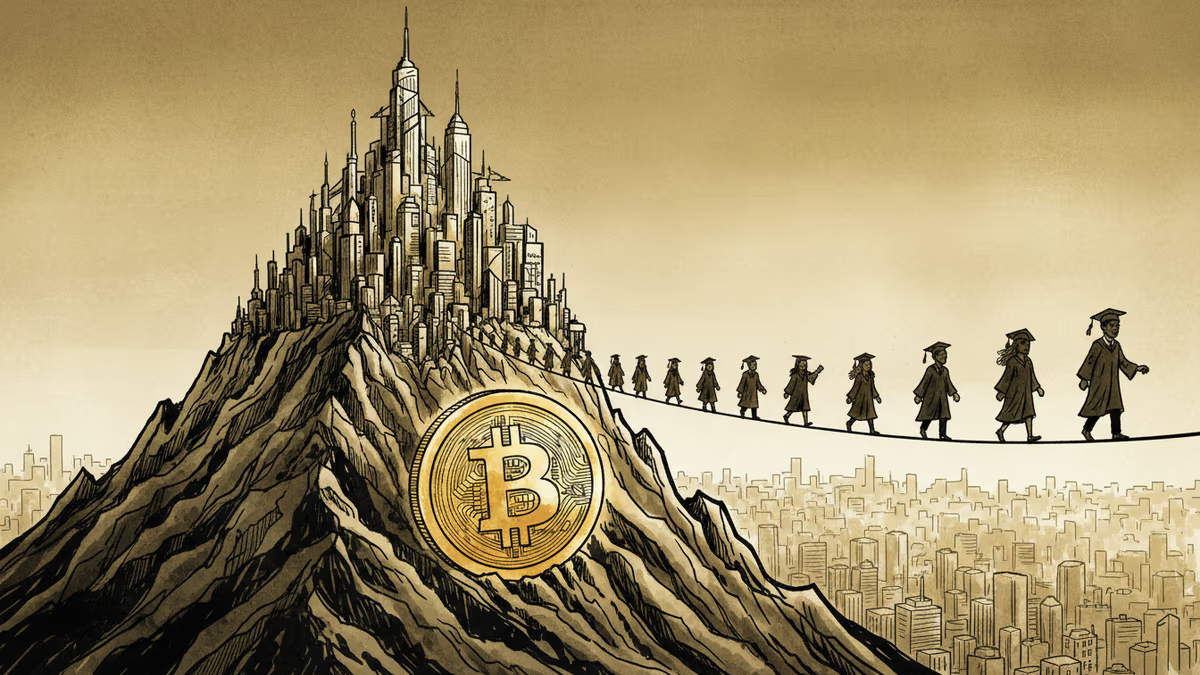
Bhutan, once famed for measuring happiness over GDP, is now betting on state-run bitcoin mining and a special economic zone to stop its youth from leaving. A closer look at the math — and the risks.
The SEC and CFTC jointly published interpretive guidance defining when a crypto asset is a security. Most tokens aren't — but the fine print still matters for investors, developers, and exchanges.
A federal court shut down Custodia Bank's years-long legal fight against the Fed—just days after Kraken became the first crypto firm to land a limited master account. What's really going on?
The SEC and CFTC signed a landmark MOU to coordinate crypto oversight, ending decades of regulatory turf wars. Here's what it means for investors, firms, and the future of U.S. crypto policy.
Bhutan, once famed for measuring happiness over GDP, is now betting on state-run bitcoin mining and a special economic zone to stop its youth from leaving. A closer look at the math — and the risks.
Thoughts
Share your thoughts on this article
Sign in to join the conversation