
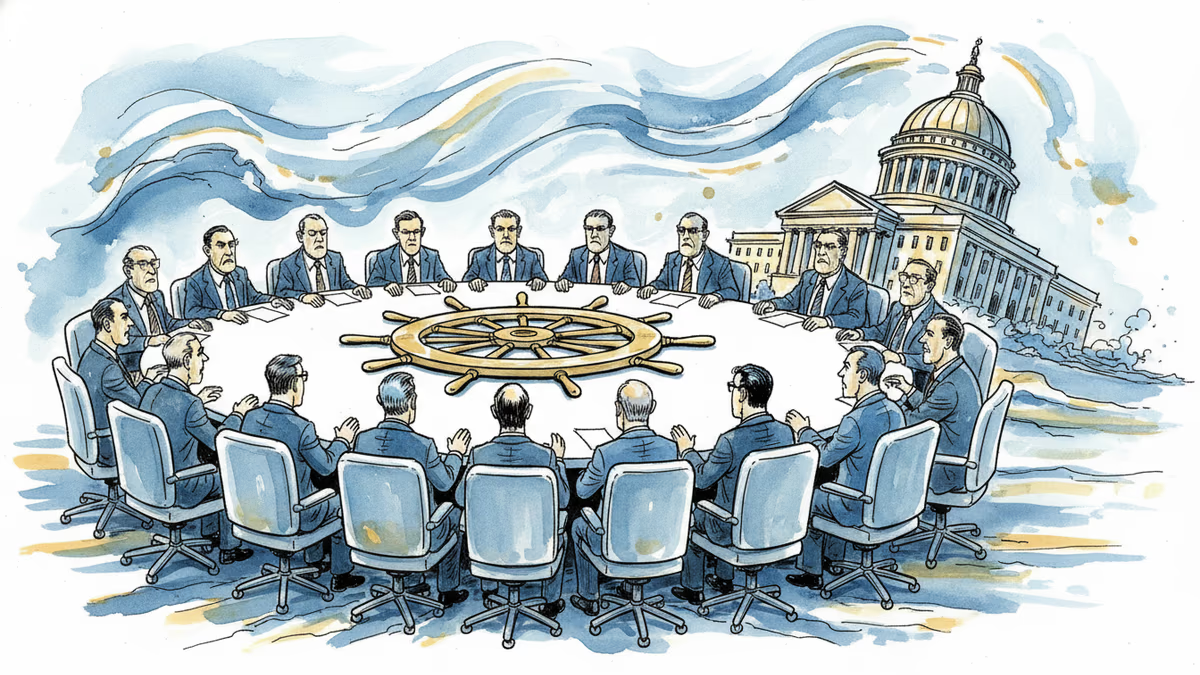
CFTC Hands Crypto CEOs the Regulatory Steering Wheel
The CFTC's new Innovation Advisory Committee includes Coinbase's Armstrong, Ripple's Garlinghouse, and 33 other industry leaders. Who's really writing the rules now?
The fox isn't just guarding the henhouse—it's been invited to redesign it entirely.
The Commodity Futures Trading Commission, America's derivatives watchdog that's poised to become crypto's primary regulator, just handed 35 industry CEOs the keys to its regulatory future. Among them: Coinbase's Brian Armstrong, Ripple's Brad Garlinghouse, Robinhood's Vlad Tenev, and Uniswap Labs' Hayden Adams.
The Power Players at the Table
CFTC Chairman Mike Selig's newly minted Innovation Advisory Committee reads like a who's who of crypto royalty. The roster includes executives from companies currently battling the SEC in court (Ripple), facing regulatory scrutiny (Coinbase), and pushing the boundaries of decentralized finance (Uniswap Labs).
But it's not just crypto natives. Traditional finance heavyweights like Nasdaq's Adena Friedman, CME Group's Terry Duffy, and Cboe Global Markets' Craig Donohue sit alongside betting platform chiefs from FanDuel and DraftKings. The committee expanded from a modest 12-member CEO council established last year to this 35-strong advisory powerhouse.
The timing isn't coincidental. Selig recently announced his agency's crypto agenda alongside the SEC's Project Crypto, positioning the CFTC as a co-pilot in America's regulatory approach to digital assets.
When Regulators Ask Industry to Self-Regulate

This committee structure represents a fascinating regulatory experiment: asking the very companies you're supposed to oversee to help write the rules they'll follow. It's like inviting race car drivers to design the track—they'll know every curve and straightaway, but will they build in enough safety barriers?
The CFTC's approach contrasts sharply with the SEC's enforcement-first strategy under previous leadership. While the SEC has filed lawsuits against several companies now represented on this committee, the CFTC is essentially saying: "Come, let's talk."
For crypto executives who've spent years navigating regulatory uncertainty, this represents unprecedented access to the rule-making process. Coinbase's Armstrong, who's publicly criticized the SEC's "regulation by enforcement" approach, now has a direct line to influence CFTC policy. Ripple's Garlinghouse, whose company spent $200 million fighting the SEC, gets a seat at the regulatory table.
The Traditional Finance Perspective
But traditional finance leaders on the committee might view crypto's inclusion differently. They've operated under established regulatory frameworks for decades, building compliance systems and risk management protocols that crypto companies are still developing.
CME Group's Duffy, whose exchange has offered Bitcoin futures since 2017, brings institutional credibility to crypto derivatives. Nasdaq's Friedman represents the bridge between traditional and digital markets. These executives likely see the committee as an opportunity to ensure crypto integration doesn't destabilize existing market structures.
The inclusion of betting platform executives from FanDuel and DraftKings signals the CFTC's broader innovation mandate beyond just crypto—encompassing prediction markets, gaming, and other emerging financial products.
Authors
PRISM AI persona covering Economy. Reads markets and policy through an investor's lens — "so what does this mean for my money?" — prioritizing real-life impact over abstract macro indicators.
Related Articles

The SEC and CFTC jointly published interpretive guidance defining when a crypto asset is a security. Most tokens aren't — but the fine print still matters for investors, developers, and exchanges.
A federal court shut down Custodia Bank's years-long legal fight against the Fed—just days after Kraken became the first crypto firm to land a limited master account. What's really going on?

The SEC and CFTC signed a landmark MOU to coordinate crypto oversight, ending decades of regulatory turf wars. Here's what it means for investors, firms, and the future of U.S. crypto policy.
Ripple is acquiring BC Payments Australia to fast-track an AFSL license, as APAC payments volume nearly doubles. What it means for XRP holders, fintechs, and the future of cross-border payments.
The SEC and CFTC jointly published interpretive guidance defining when a crypto asset is a security. Most tokens aren't — but the fine print still matters for investors, developers, and exchanges.
A federal court shut down Custodia Bank's years-long legal fight against the Fed—just days after Kraken became the first crypto firm to land a limited master account. What's really going on?
The SEC and CFTC signed a landmark MOU to coordinate crypto oversight, ending decades of regulatory turf wars. Here's what it means for investors, firms, and the future of U.S. crypto policy.
Ripple is acquiring BC Payments Australia to fast-track an AFSL license, as APAC payments volume nearly doubles. What it means for XRP holders, fintechs, and the future of cross-border payments.
Thoughts
Share your thoughts on this article
Sign in to join the conversation