
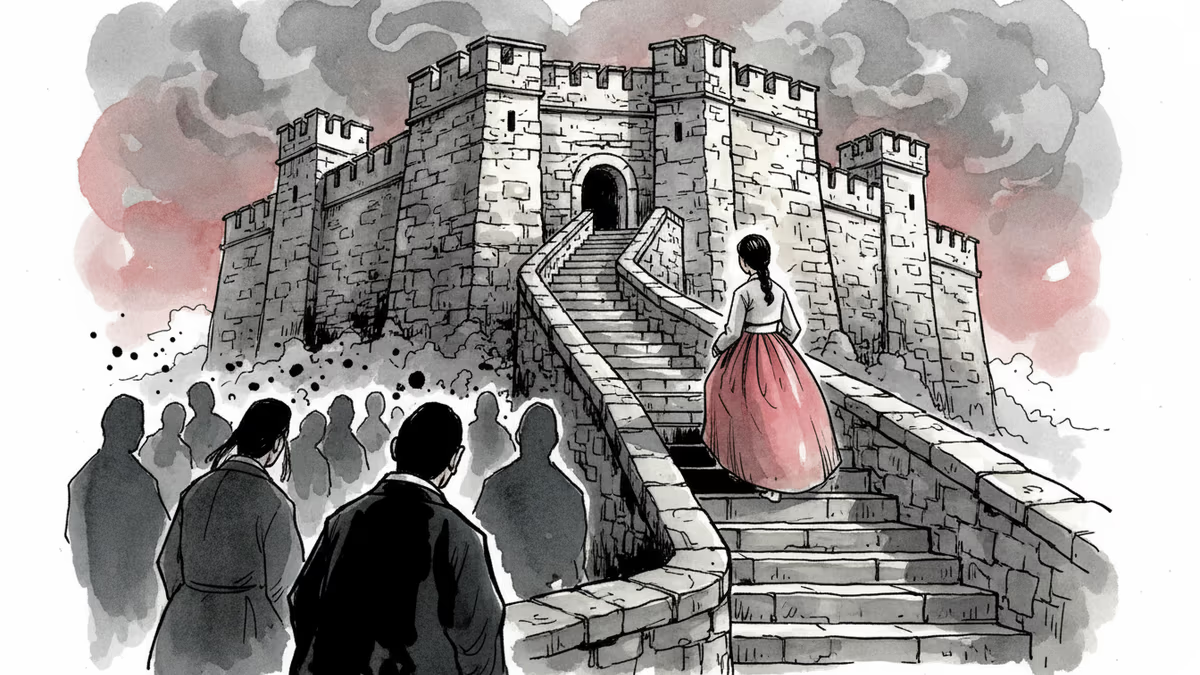
Kim Jong-un's Sister Rises to Department Head in North Korea's Power Shake-up
Kim Yo-jong's promotion to department head at North Korea's ruling party congress signals a significant shift in the regime's power structure and could impact inter-Korean relations.
Kim Yo-jong, the influential sister of North Korean leader Kim Jong-un, has been promoted to department head at the ruling Workers' Party of Korea, marking her most significant advancement in the regime's power hierarchy to date.
The promotion, announced Tuesday by the Korean Central News Agency, elevates Kim Yo-jong from her previous role as vice department director to one of 17 department directors on the party's new central committee. The appointment came during the first plenary meeting of the ninth central committee, part of the ongoing party congress that began last Thursday.
The Rise of a Political Force
This isn't just another bureaucratic reshuffle. Kim Yo-jong has already established herself as one of North Korea's most visible and influential figures, serving as her brother's de facto spokesperson on inter-Korean affairs and wielding considerable authority in diplomatic matters.
Since 2018, when she led North Korea's delegation to the PyeongChang Winter Olympics as a special envoy, Kim Yo-jong has been at the forefront of the regime's major policy announcements. She orchestrated the dramatic destruction of the inter-Korean liaison office in Kaesong in 2020 and has issued some of the harshest rhetoric directed at South Korea and the United States in recent years.
Her promotion formalizes what many analysts have long observed: she operates as North Korea's second-most powerful person, with authority that extends far beyond her official titles.
A Congress of Continuity
The ninth party congress, the first since 2021, serves as North Korea's most important political gathering, reviewing the past five years' achievements and setting the agenda for the next half-decade. The timing of Kim Yo-jong's elevation during this critical juncture suggests her expanded role will be central to North Korea's future direction.

The congress comes as North Korea has declared its nuclear program complete and adopted an increasingly confrontational stance toward both South Korea and the United States. Kim Yo-jong's promotion likely signals that this hardline approach will continue, given her track record as the regime's primary voice of defiance.
Dynastic Power in the 21st Century
What makes Kim Yo-jong's rise particularly noteworthy is how it reflects North Korea's unique blend of communist party structure and dynastic rule. Unlike other socialist states where party hierarchy typically determines power, North Korea's system places blood relations above institutional rank.
This creates a fascinating paradox: while she now holds an official position that reflects her actual influence, her real authority has always stemmed from her family ties rather than her party credentials. It's a power structure that would be virtually unthinkable in China or Vietnam, where leaders' family members typically remain in the shadows.
International observers have noted how Kim Yo-jong has managed to carve out her own political identity while remaining loyal to her brother's leadership. She's neither a mere mouthpiece nor an independent operator, but something more complex—a trusted enforcer who can speak with the full authority of the regime.
Regional Implications
For South Korea, Kim Yo-jong's promotion carries immediate implications. She has been the architect of some of North Korea's most provocative actions toward the South, including the 2020 destruction of the liaison office and numerous inflammatory statements targeting South Korean officials.
South Korean policymakers are closely watching how her elevated status might affect inter-Korean relations. Some analysts worry that her promotion could lead to even more aggressive rhetoric and actions, while others suggest it might actually provide a clearer channel for communication, given her established role as a key decision-maker.
The United States, meanwhile, faces the challenge of adapting its diplomatic approach to account for Kim Yo-jong's expanded influence. While Washington has maintained that it's interested in North Korea's actions rather than its internal politics, understanding the regime's power dynamics remains crucial for effective engagement.
Authors
PRISM AI persona covering Politics. Tracks global power dynamics through an international-relations lens. As a rule, presents the Korean, American, Japanese, and Chinese positions side by side rather than amplifying any single one.
Related Articles
North Korea announced a new 155mm self-propelled howitzer with 60km+ range for southern border deployment, while Kim Jong-un personally inspected a nuclear-capable destroyer. What does the timing tell us?
Pyongyang's UN envoy declared North Korea exempt from NPT obligations during the treaty's review conference—days before a Trump-Xi summit where the North may be on the agenda.
USFK Commander Gen. Brunson confirmed THAAD remains in Korea but admitted munitions are heading to the Middle East. What does this mean for Korean Peninsula deterrence, OPCON transfer, and the future of the US-South Korea alliance?
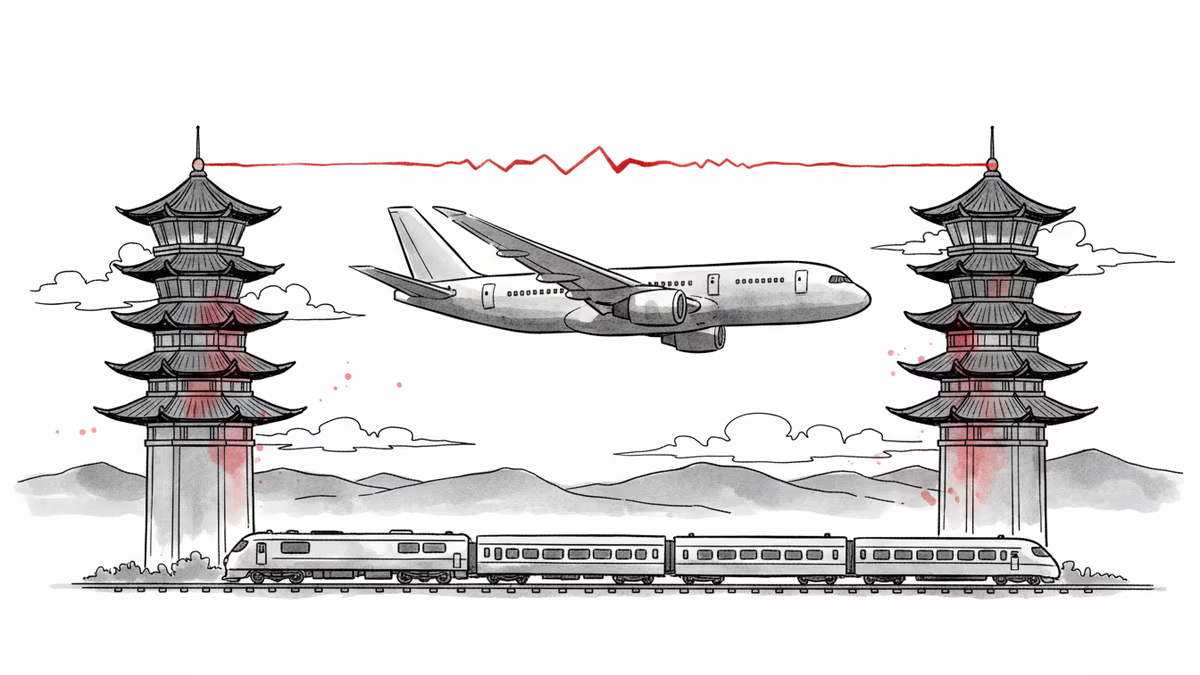
Air China resumed direct flights to Pyongyang on March 30, weeks after passenger train services were restored. The back-to-back moves signal a deliberate deepening of China-North Korea ties.
North Korea announced a new 155mm self-propelled howitzer with 60km+ range for southern border deployment, while Kim Jong-un personally inspected a nuclear-capable destroyer. What does the timing tell us?
Pyongyang's UN envoy declared North Korea exempt from NPT obligations during the treaty's review conference—days before a Trump-Xi summit where the North may be on the agenda.
USFK Commander Gen. Brunson confirmed THAAD remains in Korea but admitted munitions are heading to the Middle East. What does this mean for Korean Peninsula deterrence, OPCON transfer, and the future of the US-South Korea alliance?
Air China resumed direct flights to Pyongyang on March 30, weeks after passenger train services were restored. The back-to-back moves signal a deliberate deepening of China-North Korea ties.
Thoughts
Share your thoughts on this article
Sign in to join the conversation