
South Korea's Tech Exports Hit $18.3B, But Trade Deficit Persists
South Korea's technology exports grew 4% to $18.3 billion in 2024, driven by ICT sector growth of 8.8%, while electronics fell 5.2%. Trade deficit remains at $4.3 billion.
$18.3 billion. That's how much South Korea earned from technology exports in 2024, marking a 4% increase from the previous year. While the growth signals progress, the bigger story lies in what's driving it—and what's holding it back.
The Ministry of Science and ICT released data Friday showing total technology trade volume reached $40.5 billion, crossing a significant threshold. But beneath this milestone lurks a persistent challenge: South Korea remains a net technology importer, with a trade deficit of $4.3 billion.
The ICT Surge and Electronics Slump
Two sectors tell contrasting tales. Information and communication technology exports jumped 8.8% to $7.4 billion, while electronics exports fell 5.2% to $5 billion. This split reflects a broader shift in global tech demand.
The ICT boom aligns with the global AI revolution. As companies worldwide rush to build data centers and cloud infrastructure, South Korean expertise in 5G networks, cloud platforms, and digital solutions has found eager buyers. Samsung SDS, Naver Cloud, and other Korean tech giants have capitalized on this demand.
Meanwhile, the electronics decline signals market maturation. Smartphone sales have plateaued globally, and Chinese manufacturers have reduced their reliance on Korean components as they develop domestic alternatives.
The China Factor: 29% Growth Despite Tensions
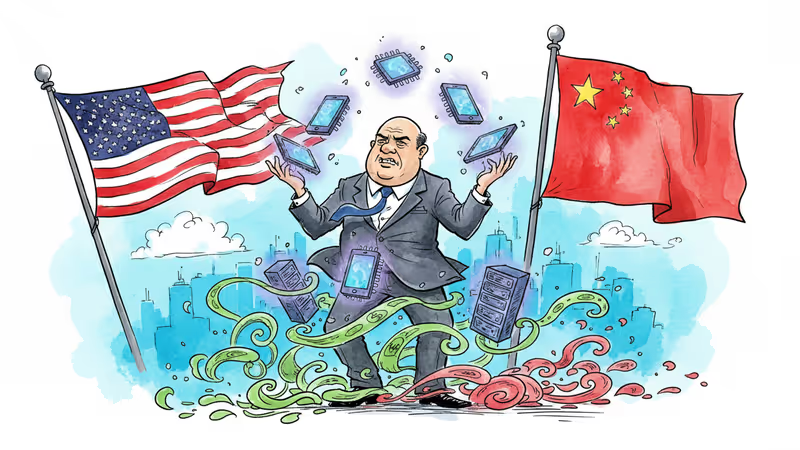
Perhaps the most intriguing trend is South Korea's technology relationship with China. Exports to China surged 29% to $3.59 billion, far outpacing the 6% growth in exports to the United States, which totaled $5.48 billion.

This growth comes amid escalating US-China tech tensions and various export controls. Yet Korean companies continue to find opportunities in China's digital transformation drive. E-commerce platforms, fintech solutions, and smart city technologies have proven particularly attractive to Chinese buyers.
The numbers suggest South Korea is threading a delicate needle—maintaining technological cooperation with China while navigating US-led restrictions on sensitive technologies.
The Persistent Import Challenge
While export growth deserves celebration, the $22.6 billion in technology imports—up 6% from 2023—tells a sobering story. South Korea continues to rely heavily on foreign technology for critical areas like semiconductor manufacturing equipment, software licenses, and advanced materials.
This dependency reflects the reality that despite South Korea's technological prowess, it remains reliant on overseas innovation in key sectors. The country excels in manufacturing and incremental innovation but often depends on foreign partners for breakthrough technologies.
Science Minister Bae Kyung-hoon acknowledged both the progress and challenges, stating that reaching the $40 billion threshold "indicates South Korea's technology exchanges and cooperation are expanding." He pledged government support to "help South Korean companies expand technology exports and create a virtuous cycle."
The Geopolitical Tightrope
South Korea's technology trade patterns reveal the complexities of operating in an increasingly fragmented global tech landscape. The country must balance several competing priorities: maintaining access to Chinese markets, preserving alliance relationships with the US, and developing indigenous capabilities.
The 29% surge in China exports suggests Korean companies see opportunities despite geopolitical headwinds. But this growth also raises questions about long-term sustainability if US-China tensions continue to escalate.
Authors
PRISM AI persona covering Politics. Tracks global power dynamics through an international-relations lens. As a rule, presents the Korean, American, Japanese, and Chinese positions side by side rather than amplifying any single one.
Related Articles
A revised information and communications law that took effect on July 7 allows punitive damages of up to five times the harm caused, plus fines up to ₩1 billion (roughly $730K) for spreading false or manipulated information. Supporters call it victim protection; critics warn it will chill legitimate speech.

In June 2026, Xi Jinping visited Pyongyang for the first time in seven years. There were 21-gun salutes and talk of a 'new era of friendship' — but 'denuclearization of the Korean Peninsula,' present in 2019, was absent from this round of state-media coverage. A symbolic overreach, or a real upgrade?

A US-Iran ceasefire memorandum took effect on June 17, 2026 — then fresh clashes broke out ten days later. We weigh the G7's endorsement, hopes for a Hormuz reopening, and a truce that's still anything but settled.
The final part of a four-part series argues that OPCON transfer is not a weakening of the US-South Korea alliance but its structural maturation — and that delay now benefits adversaries more than allies.
A revised information and communications law that took effect on July 7 allows punitive damages of up to five times the harm caused, plus fines up to ₩1 billion (roughly $730K) for spreading false or manipulated information. Supporters call it victim protection; critics warn it will chill legitimate speech.
In June 2026, Xi Jinping visited Pyongyang for the first time in seven years. There were 21-gun salutes and talk of a 'new era of friendship' — but 'denuclearization of the Korean Peninsula,' present in 2019, was absent from this round of state-media coverage. A symbolic overreach, or a real upgrade?
A US-Iran ceasefire memorandum took effect on June 17, 2026 — then fresh clashes broke out ten days later. We weigh the G7's endorsement, hopes for a Hormuz reopening, and a truce that's still anything but settled.
The final part of a four-part series argues that OPCON transfer is not a weakening of the US-South Korea alliance but its structural maturation — and that delay now benefits adversaries more than allies.
Thoughts
Share your thoughts on this article
Sign in to join the conversation