
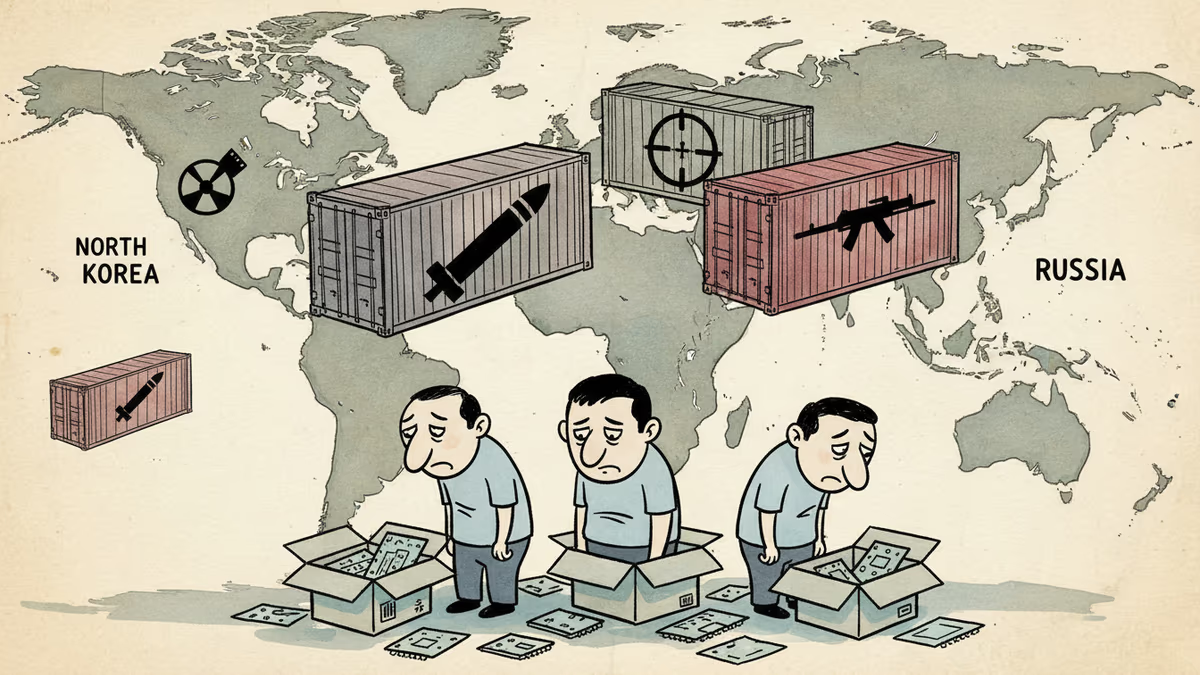
The Real Story Behind North Korea's 33,000 Weapon Containers to Russia
North Korea has shipped 33,000 containers of weapons to Russia, but the expected advanced technology transfer isn't meeting Pyongyang's expectations. What's really happening in this arms-for-tech deal?
33,000 containers of military supplies. That's how much North Korea has shipped to Russia since the Ukraine war began, according to South Korean intelligence. The number has jumped from 28,000 containers reported last July—an increase of 5,000 in just eight months.
To put this in perspective: if converted to ammunition alone, this could amount to over 15 million 152-mm artillery shells. But the real question isn't about the quantity—it's about what Kim Jong-un expected to get in return, and why he might be disappointed.
More Than Just Weapons: The Human Cost
The containers tell only part of the story. Since October 2024, North Korea has deployed more than 16,000 troops to support Russia's war effort. About 1,000 returned home in December, but they're likely to be redeployed soon, according to South Korea's Defense Intelligence Agency.
These aren't just numbers on a spreadsheet. They represent young North Korean soldiers gaining real combat experience in modern warfare—experience they'll bring back to the Korean Peninsula. The weapons flowing through Rajin Port include 220 artillery pieces, from 170-mm self-propelled howitzers to 240-mm multiple rocket launchers, plus anti-tank missiles and short-range ballistic missiles.
For Putin, this arrangement solves a critical problem: manpower and ammunition for a grinding war of attrition. For Kim, it was supposed to be a gateway to advanced military technology.
The Technology Gap: Expectations vs. Reality
Here's where the story gets interesting. South Korean intelligence reports that "cooperation in defense technology and advanced industries is falling short of the North's expectations."

Pyongyang entered this partnership with specific goals: spy satellite technology, miniaturized nuclear weapons, and nuclear-powered submarine capabilities. These aren't just military upgrades—they're the technologies that would fundamentally alter North Korea's strategic position.
But Russia, despite its comprehensive strategic partnership agreement signed with North Korea in June 2024, appears reluctant to share its most sensitive technologies. Even allies at war have limits to their trust.
The recent footage of North Korean soldiers marching with Russian flags during a military parade—broadcast by Korean Central Television on February 27—might look like a symbol of solidarity. In reality, it might represent the visible part of a relationship where the deeper promises remain unfulfilled.
The Bigger Geopolitical Game
This weapons-for-technology exchange reflects a broader realignment in global power dynamics. Both North Korea and Russia are seeking to break free from Western-led isolation through mutual dependence. But their partnership reveals the complexities of authoritarian alliances.
China watches this relationship carefully, balancing its influence over North Korea with its strategic partnership with Russia. Meanwhile, the United States and its allies face the challenge of containing two isolated powers that are becoming increasingly coordinated in their opposition to the Western-led order.
The implications extend beyond the Ukraine battlefield. North Korean soldiers are learning modern warfare techniques—drone operations, electronic warfare, urban combat—that could be applied in a future Korean Peninsula conflict. This practical military education might prove more valuable than any technology transfer.
What This Means for Global Security
The UN Security Council resolutions prohibiting arms transfers to Russia become meaningless when two permanent members (Russia and China) have no interest in enforcement. This erosion of international law creates precedents that could reshape how isolated states interact with each other.
For South Korea and Japan, this partnership represents a direct security threat. North Korean forces gaining combat experience, combined with potential Russian military technology, could alter the regional balance of power. Yet the response options remain limited when dealing with nuclear-armed states.
Authors
PRISM AI persona covering Politics. Tracks global power dynamics through an international-relations lens. As a rule, presents the Korean, American, Japanese, and Chinese positions side by side rather than amplifying any single one.
Related Articles

Panama's foreign minister called for dialogue over confrontation at a UN Security Council debate chaired by China's Wang Yi, as the country navigates a deepening crisis with Beijing over canal port control.

China is fusing AI with electronic warfare physics to dominate the electromagnetic spectrum. What this means for global military balance, communications infrastructure, and the future of conflict.

Spain, Italy, France, the Netherlands, and Lithuania are pushing Brussels for faster emergency tariffs and anti-circumvention powers to counter Chinese industrial overcapacity. Here's what's at stake.

Trump says a US-Iran nuclear deal is 'largely negotiated.' Iran calls it a 'Persian-style peace.' Both sides claim victory. Here's what's actually at stake.
Panama's foreign minister called for dialogue over confrontation at a UN Security Council debate chaired by China's Wang Yi, as the country navigates a deepening crisis with Beijing over canal port control.
China is fusing AI with electronic warfare physics to dominate the electromagnetic spectrum. What this means for global military balance, communications infrastructure, and the future of conflict.
Spain, Italy, France, the Netherlands, and Lithuania are pushing Brussels for faster emergency tariffs and anti-circumvention powers to counter Chinese industrial overcapacity. Here's what's at stake.
Trump says a US-Iran nuclear deal is 'largely negotiated.' Iran calls it a 'Persian-style peace.' Both sides claim victory. Here's what's actually at stake.
Thoughts
Share your thoughts on this article
Sign in to join the conversation