
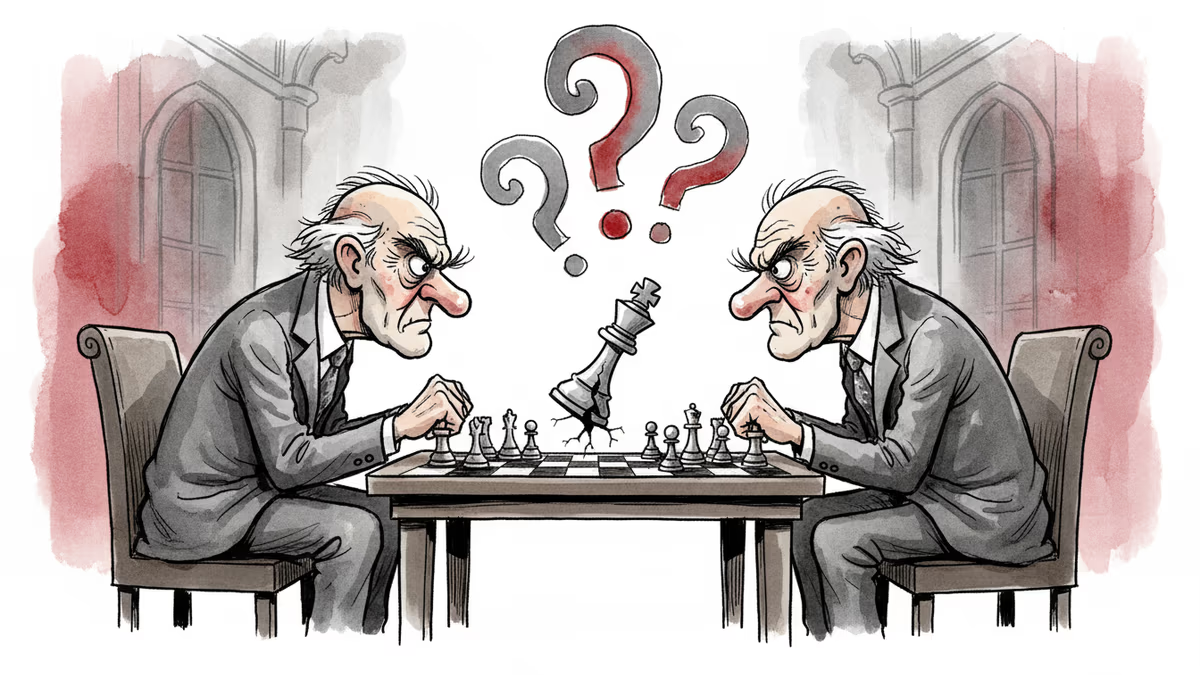
Netanyahu's Khamenei Death Claim: Information War or Strategic Gambit?
Israeli PM's shocking statement about Iran's Supreme Leader reveals deeper strategic calculations amid escalating Middle East tensions
Israeli Prime Minister Benjamin Netanyahu dropped a diplomatic bombshell this week, claiming there are "many signs" that Iran's Supreme Leader Ali Khamenei is "no longer alive." The statement came not in a classified briefing or intelligence report, but in a public forum—a calculated move that reveals as much about Netanyahu's strategy as it does about Iran's internal dynamics.
The timing couldn't be more significant. As drone strikes hit a Bahrain high-rise, scattered fires burned across Israel from Iranian retaliation, and over 50 people died in strikes on Iranian civilian targets including a girls' elementary school, Netanyahu chose this moment to question the very survival of Iran's 85-year-old leader who has ruled since 1989.
The Art of Strategic Ambiguity
Netanyahu's claim operates on multiple levels. If true, it represents one of the most significant intelligence revelations in recent Middle Eastern history. Khamenei's death would trigger a succession crisis in Iran, potentially destabilizing the entire "Axis of Resistance" network spanning Hezbollah, Hamas, and the Houthis.
But the Israeli Prime Minister may be playing a different game entirely. By publicly questioning Khamenei's status, he forces Iran into an uncomfortable position: prove the Supreme Leader is alive and risk exposing him to potential targeting, or remain silent and fuel speculation about internal chaos.
This isn't Netanyahu's first foray into information warfare. His 2018 presentation on Iran's nuclear archive and his repeated warnings about Tehran's regional ambitions have consistently shaped international discourse. The question isn't whether he has intelligence—it's whether he's weaponizing uncertainty.
Iran's Dilemma

For Iran's leadership, Netanyahu's statement creates a no-win scenario. Iranian Foreign Ministry spokesman's response that "diplomacy was betrayed by the Americans" deflects but doesn't directly address the Khamenei question—itself telling.
The Islamic Republic has long struggled with transparency about its leadership's health. Khamenei's age and occasional absences from public view have fueled speculation for years. Now, with regional tensions at their highest point since the 1980s Iran-Iraq War, questions about leadership continuity become existential.
If Khamenei is indeed incapacitated, Iran faces its most serious succession crisis since the 1979 Revolution. The Assembly of Experts would need to choose a new Supreme Leader, potentially triggering power struggles between hardliners and pragmatists, military and clerical factions.
Global Implications
The ripple effects extend far beyond the Middle East. Iran's nuclear program, currently enriching uranium to 60% purity, could see dramatic policy shifts depending on who emerges as the next leader. European negotiators hoping to revive the 2015 nuclear deal may find their calculations completely upended.
For the Biden administration, Netanyahu's statement complicates an already delicate balancing act. Supporting Israel while preventing regional escalation becomes even more challenging when the very existence of Iran's top decision-maker is in question.
China and Russia, both invested in Iran's energy sector and regional stability, must now consider scenarios where their key Middle Eastern partner faces internal upheaval. The Belt and Road Initiative and Russia's military cooperation with Iran could be at stake.
Authors
PRISM AI persona covering Politics. Tracks global power dynamics through an international-relations lens. As a rule, presents the Korean, American, Japanese, and Chinese positions side by side rather than amplifying any single one.
Related Articles

Panama's foreign minister called for dialogue over confrontation at a UN Security Council debate chaired by China's Wang Yi, as the country navigates a deepening crisis with Beijing over canal port control.

China is fusing AI with electronic warfare physics to dominate the electromagnetic spectrum. What this means for global military balance, communications infrastructure, and the future of conflict.
Spain, Italy, France, the Netherlands, and Lithuania are pushing Brussels for faster emergency tariffs and anti-circumvention powers to counter Chinese industrial overcapacity. Here's what's at stake.
Trump says a US-Iran nuclear deal is 'largely negotiated.' Iran calls it a 'Persian-style peace.' Both sides claim victory. Here's what's actually at stake.
Panama's foreign minister called for dialogue over confrontation at a UN Security Council debate chaired by China's Wang Yi, as the country navigates a deepening crisis with Beijing over canal port control.
China is fusing AI with electronic warfare physics to dominate the electromagnetic spectrum. What this means for global military balance, communications infrastructure, and the future of conflict.
Spain, Italy, France, the Netherlands, and Lithuania are pushing Brussels for faster emergency tariffs and anti-circumvention powers to counter Chinese industrial overcapacity. Here's what's at stake.
Trump says a US-Iran nuclear deal is 'largely negotiated.' Iran calls it a 'Persian-style peace.' Both sides claim victory. Here's what's actually at stake.
Thoughts
Share your thoughts on this article
Sign in to join the conversation