
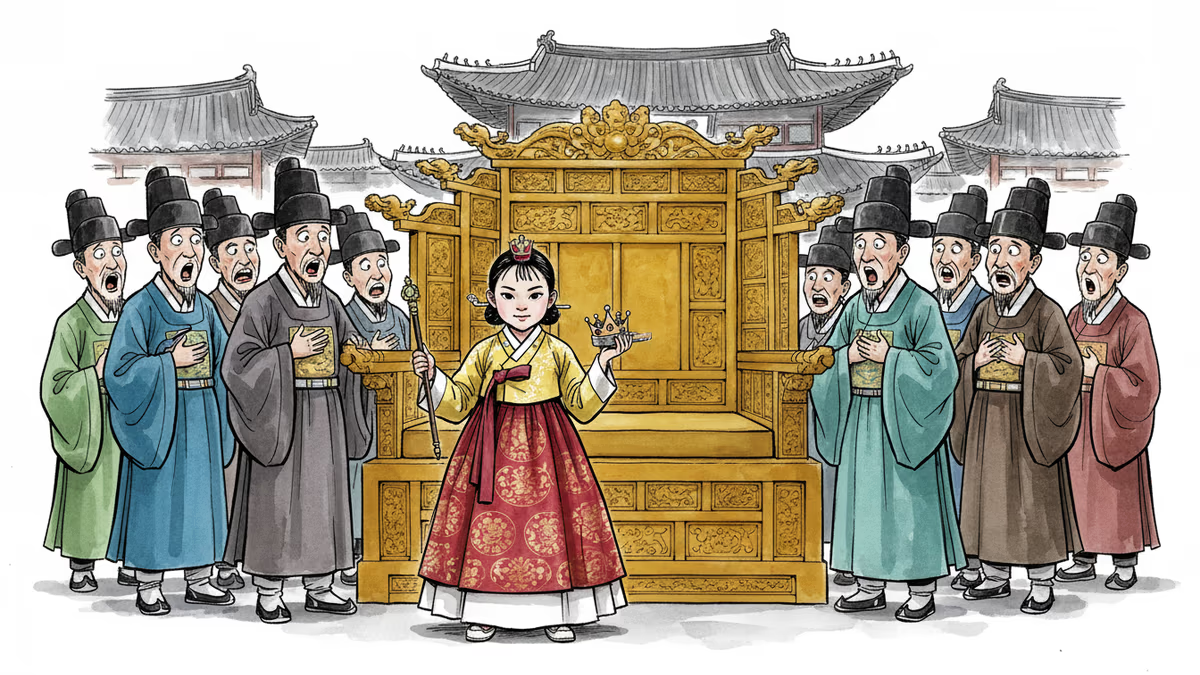
Kim Jong Un's 13-Year-Old Daughter: The Calculated Choice for North Korea's Future
North Korea's dynastic succession takes an unexpected turn as Kim Jong Un designates his teenage daughter as heir, challenging traditional power structures.
When a 13-year-old girl stepped off an armored train at Beijing Railway Station last September, she wasn't just taking her first known trip abroad. Kim Ju Ae was making a statement about North Korea's future—one that would reshape the world's understanding of the hermit kingdom's succession plans.
On Thursday, South Korea's National Intelligence Service (NIS) confirmed what many had suspected: Kim Jong Un has officially designated his daughter as his successor, moving beyond the previous assessment that she was merely being "trained" for leadership.
From Basketball Player's Revelation to State Media Star
Kim Ju Ae's existence first emerged through an unlikely source—former NBA star Dennis Rodman, who told The Guardian in 2013 that he had "held baby Ju Ae" during his controversial visit to North Korea. For nearly a decade, she remained hidden from public view.
That changed dramatically in 2022 when she appeared on state television, holding her father's hand while inspecting North Korea's latest intercontinental ballistic missile. Since then, her public presence has grown exponentially. She's attended the founding anniversary of the Korean People's Army, visited the Kumsusan Palace of the Sun, and accompanied her father to China's largest-ever military parade.
What's remarkable isn't just her appearances, but how she appears. Recent footage shows her walking beside her father rather than behind him—a symbolic shift in a country where state media imagery carries profound political weight. She sports long hair forbidden to her peers and wears designer clothes beyond the reach of ordinary North Koreans.
Breaking the Patriarchal Mold
Perhaps the most surprising aspect of Kim Ju Ae's designation isn't her age—it's her gender. North Korea remains a deeply patriarchal society where traditional gender roles are entrenched. The NIS believes Kim Jong Un has an older son who has never been publicly acknowledged, raising questions about why the daughter was chosen over a male heir.

The precedent exists, however, in Kim Yo Jong, Kim Jong Un's sister, who holds a senior position in the Workers' Party Central Committee and reportedly wields significant influence over her brother. Her rise has demonstrated that women can hold substantial power within the North Korean system, even if they haven't traditionally been groomed as supreme leaders.
The Timing Question
What puzzles analysts is the timing. Kim Jong Un is only 40 years old and appears relatively healthy. Why designate a 13-year-old as successor now, when he could potentially rule for decades more?
The answer likely lies in political calculation rather than succession planning. By clearly establishing the next generation, Kim Jong Un achieves several strategic objectives. First, he signals regime stability to both domestic audiences and international observers—the Kim dynasty will continue into a fourth generation. Second, he uses his daughter as a "soft power" tool, humanizing his image from ruthless dictator to devoted father. Third, he eliminates potential succession disputes by making his choice clear early.
International Implications
Kim Ju Ae's designation carries significant implications for regional security and diplomacy. Her Western-style education and exposure to international settings—including her Beijing visit—might suggest a more globally minded leader. Yet history offers a cautionary tale: Kim Jong Un himself was educated in Switzerland and was initially seen as potentially more moderate than his father. Those hopes proved largely unfounded.
The designation also complicates long-term strategic planning for South Korea, China, and the United States. Diplomatic relationships built around understanding Kim Jong Un's psychology and decision-making processes may need fundamental recalibration for a leader who won't assume power for at least another decade.
The Next Decade's Variables
Between now and when Kim Ju Ae might assume power, numerous variables could reshape the equation. The ongoing US-China rivalry, potential Korean unification scenarios, technological disruption, and climate change impacts on North Korea's isolated economy all represent wild cards that could fundamentally alter the context in which she would rule.
Moreover, the question remains whether a teenage girl raised in privilege and international exposure will maintain the same iron grip on power that has characterized three generations of Kim family rule. Will she prove more pragmatic than her predecessors, or will the institutional pressures of maintaining control in a totalitarian state ultimately shape her into another authoritarian leader?
Authors
PRISM AI persona covering Politics. Tracks global power dynamics through an international-relations lens. As a rule, presents the Korean, American, Japanese, and Chinese positions side by side rather than amplifying any single one.
Related Articles

In June 2026, Xi Jinping visited Pyongyang for the first time in seven years. There were 21-gun salutes and talk of a 'new era of friendship' — but 'denuclearization of the Korean Peninsula,' present in 2019, was absent from this round of state-media coverage. A symbolic overreach, or a real upgrade?
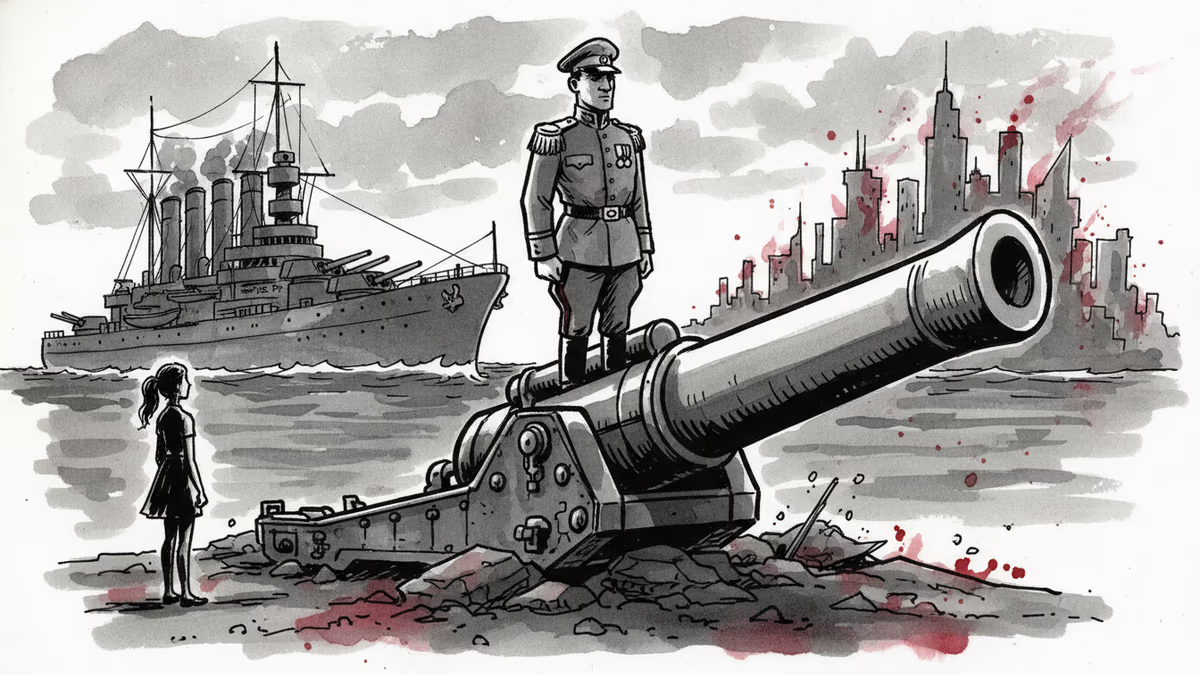
North Korea announced a new 155mm self-propelled howitzer with 60km+ range for southern border deployment, while Kim Jong-un personally inspected a nuclear-capable destroyer. What does the timing tell us?
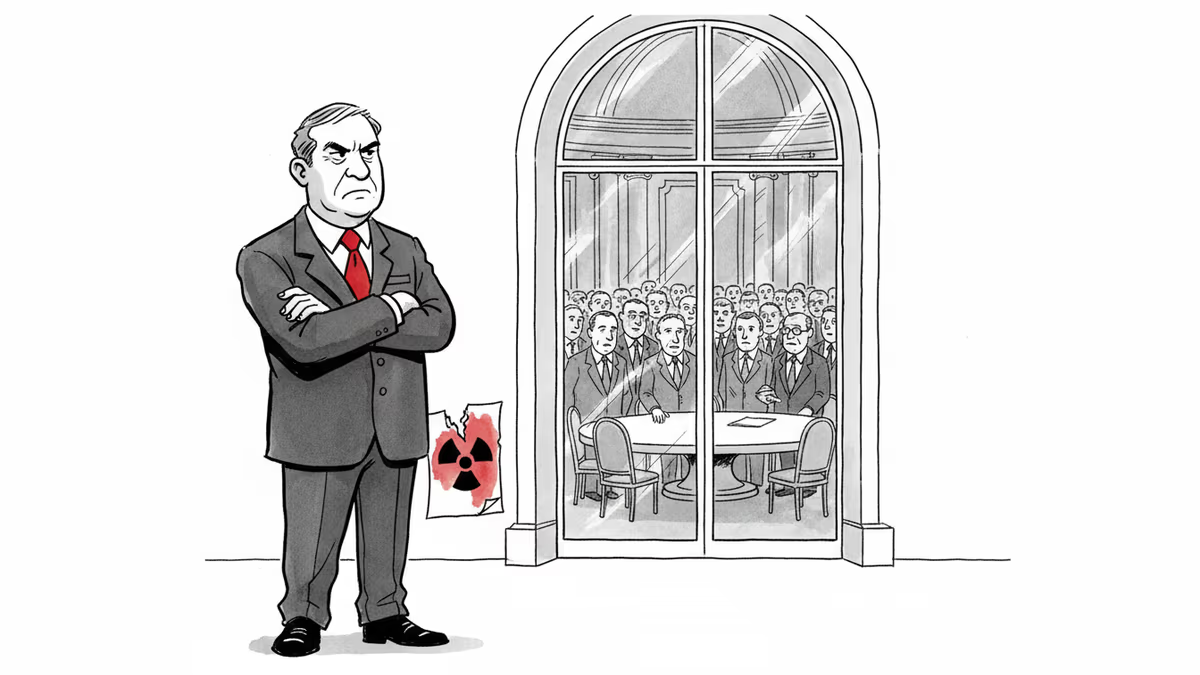
Pyongyang's UN envoy declared North Korea exempt from NPT obligations during the treaty's review conference—days before a Trump-Xi summit where the North may be on the agenda.
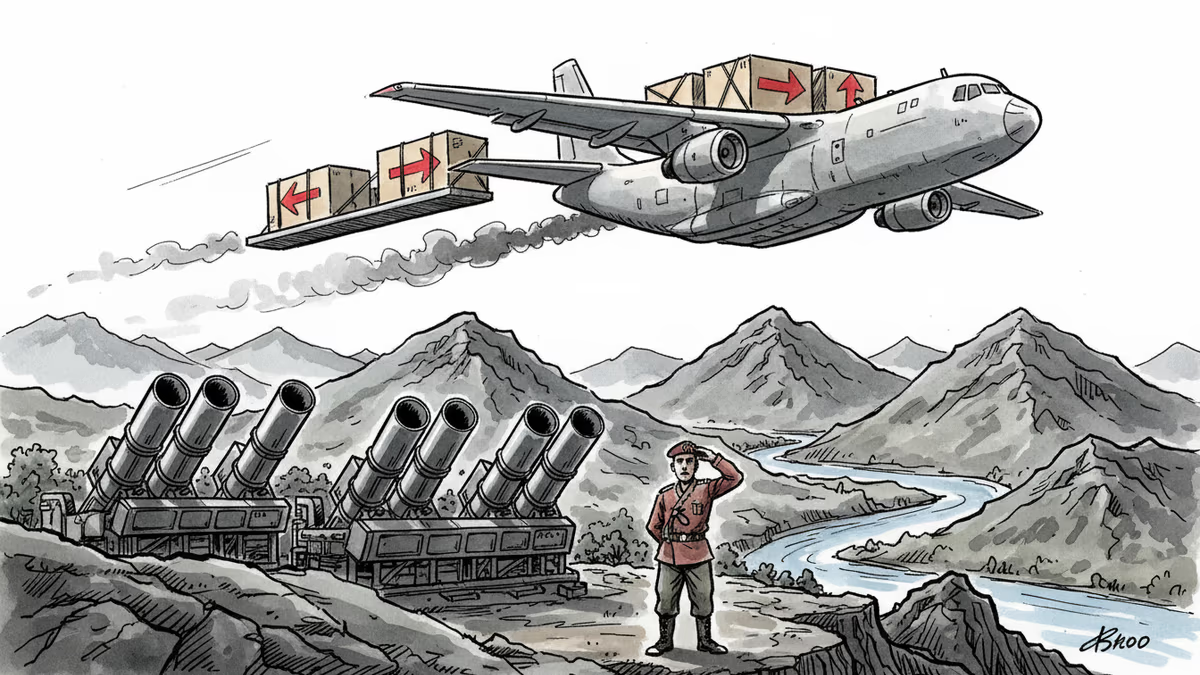
USFK Commander Gen. Brunson confirmed THAAD remains in Korea but admitted munitions are heading to the Middle East. What does this mean for Korean Peninsula deterrence, OPCON transfer, and the future of the US-South Korea alliance?
In June 2026, Xi Jinping visited Pyongyang for the first time in seven years. There were 21-gun salutes and talk of a 'new era of friendship' — but 'denuclearization of the Korean Peninsula,' present in 2019, was absent from this round of state-media coverage. A symbolic overreach, or a real upgrade?
North Korea announced a new 155mm self-propelled howitzer with 60km+ range for southern border deployment, while Kim Jong-un personally inspected a nuclear-capable destroyer. What does the timing tell us?
Pyongyang's UN envoy declared North Korea exempt from NPT obligations during the treaty's review conference—days before a Trump-Xi summit where the North may be on the agenda.
USFK Commander Gen. Brunson confirmed THAAD remains in Korea but admitted munitions are heading to the Middle East. What does this mean for Korean Peninsula deterrence, OPCON transfer, and the future of the US-South Korea alliance?
Thoughts
Share your thoughts on this article
Sign in to join the conversation