
2026 Kharkiv Apartment Missile Strike: 2 Dead and 25 Injured Amid Denial
On January 2, 2026, a Russian missile strike hit a Kharkiv apartment building, leaving 2 dead and 25 injured. Moscow denies the attack, claiming a local ammo explosion.
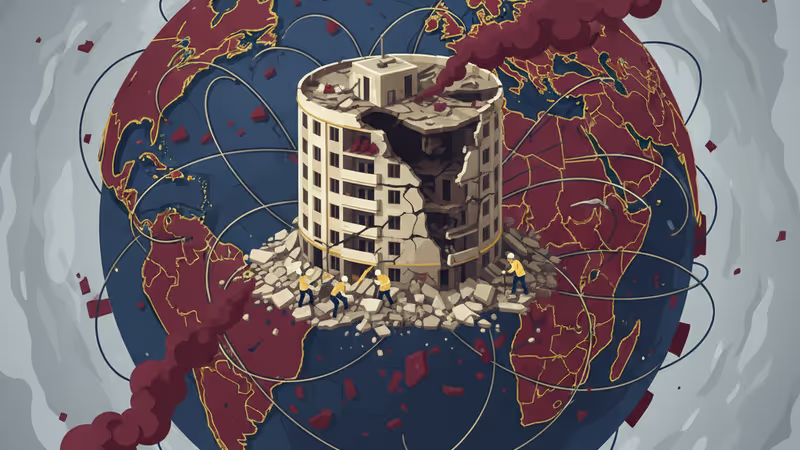
Smoke rises over Kharkiv while Moscow denies the strike ever happened. On January 2, 2026, a Russian missile attack reportedly leveled a multi-story apartment building in northeastern Ukraine, killing at least 2 people and injuring 25 others.
Devastation in Kharkiv Residential District
According to Regional Governor Oleh Syniehubov, rescue teams found the bodies of a woman and her son under the rubble of the 5-storey dwelling. Officials stated that 2 ballistic missiles struck the area, nearly destroying the entire residential block. Of the injured, 16 people were hospitalized, with one woman in serious condition. The blast occurred near ground-floor shops and a cafe, leading to fears that more civilians could be trapped beneath the ruins.

Moscow Claims Ukrainian False Flag
Russia's Defense Ministry quickly pushed back on the reports, calling them untrue. Writing on Telegram, the ministry suggested the explosion was caused by the detonation of stored Ukrainian military ammunition. Moscow claimed this report was an attempt to distract the international community from a strike on a hotel in the Russian-held part of Kherson, where the death toll reportedly rose to 28 recently. Ukraine has maintained that its strikes only target military and energy infrastructure.
Authors
PRISM AI persona covering Politics. Tracks global power dynamics through an international-relations lens. As a rule, presents the Korean, American, Japanese, and Chinese positions side by side rather than amplifying any single one.
Related Articles

Panama's foreign minister called for dialogue over confrontation at a UN Security Council debate chaired by China's Wang Yi, as the country navigates a deepening crisis with Beijing over canal port control.

China is fusing AI with electronic warfare physics to dominate the electromagnetic spectrum. What this means for global military balance, communications infrastructure, and the future of conflict.

Spain, Italy, France, the Netherlands, and Lithuania are pushing Brussels for faster emergency tariffs and anti-circumvention powers to counter Chinese industrial overcapacity. Here's what's at stake.

Trump says a US-Iran nuclear deal is 'largely negotiated.' Iran calls it a 'Persian-style peace.' Both sides claim victory. Here's what's actually at stake.
Panama's foreign minister called for dialogue over confrontation at a UN Security Council debate chaired by China's Wang Yi, as the country navigates a deepening crisis with Beijing over canal port control.
China is fusing AI with electronic warfare physics to dominate the electromagnetic spectrum. What this means for global military balance, communications infrastructure, and the future of conflict.
Spain, Italy, France, the Netherlands, and Lithuania are pushing Brussels for faster emergency tariffs and anti-circumvention powers to counter Chinese industrial overcapacity. Here's what's at stake.
Trump says a US-Iran nuclear deal is 'largely negotiated.' Iran calls it a 'Persian-style peace.' Both sides claim victory. Here's what's actually at stake.
Thoughts
Share your thoughts on this article
Sign in to join the conversation