
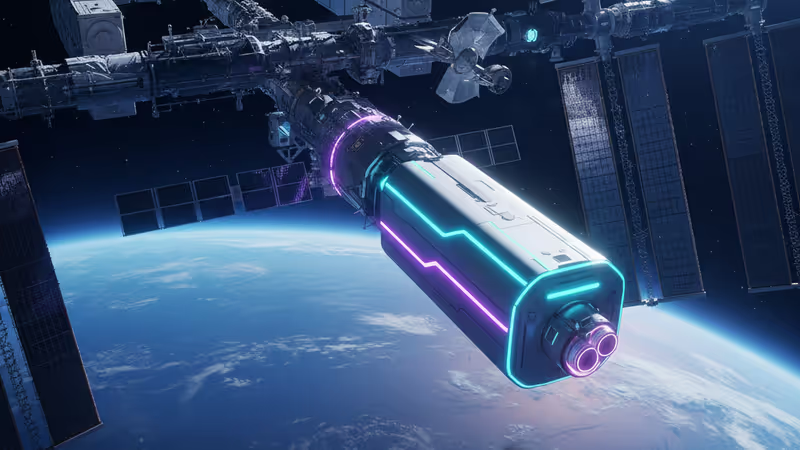
NASA Eyes ISS Extension as Race for Commercial Replacements Heats Up
US Senate staff members suggest a potential ISS extension while urging NASA to accelerate commercial replacements to avoid a dangerous 'space station gap' in low Earth orbit.
Is the world's most famous orbital laboratory getting a lease on life? While the International Space Station (ISS) is currently slated for a fiery retirement in 2030, key U.S. lawmakers are now discussing a potential extension to ensure America doesn't lose its foothold in low Earth orbit.
The Dual Strategy: Extending the ISS While Hurrying Private Successors
According to remarks made this week, Maddy Davis, an aide to Senator Ted Cruz (R-Texas), confirmed that an extension of the ISS is officially on the table. Cruz, who chairs the Senate Committee on Commerce, Science, and Transportation, holds significant sway over NASA's budget and long-term roadmap.

The message to the Texas Space Coalition was clear: NASA needs to move faster on its program to replace the aging station with commercial alternatives. However, the prospect of an "extension" suggests that the transition to private stations might not be ready by the original 2030 deadline. This is a critical issue for the Johnson Space Center in Houston, which manages the ISS program.
Political Interests and the Future of Low Earth Orbit
For Senator Cruz, the ISS isn't just a scientific marvel; it's a vital part of the Texas economy. Ensuring there's no gap between the ISS decommissioning and the arrival of commercial stations like those planned by Axiom Space or Blue Origin is paramount. A "space station gap" would cede the orbital high ground to international competitors, most notably China.
Authors
Related Articles

NASA's Artemis III has been redesigned as an Earth-orbit mission. SpaceX and Blue Origin say their landers won't be ready until late 2027. What does this mean for the future of lunar exploration?

Artemis II splashed down successfully in the Pacific, marking humanity's first crewed deep space mission in over 50 years. But the harder question isn't whether we can go back — it's why we should.

NASA's Orion capsule splashed down safely after humanity's first crewed lunar voyage in 54 years. The mission succeeded. Now the harder questions begin.

Artemis II's four astronauts are returning to Earth Friday night. The splashdown off Southern California isn't the anticlimax it sounds—it's the most technically perilous moment of the entire lunar journey.
NASA's Artemis III has been redesigned as an Earth-orbit mission. SpaceX and Blue Origin say their landers won't be ready until late 2027. What does this mean for the future of lunar exploration?
Artemis II splashed down successfully in the Pacific, marking humanity's first crewed deep space mission in over 50 years. But the harder question isn't whether we can go back — it's why we should.
NASA's Orion capsule splashed down safely after humanity's first crewed lunar voyage in 54 years. The mission succeeded. Now the harder questions begin.
Artemis II's four astronauts are returning to Earth Friday night. The splashdown off Southern California isn't the anticlimax it sounds—it's the most technically perilous moment of the entire lunar journey.
Thoughts
Share your thoughts on this article
Sign in to join the conversation