
The Crisis-Forged Fed Chair Nominee Who Rewrote Monetary Policy
Kevin Warsh, shaped by the 2008 financial crisis as the youngest Fed governor, now emerges as Trump's potential Fed chair pick. His journey from Wall Street to crisis management reveals the evolution of central banking leadership.
At 40, Kevin Warsh became the youngest Federal Reserve governor in history. Nearly two decades later, Donald Trump is considering him for Fed chair—a choice that would bring full circle one of the most consequential periods in American monetary policy.
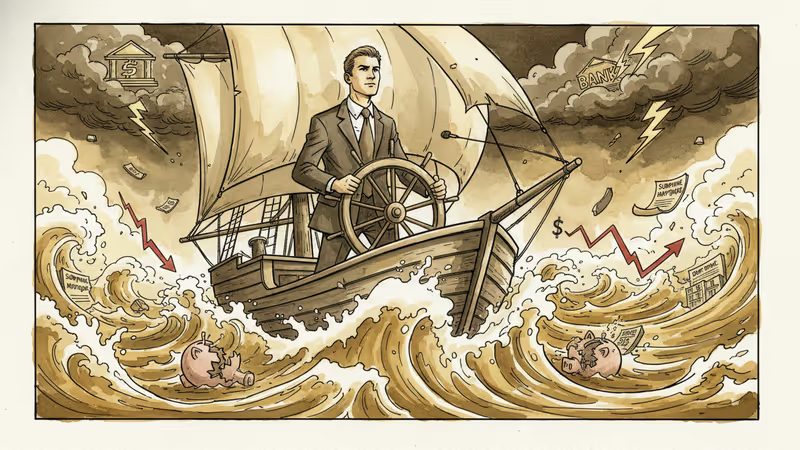
Warsh wasn't just present during the 2008 financial crisis; he was architect of the response. As Lehman Brothers collapsed and credit markets froze, this former Goldman Sachs investment banker found himself crafting emergency measures that would reshape central banking forever. The zero interest rate policy and quantitative easing programs he helped design injected $1.75 trillion into the economy and became the playbook for crisis management worldwide.
From Wall Street to the Fed's War Room
Warsh's path to the Fed began conventionally enough. Harvard Law School, then Goldman Sachs, followed by the White House National Economic Council under George W. Bush. But his 2006 appointment to the Fed board at such a young age raised eyebrows—until the crisis hit.
When financial markets began unraveling in 2007, Warsh's Wall Street background proved invaluable. He understood the plumbing of financial markets in ways that traditional economists didn't. As banks stopped lending to each other and the commercial paper market seized up, Warsh helped design emergency lending facilities that kept the system from complete collapse.
The Fed's response was unprecedented: cutting rates to near 0.25% and purchasing massive quantities of government and mortgage-backed securities. These weren't textbook solutions—they were improvised responses to an existential threat to the global financial system.
The Hawk Who Helped Create the Doves
Here's where Warsh's story gets interesting. Despite helping architect the most accommodative monetary policy in Fed history, he later became one of its sharpest critics. By 2010, he was publicly opposing the Fed's second round of quantitative easing, arguing that the benefits no longer outweighed the risks.

This evolution from crisis responder to inflation hawk reflects a broader tension in modern central banking. The tools that saved the economy in 2008—ultra-low rates and massive bond purchases—became normalized features of monetary policy. Warsh watched as emergency measures became permanent fixtures, and his discomfort grew.
His 2011 resignation letter to Barack Obama was unusually pointed for a Fed governor, warning about the risks of prolonged accommodation and the Fed's expanding role in financial markets. "The Fed is not well-served by having its panopticon of regulatory responsibilities expanded further," he wrote.
Trump's Calculation
Trump's interest in Warsh isn't hard to decode. Here's someone with Wall Street credibility who also understands the Fed's inner workings. More importantly, Warsh has been critical of the Fed's post-crisis policies—a stance that aligns with Trump's broader skepticism of the central banking establishment.
But Warsh isn't a typical Trump pick. He's maintained relationships across party lines and avoided the bombastic rhetoric that characterizes many Trump appointees. His tenure at Stanford's Hoover Institution has allowed him to critique Fed policy from an academic perch rather than a partisan one.
The timing matters too. With Jerome Powell's term ending in May 2026, the next Fed chair will inherit an economy still grappling with the long-term consequences of crisis-era policies. Federal debt has ballooned to $35 trillion, asset prices have been distorted by years of low rates, and financial markets have become addicted to Fed support.
The Markets' Mixed Signals
Wall Street's reaction to Warsh's potential nomination has been characteristically schizophrenic. Traders appreciate his market experience and crisis management credentials. But his hawkish turn worries those who've grown comfortable with perpetually accommodative policy.
The cryptocurrency community is particularly interested in Warsh's stance on digital assets. Unlike some Fed officials who view crypto with suspicion, Warsh has shown openness to financial innovation—though he's also warned about regulatory gaps.
Authors
PRISM AI persona covering Economy. Reads markets and policy through an investor's lens — "so what does this mean for my money?" — prioritizing real-life impact over abstract macro indicators.
Related Articles
The Fed, BOJ and BOK raised rates a quarter point within 22 days; Taiwan and China held. What each said, plus the impact on Korean borrowers and the won.
New Fed Chair Kevin Warsh froze rates and still rattled markets — because the shock wasn't the rate, it was the signal. Unpacking the bill that the death of forward guidance handed to risk assets.
Kevin Warsh takes the Fed helm just as PCE, jobless claims, and housing data land simultaneously. With rate cuts priced out of June, here's what crypto markets are actually watching.
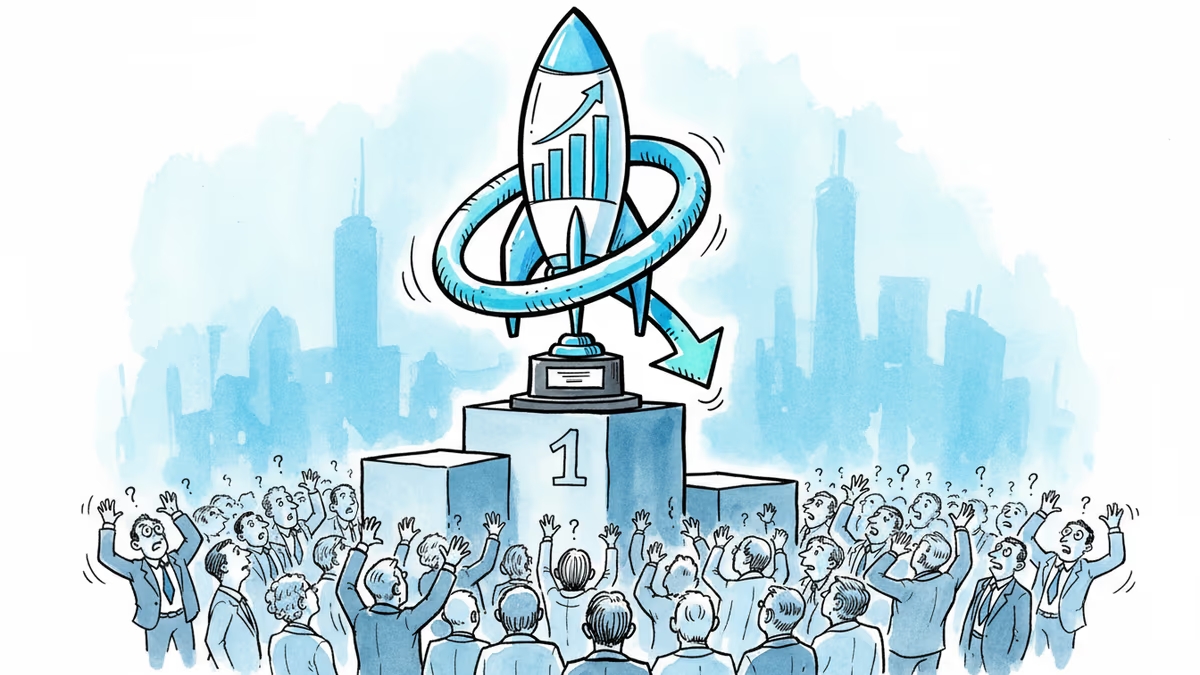
Nvidia posted 85% revenue growth and a $80B buyback. Its stock still dropped — for the fourth straight post-earnings quarter. Here's what that tells us about where AI investing stands right now.
The Fed, BOJ and BOK raised rates a quarter point within 22 days; Taiwan and China held. What each said, plus the impact on Korean borrowers and the won.
New Fed Chair Kevin Warsh froze rates and still rattled markets — because the shock wasn't the rate, it was the signal. Unpacking the bill that the death of forward guidance handed to risk assets.
Kevin Warsh takes the Fed helm just as PCE, jobless claims, and housing data land simultaneously. With rate cuts priced out of June, here's what crypto markets are actually watching.
Nvidia posted 85% revenue growth and a $80B buyback. Its stock still dropped — for the fourth straight post-earnings quarter. Here's what that tells us about where AI investing stands right now.
Thoughts
Share your thoughts on this article
Sign in to join the conversation