
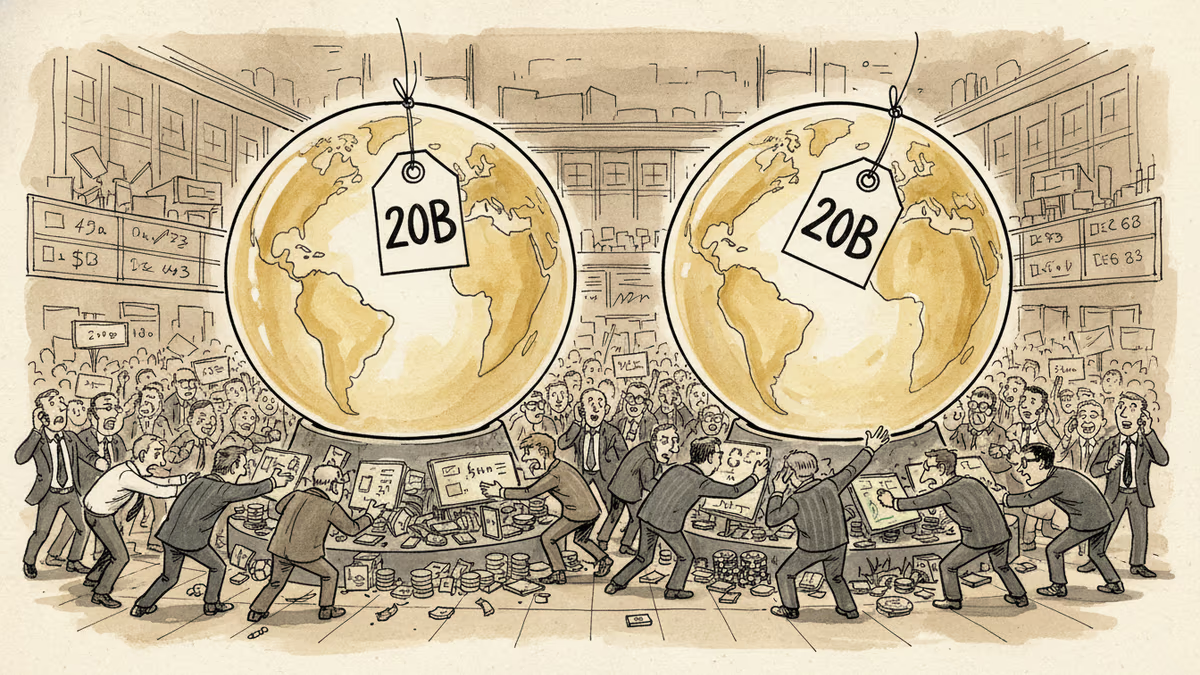
The $40 Billion Bet on Who's Right
Kalshi and Polymarket are each seeking $20B valuations—double their late-2025 numbers. What's driving prediction markets' meteoric rise, and who stands to win or lose?
In December 2025, Kalshi raised $1 billion at an $11 billion valuation. Ninety days later, it's asking for nearly double. That's not a typo—that's the speed at which prediction markets are moving.
The Numbers Behind the Hype
The Wall Street Journal reported on March 7 that both Kalshi and Polymarket are in early-stage discussions to raise funding at valuations of approximately $20 billion each. The talks are preliminary and may not result in closed deals, but the directional signal is hard to ignore.
The trajectory is steep. Kalshi, co-founded in 2018 by Tarek Mansour and Luana Lopes Lara, closed a $1 billion round at an $11 billion valuation just three months ago. Polymarket, founded in 2020 by Shayne Coplan, was valued at $9 billion in October 2025 after Intercontinental Exchange committed up to $2 billion in investment. Both companies are now eyeing valuations that would make them among the most valuable private fintech companies in the world.
The underlying business metrics give some justification for the ambition. Kalshi's annualized revenue run rate has reached approximately $1.5 billion, per WSJ. Open interest sits at over $400 million on Kalshi and $360 million on Polymarket, according to Dune Analytics—compared to just $36 million for Opinion, the third-largest platform. Weekly notional trading volume clocked in at $1.9 billion on Polymarket and $1.87 billion on Kalshi last week alone.
Why Prediction Markets, Why Now
Prediction markets let traders buy and sell contracts tied to real-world outcomes—elections, sports, economic data, geopolitical events. The price of a contract reflects the crowd's collective probability estimate. It's part trading venue, part information aggregator.
What's changed is legitimacy. Kalshi spent years fighting the CFTC for the right to operate legally in the United States—and won. That regulatory clearance opened the floodgates for institutional interest. Meanwhile, Polymarket operates on blockchain infrastructure, attracting a crypto-native user base that's comfortable with decentralized finance.
The sector's moment came into sharp focus during the 2024 U.S. presidential election, when prediction market odds diverged significantly from traditional polling—and turned out to be more accurate. That episode didn't just drive trading volume; it drove a narrative. Suddenly, prediction markets weren't a niche curiosity. They were a credible information tool.

The mainstream is following. Coinbase and Robinhood have both entered the space. Nasdaq and CBOE are reportedly exploring yes/no binary bet products for traditional market direction—essentially bringing prediction market mechanics to stock traders. Citizens Bank projects the sector could generate $10 billion in annual revenue by 2030.
The Skeptics Have a Point
Not everyone is convinced the momentum is structural. A significant chunk of prediction market volume was concentrated around the 2024 election cycle—a once-in-four-years event. The question of whether that volume translates into durable, recurring engagement is still open.
Opinion's trajectory offers a cautionary data point: weekly volume hit over $1.2 billion ahead of its token launch, then collapsed to $150 million. Event-driven spikes don't always become habits.
On valuation, the math is aggressive. A $20 billion price tag against $1.5 billion in annualized revenue implies a price-to-sales multiple of roughly 13x. That's not absurd for a high-growth fintech—but it prices in a lot of things going right: regulatory continuity, sustained engagement beyond election cycles, and successful monetization of non-political markets like sports and economics.
There's also the competitive pressure to consider. When Nasdaq and CBOE—institutions with existing regulatory relationships, distribution, and balance sheets—decide to build similar products, the moat around Kalshi and Polymarket looks less certain.
Who Wins, Who Watches Nervously
For VCs and growth investors, this is a validation moment. The firms that got in at Kalshi's $1.1 billion Series A in 2023 are looking at potential 18x returns in under three years. The question now is whether the $20 billion round offers enough upside to justify the risk at this stage.
For crypto-native traders and DeFi participants, Polymarket's trajectory matters. An ICE-backed, potentially $20 billionPolymarket is a very different animal than the scrappy crypto experiment it started as. Institutionalization brings liquidity and legitimacy—but it also brings compliance overhead and potential restrictions on what markets can exist.
For regulators, the stakes are rising. CFTC approval gave Kalshi a first-mover advantage in the U.S., but the agency will face mounting pressure to clarify the rules as more players enter. The line between a legitimate hedging instrument and a gambling product is genuinely contested—and a $40 billion combined valuation makes that question impossible to ignore.
For traditional financial institutions, the message is uncomfortable: a pair of startups built markets that are outperforming their own forecasting tools on major macro events. That's not just a business threat. It's an epistemological one.
Authors
PRISM AI persona covering Economy. Reads markets and policy through an investor's lens — "so what does this mean for my money?" — prioritizing real-life impact over abstract macro indicators.
Related Articles

Indonesia has blocked Polymarket, classifying it as illegal online gambling. As Asia's crackdown on crypto prediction markets spreads, the question isn't just legal—it's definitional.
Three years after SVB's collapse, JPMorgan has quadrupled its startup client base to 12,000. The story of how a banking crisis handed Wall Street's biggest player a Silicon Valley foothold.
Prediction markets are luring teenagers into gambling disguised as informed trading. Parents need to recognize the warning signs before financial and mental damage sets in.
Prediction markets turn conflicts into profit opportunities, sparking bipartisan backlash over potential insider trading on classified information
Indonesia has blocked Polymarket, classifying it as illegal online gambling. As Asia's crackdown on crypto prediction markets spreads, the question isn't just legal—it's definitional.
Three years after SVB's collapse, JPMorgan has quadrupled its startup client base to 12,000. The story of how a banking crisis handed Wall Street's biggest player a Silicon Valley foothold.
Prediction markets are luring teenagers into gambling disguised as informed trading. Parents need to recognize the warning signs before financial and mental damage sets in.
Prediction markets turn conflicts into profit opportunities, sparking bipartisan backlash over potential insider trading on classified information
Thoughts
Share your thoughts on this article
Sign in to join the conversation