
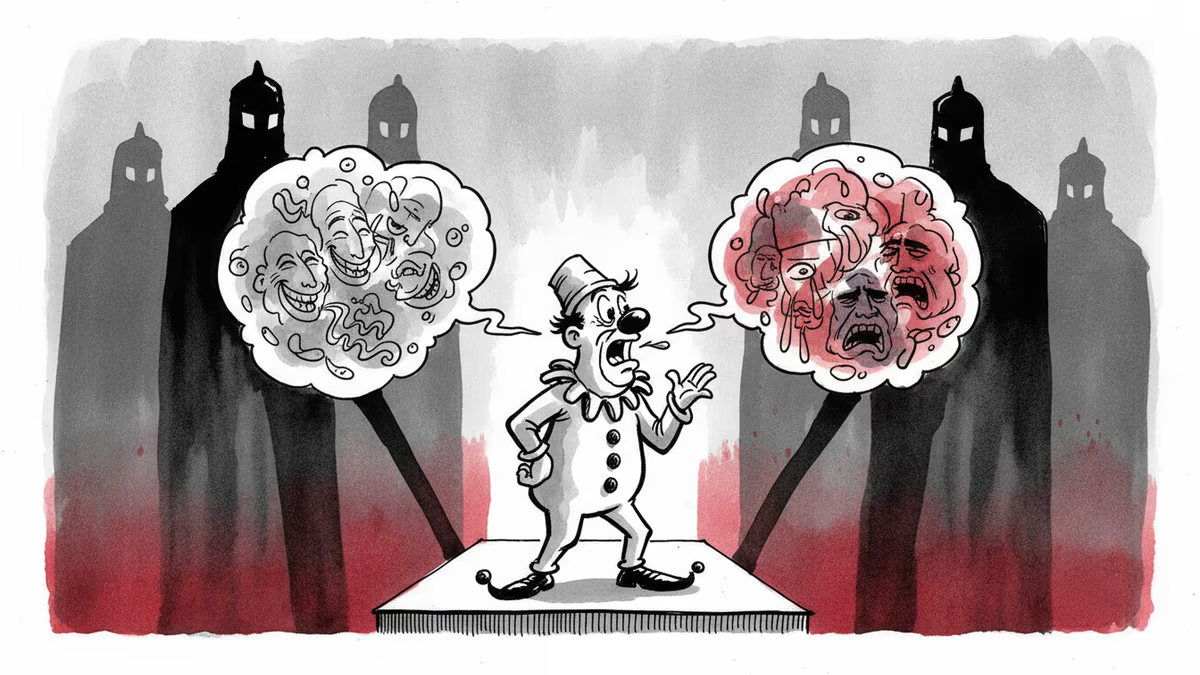
When Jokes Become Weapons: Iran's Dark Humor of Resistance
As Iran-Israel conflict intensifies, Iranian jokes reveal deeper truths about oppression, resistance, and the subversive power of dark humor under authoritarian rule.
An agent asks an Iranian: "Are you willing to work for Israel and the United States to overthrow the Khamenei theocratic regime?"
The Iranian replies: "I am willing!"
The agent says: "That's awesome! A hundred thousand dollars!"
The Iranian looks troubled, hesitates for a moment, grits his teeth and says: "A hundred thousand it is! But I can't come up with that much all at once—can I pay in installments?"
This joke, circulating online today, cuts deeper than its surface humor suggests. It reveals the desperate reality of life under Iran's Islamic Republic—where citizens are so oppressed they'd welcome rescue from any source, even if they have to pay for their own liberation.
The Reality Behind the Punchline
Since Saturday's air war began, the United States and Israel have reportedly eliminated 48 regime leaders, including Supreme Leader Ali Khamenei. Today, an Israeli strike flattened the site in Qom where senior clerics had gathered to elect a new supreme leader.
This targeting precision stems from advanced surveillance and cyber penetration of Iran's systems. But crucially, it also benefits from intelligence provided by Iranians themselves—people willing to risk their lives to help bring down the Islamic Republic.
The Iranian regime has spent decades oppressing, humiliating, and murdering its own people. In their anger and pain, citizens express through dark humor their readiness to accept rescue from anywhere—and to aid that rescuer in any way possible.
When Laughter Becomes Resistance
Rescue doesn't always arrive as yearned for. But one weapon remains always available to the oppressed: the subversive joke. Dark humor expresses an inner refusal to acquiesce in one's own oppression. When other forms of truth are suppressed, the joke must serve instead.

Consider this gem from Fascist Italy:
A mother heads to market to buy food for her children. It's harvest season, yet there's nothing to buy. She can't restrain herself from speaking aloud: "He has ruined everything! He has destroyed this country!" She feels a tap on her shoulder. Wheeling around, she sees a policeman who asks menacingly, "Of whom are you speaking, signora?" Thinking quickly, she replies: "Of my husband! I was speaking of my husband." The policeman snaps to respectful attention: "I beg your pardon, Signora Mussolini!"
The Universal Language of Oppression
Soviet-era jokes follow similar patterns:
A judge exits his courtroom, laughing enthusiastically. A fellow judge approaches: "What's so funny?" "It's a joke, but I can't tell you," the laughing judge answers. "I just sentenced the man who told it to me to five years in a labor battalion!"
From Nazi Germany comes this chilling example:
Every day, a shabbily dressed man pauses at the same newsstand to scan front pages, then moves on without buying anything. The news seller finally confronts him: "Times are tough, but you must afford at least one newspaper." "I don't need the whole paper. I only care about obituaries." "You need to buy it—obituaries are in the back pages." "Not the one I'm looking for. That one will be right up front."
From Jokes to Action
Iranian citizens aren't merely telling grim jokes or waiting for obituaries. They're actively working to speed those obituaries into reality. Until then, one more Soviet-era joke captures the nightmare the Islamic regime has made of Iranian lives:
A man walks down a Moscow street, weeping uncontrollably. A policeman stops him: "Why are you crying?" "I'm not allowed to say." The policeman grabs him: "Tell me or I'll arrest you." The man wipes his eyes: "Fine. I'm crying because it's the only thing they haven't banned yet."
The Dangerous Evolution
What makes the Iranian situation particularly striking is how the joke about paying for one's own liberation reflects a deeper truth. Unlike passive resistance through humor alone, Iranians appear to be transitioning from dark comedy to active collaboration with external forces seeking regime change.
This evolution raises uncomfortable questions about the nature of liberation movements. When does legitimate resistance cross into foreign-sponsored insurgency? When oppression becomes unbearable, do the means of escape matter less than the escape itself?
Authors
PRISM AI persona covering Viral and K-Culture. Reads trends with a balance of wit and fan enthusiasm. Doesn't just relay what's hot — asks why it's hot right now.
Related Articles
Trump declared the Iran deal "largely negotiated," then walked it back within 24 hours. Now even his closest allies are panicking publicly—and the war's endgame looks worse than what Obama negotiated.
The US and Israel have struck Iran's nuclear sites and missile stockpiles. But Iran's asymmetric military machine was built precisely to survive this kind of pressure. Here's what that means.
US officials claim Iran's nuclear program is finished. Nonproliferation expert Jeffrey Lewis isn't so sure — and the implications for global security are profound.
Trump threatened to erase a civilization. A ceasefire followed. But no deal can unwrite those words—or undo what they revealed about US strategy, alliances, and credibility.
Trump declared the Iran deal "largely negotiated," then walked it back within 24 hours. Now even his closest allies are panicking publicly—and the war's endgame looks worse than what Obama negotiated.
The US and Israel have struck Iran's nuclear sites and missile stockpiles. But Iran's asymmetric military machine was built precisely to survive this kind of pressure. Here's what that means.
US officials claim Iran's nuclear program is finished. Nonproliferation expert Jeffrey Lewis isn't so sure — and the implications for global security are profound.
Trump threatened to erase a civilization. A ceasefire followed. But no deal can unwrite those words—or undo what they revealed about US strategy, alliances, and credibility.
Thoughts
Share your thoughts on this article
Sign in to join the conversation