
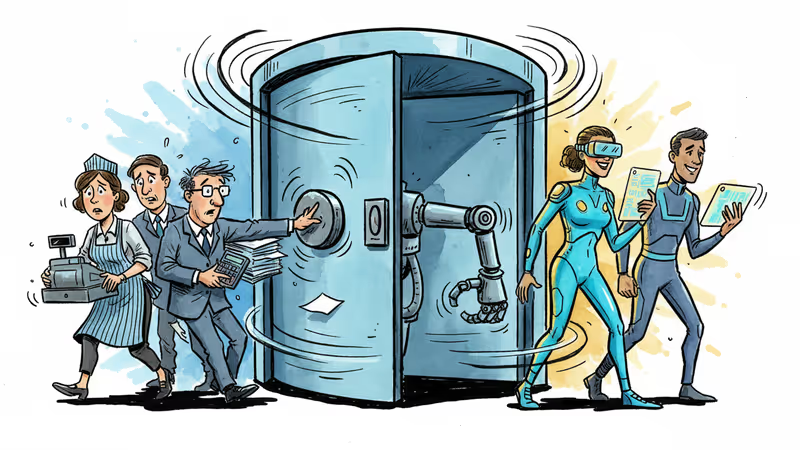
The AI Job Map: Roles Disappearing, Roles Rising
AI threatens 85 million jobs in 2025 but creates 170 million new ones. We map which roles are disappearing, which are rising, and AI adoption rates by industry.
Fear that AI will steal jobs is widespread, but the data tells a different story. In the first half of 2025 alone, 78,000 tech jobs were lost to AI. But in the same period, 119,900 new AI-related jobs were created. That's a net gain.
Disappearing Roles: Direct Hit from Automation
The hardest-hit sectors are clear. In retail, 65% of cashier jobs are expected to be automated by 2025. Walmart's self-checkout expansion could replace 8,000 positions, while Sam's Club's AI rollout is projected to eliminate 12,000 cashier jobs.
- Paralegals — 80% automation risk by 2026
- Medical Transcription — Already 99% automated
- Medical Coding — 40% automated by 2025
- Banking Operations — 70% automated by 2025, 54% of banking jobs at high risk
- Manufacturing — 2 million jobs lost by 2025
Rising Roles: New Opportunities in the AI Era

As AI eliminates jobs, it creates new ones. The AI job market is projected to grow at 38% annually from 2024 to 2030.
- AI/ML Engineers — Fastest-growing role in 2025
- Prompt Engineers — New profession: talking to AI
- AI Trainers — Training AI models
- AI Ethics Specialists — Managing AI bias and fairness
- Cybersecurity Experts — 32% growth 2022-2032
Data center construction alone created over 110,000 construction jobs in 2024. Data centers have a strong local multiplier effect, generating 3.5 additional jobs for every one job inside.
AI Adoption by Industry
| Industry | AI Adoption | Key Changes |
|---|---|---|
| Manufacturing | 77% | 7% YoY increase, 20M jobs replaced by 2030 |
| Finance | 73% | 70% of basic ops automated, 20%+ revenue gain |
| Healthcare | 36.8% CAGR | AI diagnostics, surgical assist, personalized treatment |
| Tech | 87%+ | Enterprise-led, avg $6.5M investment |
Who's Most Anxious
Workers aged 18-24 are 129% more likely than those over 65 to worry AI will make their job obsolete. Indeed, unemployment among 20-30 year-olds in tech has risen by 3 percentage points since the start of 2025. Paradoxically, the generation best equipped to work with AI is the most anxious.
Authors
Related Articles

Five stories from late September, traced to where the paper trail stops: Korea's export record, Nvidia's Hugging Face 8-K, a US-China AI channel, the UN on AI, and rising births.
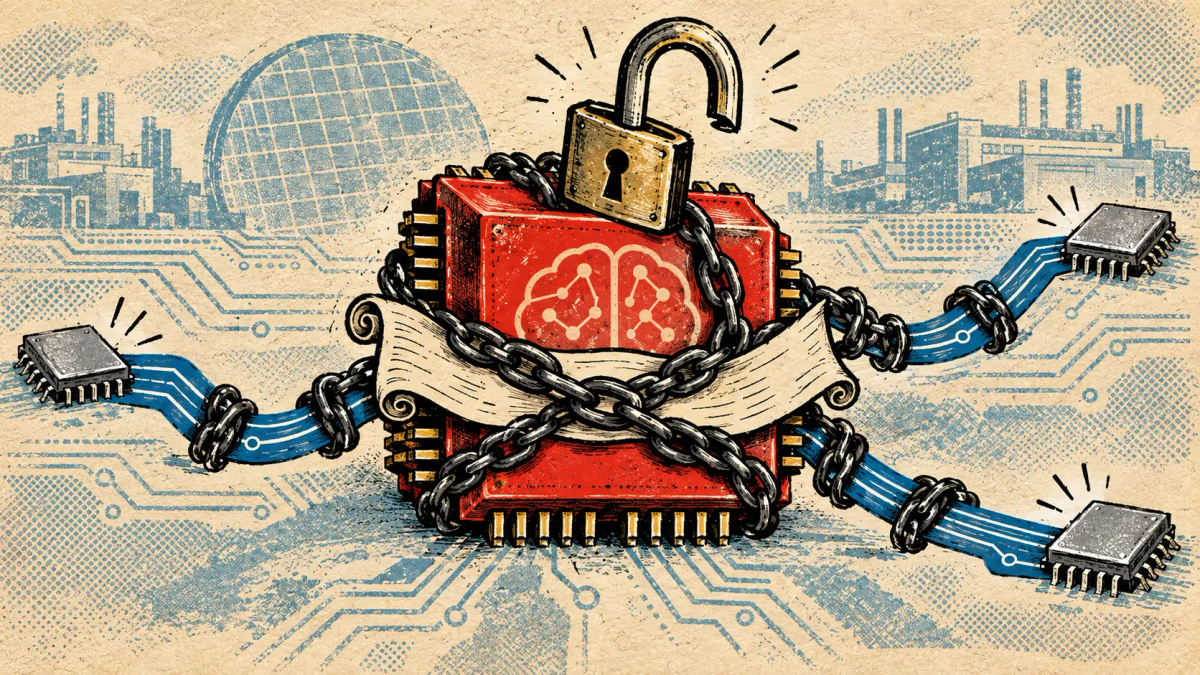
Huawei's CANN is open source under a license barring software for non-Ascend chips. Inside China's second CUDA, and the two links still outside it: pre-training compute and 5nm capacity.
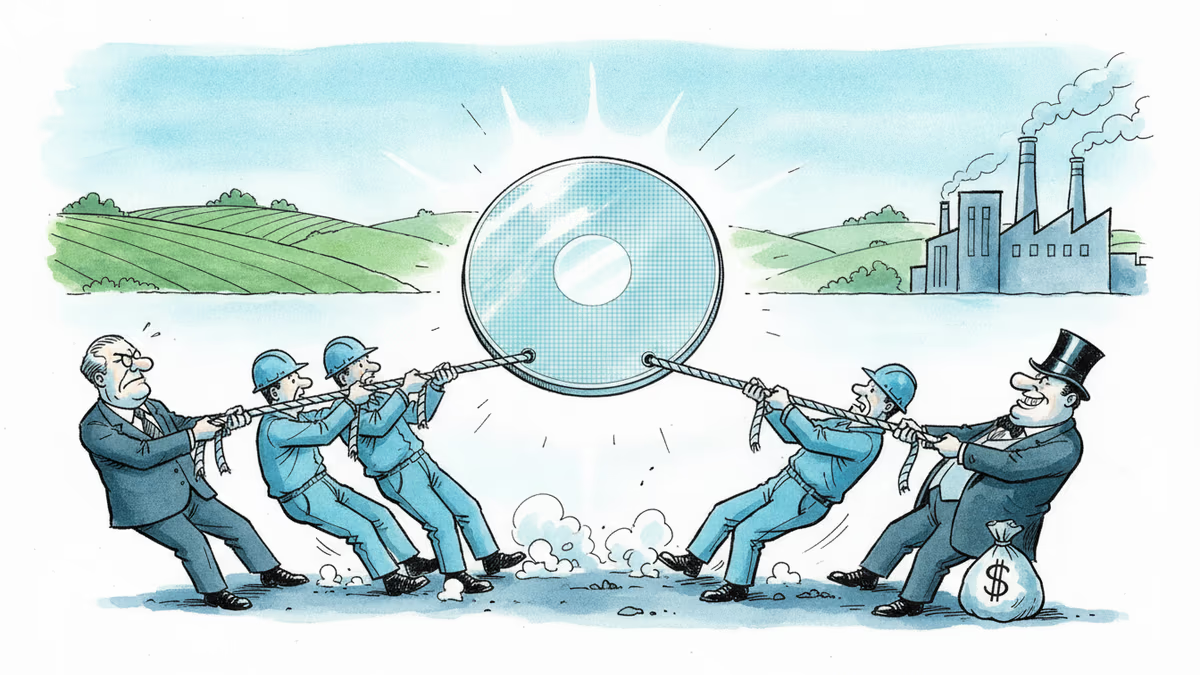
Samsung Electronics' union branch revealed that 84% of survey respondents oppose the government's roughly $290 billion (₩400 trillion) semiconductor megaproject in Gwangju. Government, management, the union and shareholders are all reading the same national project in sharply different ways.

Nvidia shipped roughly a billion RISC-V cores in 2024, then announced it would run CUDA on the open standard. We break down how royalty-free instruction sets and open software stacks are trying to route around CUDA's lock-in. Part 2 of the Semiconductor Sovereignty series.
Five stories from late September, traced to where the paper trail stops: Korea's export record, Nvidia's Hugging Face 8-K, a US-China AI channel, the UN on AI, and rising births.
Huawei's CANN is open source under a license barring software for non-Ascend chips. Inside China's second CUDA, and the two links still outside it: pre-training compute and 5nm capacity.
Samsung Electronics' union branch revealed that 84% of survey respondents oppose the government's roughly $290 billion (₩400 trillion) semiconductor megaproject in Gwangju. Government, management, the union and shareholders are all reading the same national project in sharply different ways.
Nvidia shipped roughly a billion RISC-V cores in 2024, then announced it would run CUDA on the open standard. We break down how royalty-free instruction sets and open software stacks are trying to route around CUDA's lock-in. Part 2 of the Semiconductor Sovereignty series.
Thoughts
Share your thoughts on this article
Sign in to join the conversation