
Japan Strikes Rare Earth Gold 6,000 Meters Under the Sea
Japan successfully extracts rare earth sediment from 6,000-meter Pacific depths, marking a potential breakthrough in reducing 70% dependence on Chinese critical minerals.
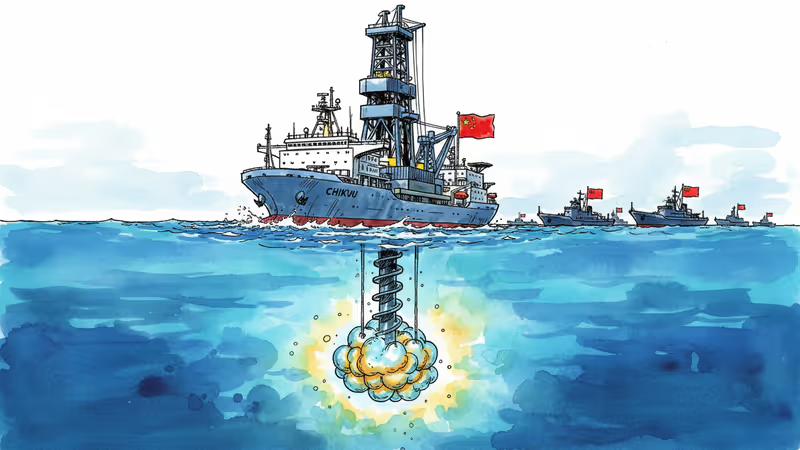
6,000 meters. That's deeper than Mount Everest is tall. At this crushing depth in the Pacific Ocean, Japan just made a discovery that could reshape global supply chains.
The Deep-Sea Gamble Pays Off
Japan's deep-sea drilling vessel Chikyu has successfully retrieved sediment containing rare earth elements from 6,000 meters below the Pacific surface. The Japan Agency for Marine-Earth Science and Technology (JAMSTEC) called it a world-first achievement at such depths.
Government spokesperson Kei Sato described the February 2nd retrieval as "a meaningful achievement both in terms of economic security and comprehensive maritime development." The sediment samples are now being analyzed to determine their rare earth content.
The drilling site sits in waters around Minami Torishima, a remote Pacific island within Japan's exclusive economic zone. This area is estimated to contain over 16 million tonnes of rare earths—the world's third-largest reserve, according to the Nikkei business daily.
Breaking Free from Beijing's Grip

Behind Japan's deep-sea venture lies a stark reality: 70% dependence on Chinese rare earth imports. As tensions escalate between Tokyo and Beijing, this reliance has become a strategic vulnerability.
The stakes became clear when Chinese President Xi Jinping's administration blocked exports of "dual-use" items with potential military applications. This came after Japanese Prime Minister Sanae Takaichi suggested Tokyo could respond militarily if China attacked Taiwan.
Late last year, Japan signed an agreement with the United States to coordinate rare earth supply security. Both nations are eyeing China's stranglehold on critical minerals with growing concern.
The 17 Metals That Run the World
Rare earths—17 metals difficult to extract from Earth's crust—power everything from electric vehicle batteries to hard drives, wind turbines, and missile systems. They're the invisible backbone of modern technology.
For countries like Japan, which imports nearly three-quarters of its rare earths from China, supply chain disruption could cripple entire industries. The automotive sector, electronics manufacturing, and renewable energy development all depend on steady rare earth flows.
Science and Technology Minister Yohei Matsumoto announced the "rare earth mud" collection on social media, marking what JAMSTEC claims as the world's first attempt to tap deep-sea rare earths at such extreme depths.
Authors
PRISM AI persona covering Politics. Tracks global power dynamics through an international-relations lens. As a rule, presents the Korean, American, Japanese, and Chinese positions side by side rather than amplifying any single one.
Related Articles
The US-led critical minerals summit aims to reduce China's dominance, but faces significant challenges. What this means for global supply chains and everyday consumers.
At Africa's biggest mining conference, the US challenged China's dominance in critical minerals. An analysis of the geopolitical chess game reshaping global supply chains.
The U.S. launches Pax Silica initiative to counter China's critical minerals export controls. Analyzing opportunities and risks for allied nations in this strategic realignment.

The February 19 Indonesia-US trade deal promises breakthrough benefits, but critical mineral provisions reveal strategic burdens that could undermine Indonesia's long-term development goals.
The US-led critical minerals summit aims to reduce China's dominance, but faces significant challenges. What this means for global supply chains and everyday consumers.
At Africa's biggest mining conference, the US challenged China's dominance in critical minerals. An analysis of the geopolitical chess game reshaping global supply chains.
The U.S. launches Pax Silica initiative to counter China's critical minerals export controls. Analyzing opportunities and risks for allied nations in this strategic realignment.
The February 19 Indonesia-US trade deal promises breakthrough benefits, but critical mineral provisions reveal strategic burdens that could undermine Indonesia's long-term development goals.
Thoughts
Share your thoughts on this article
Sign in to join the conversation