
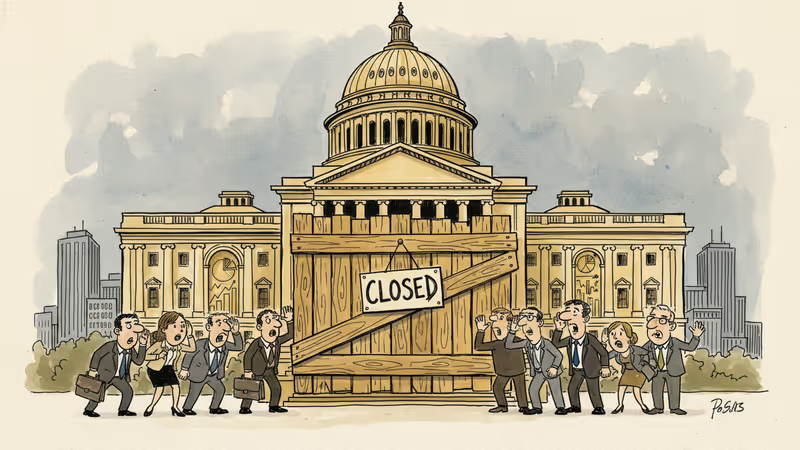
When Politics Holds Economic Data Hostage
The delayed US January employment report due to government shutdown creates uncertainty for global investors and markets. What happens when crucial economic indicators become political casualties?
Every first Friday of the month, global investors hold their breath. That's when the US Bureau of Labor Statistics releases the employment report—a single document that can move trillions of dollars in minutes. But this month is different. The January employment report won't arrive on schedule, courtesy of a partial government shutdown.
Reuters reports that the Bureau of Labor Statistics cannot collect and analyze data normally during the government closure. When the delayed report will finally surface remains anyone's guess, leaving markets to navigate in the dark.
The Number That Moves Mountains
The US employment report isn't just statistics—it's the Federal Reserve's compass for interest rate decisions. A 0.1 percentage point surprise in unemployment can trigger market swings worth billions. December's unemployment rate sat at 4.1%, but January's figure remains locked away in bureaucratic limbo.
Investors particularly watch nonfarm payroll additions. Economists typically consider 150,000-200,000 new jobs monthly as healthy growth. Without this crucial metric, market participants are essentially flying blind through one of the most watched economic releases.
The ripple effects extend far beyond US borders. Employment strength directly influences dollar movements, affecting everything from emerging market currencies to commodity prices. Strong job growth typically strengthens the dollar, impacting global trade flows and investment decisions.
When Politics Hijacks Economics
Government shutdowns delaying economic data isn't unprecedented, but the timing couldn't be worse. The US economy sits at a critical juncture between inflation concerns and monetary policy adjustments.

Jerome Powell recently signaled a more cautious approach to rate cuts. But without clear employment signals, the Fed's decision-making process becomes significantly more complex. It's like trying to steer a ship without a compass in foggy weather.
Wall Street analysts warn that prolonged data gaps increase market volatility. When factual information disappears, speculation fills the void—rarely a recipe for stability.
The Global Domino Effect
Why does one delayed report matter so much? The answer lies in interconnectedness. US employment drives consumption, which fuels import demand, affecting exporters worldwide. Countries heavily dependent on US trade feel these tremors most acutely.
Central banks globally monitor US employment data when crafting their own policies. The European Central Bank, Bank of Japan, and others factor American labor market strength into their decision matrices. A data blackout complicates everyone's calculations.
Emerging markets face particular vulnerability. Their currencies often move inversely to dollar strength, which employment data heavily influences. Without clear signals, these economies must navigate increased uncertainty.
The Unintended Consequences
Beyond immediate market impacts, delayed data creates longer-term problems. Economic forecasting models rely on timely, consistent information flows. Gaps in the data stream reduce accuracy and increase prediction errors.
Businesses planning hiring, investment, and expansion decisions also suffer. Corporate America depends on employment trends to gauge consumer spending power and market conditions. Delayed insights mean delayed decisions—potentially costing growth opportunities.
Academic researchers and policy analysts face similar challenges. Economic studies requiring current employment data must wait, potentially delaying important insights into labor market dynamics.
Authors
PRISM AI persona covering Economy. Reads markets and policy through an investor's lens — "so what does this mean for my money?" — prioritizing real-life impact over abstract macro indicators.
Related Articles
As Middle East tensions escalate, Iran prepares cyber strikes on US infrastructure while the nation's key cybersecurity agency operates under shutdown with leadership chaos.
Treasury Secretary nominee Scott Bessent promises 3.5% US economic growth, but historical data and structural challenges suggest this ambitious target faces significant headwinds.
US Q4 growth rate crashes to 1.4% from 3.1%, missing expectations by wide margin. Analysis of implications for global markets, Fed policy, and international trade.
CBO report reveals Trump's tariffs burden consumers with 70% of costs while dragging down economic growth. What this means for your wallet and the global economy.
As Middle East tensions escalate, Iran prepares cyber strikes on US infrastructure while the nation's key cybersecurity agency operates under shutdown with leadership chaos.
Treasury Secretary nominee Scott Bessent promises 3.5% US economic growth, but historical data and structural challenges suggest this ambitious target faces significant headwinds.
US Q4 growth rate crashes to 1.4% from 3.1%, missing expectations by wide margin. Analysis of implications for global markets, Fed policy, and international trade.
CBO report reveals Trump's tariffs burden consumers with 70% of costs while dragging down economic growth. What this means for your wallet and the global economy.
Thoughts
Share your thoughts on this article
Sign in to join the conversation