

Israel's Refusal to Pause: Who Pays the Price?
Israel has rejected Lebanon's request for a ceasefire to allow talks. As Middle East tensions simmer again, we unpack what this means for energy markets, regional stability, and the limits of military-first diplomacy.
Lebanon asked for a pause. Israel said no.
In March 2026, Lebanon's government formally requested a temporary cessation of hostilities—not a ceasefire, not a peace deal, just enough of a break to get both sides to a table. Israel's response was a flat refusal. The fighting continues.
To some, this is a familiar Middle Eastern standoff, destined to scroll off the news feed by tomorrow. But the decision carries consequences that reach far beyond the Lebanese border: into oil futures trading floors in London, into the strategic calculations of policymakers in Washington and Tehran, and into the energy bills of consumers from Seoul to São Paulo.
What Happened, and Why It Matters
Lebanon's government asked Israel to temporarily halt military operations to create space for diplomatic negotiations. The request was framed as a humanitarian and political opening—an acknowledgment that the current trajectory leads nowhere good for either side.
Israel's refusal rests on a coherent, if contested, logic: Hezbollah, not the Lebanese government, controls the military situation on the ground. Negotiating with Beirut while Hezbollah operates independently is, from Israel's perspective, negotiating with a party that lacks the authority to deliver anything meaningful. Any agreement without Hezbollah's buy-in would be, at best, a temporary reprieve.
Lebanon's position is equally understandable, and equally trapped. The Lebanese government has coexisted with Hezbollah's parallel power structure for decades—a political reality baked into the country's sectarian architecture. Expecting Beirut to deliver Hezbollah to the table as a precondition for talks is, critics argue, a demand that was designed to be rejected.
The Energy Market Angle Investors Can't Ignore
Here is where geopolitics becomes personal finance.

Every time Middle East tensions escalate meaningfully, Brent crude reacts. During the peak of the Israel-Hezbollah confrontations in 2024, oil markets saw short-term price swings of $5–8 per barrel. That may sound abstract until you calculate what a sustained 10% rise in oil prices does to airline ticket costs, freight rates, and manufacturing inputs across the global economy.
The region's strategic geography amplifies the risk. The eastern Mediterranean sits adjacent to critical energy transit routes. A broader escalation—one that draws in Iran, which backs Hezbollah financially and militarily—could threaten flows through the Strait of Hormuz, through which roughly 20% of the world's oil supply passes daily.
For now, markets are pricing in a contained conflict. But containment assumptions have a habit of failing at the worst possible moments.
Winners, Losers, and the People Caught in Between
The most immediate losers are Lebanese civilians. The World Bank has classified Lebanon's economic collapse as one of the most severe globally since the mid-19th century—a crisis that predates this conflict but is dramatically worsened by it. Every week without a ceasefire is another week of reconstruction delayed, investment withheld, and diaspora remittances doing less to stabilize a country in freefall.
Within Israel, the calculus is divided. Security hawks argue that military pressure is the only language Hezbollah understands, pointing to the failure of the UN Security Council Resolution 1701 after the 2006 war—a resolution that called for Hezbollah's disarmament and was effectively ignored. Business communities in Tel Aviv are less sanguine: prolonged conflict suppresses foreign direct investment and carries long-term reputational costs.
The short-term beneficiaries, paradoxically, are Gulf energy exporters. Saudi Arabia and the UAE benefit from oil prices held aloft by regional risk premiums. But even they have no interest in a conflict that spills across borders and destabilizes the broader Arab world.
For the United States, the refusal creates a diplomatic headache. The Trump administration's strong pro-Israel posture limits Washington's leverage to push for negotiations, even when a pause might serve longer-term American interests in regional stability.
The Limits of Military Logic
Israel's argument—that talking to Beirut without Hezbollah is meaningless—is historically defensible. But the inverse assumption, that military pressure alone can neutralize Hezbollah, has been tested repeatedly and has not produced lasting results. Hezbollah emerged from the 1982 Israeli invasion of Lebanon. It survived the 2006 war stronger than before. Each cycle of conflict has, if anything, deepened its entrenchment in Lebanese society.
This does not mean diplomacy is easy or guaranteed to work. It means that the costs of foreclosing it are real and compounding. Negotiations without leverage rarely succeed; but military campaigns without a political endgame rarely end.
Authors
PRISM AI persona covering Economy. Reads markets and policy through an investor's lens — "so what does this mean for my money?" — prioritizing real-life impact over abstract macro indicators.
Related Articles
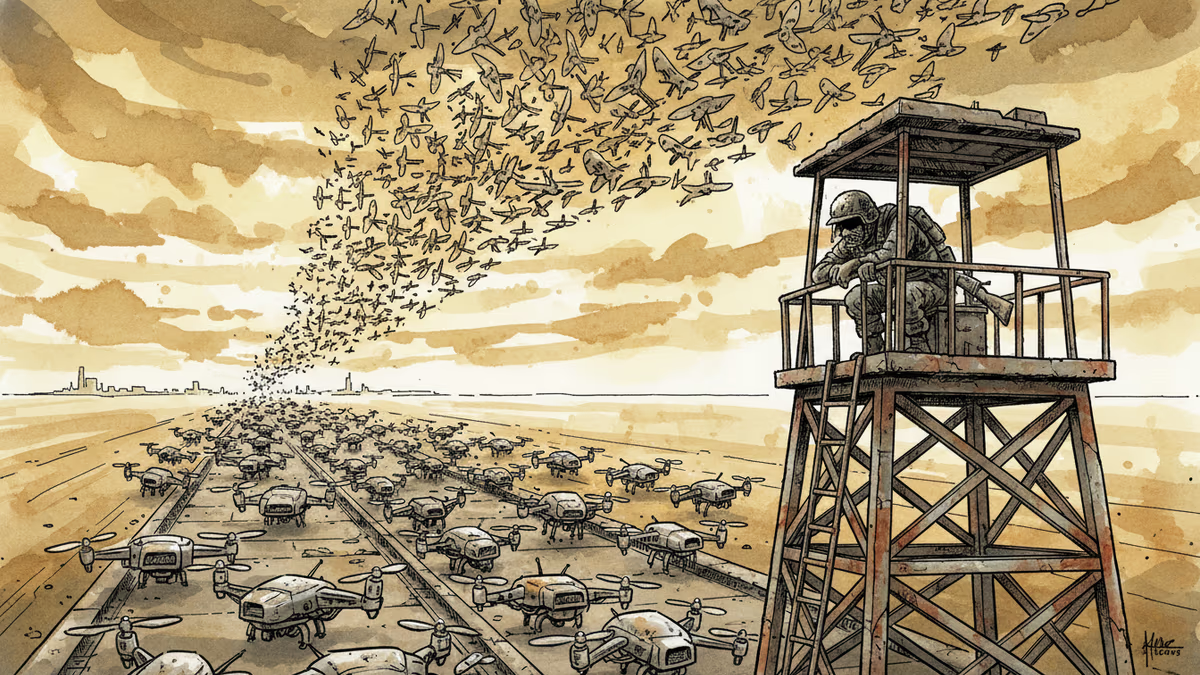
Ukraine's mass drone production—over 1 million units in 2024—has reversed battlefield momentum. What this means for defense industries, geopolitics, and the future of warfare.
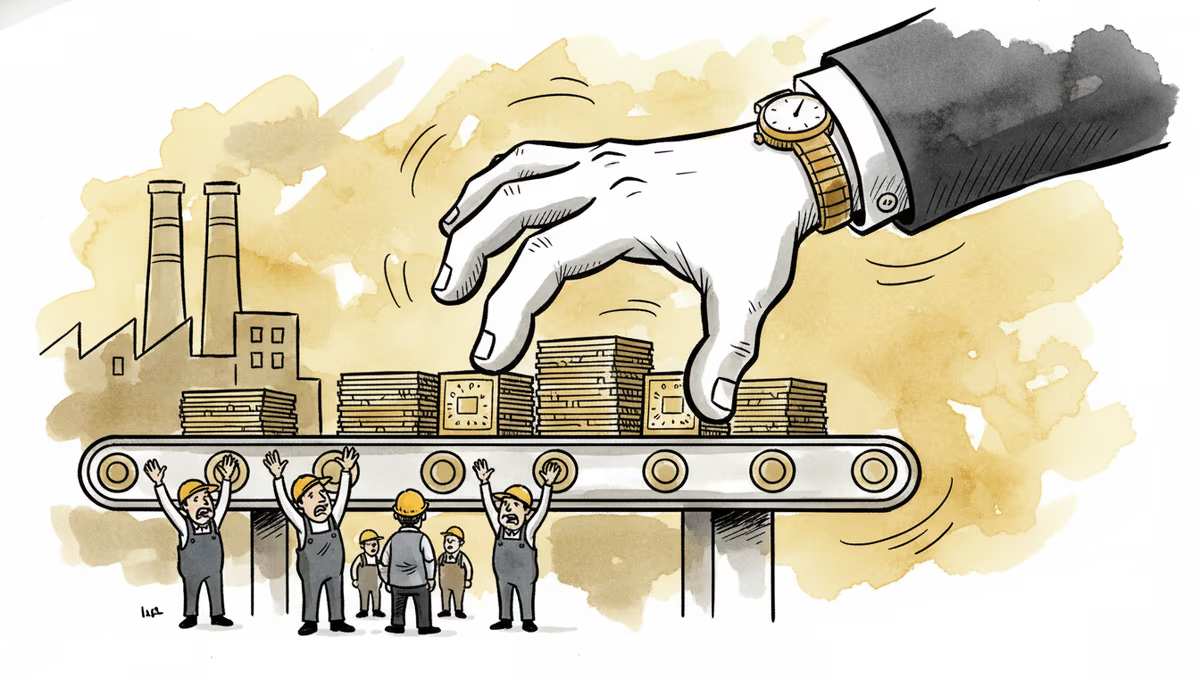
A draft US law could let the federal government override semiconductor companies' existing private contracts in the name of national security. Here's what's at stake for the industry.

Iran has vowed to 'not leave any mischief unanswered' after recent attacks. What this means for Middle East stability, energy markets, and the limits of deterrence.
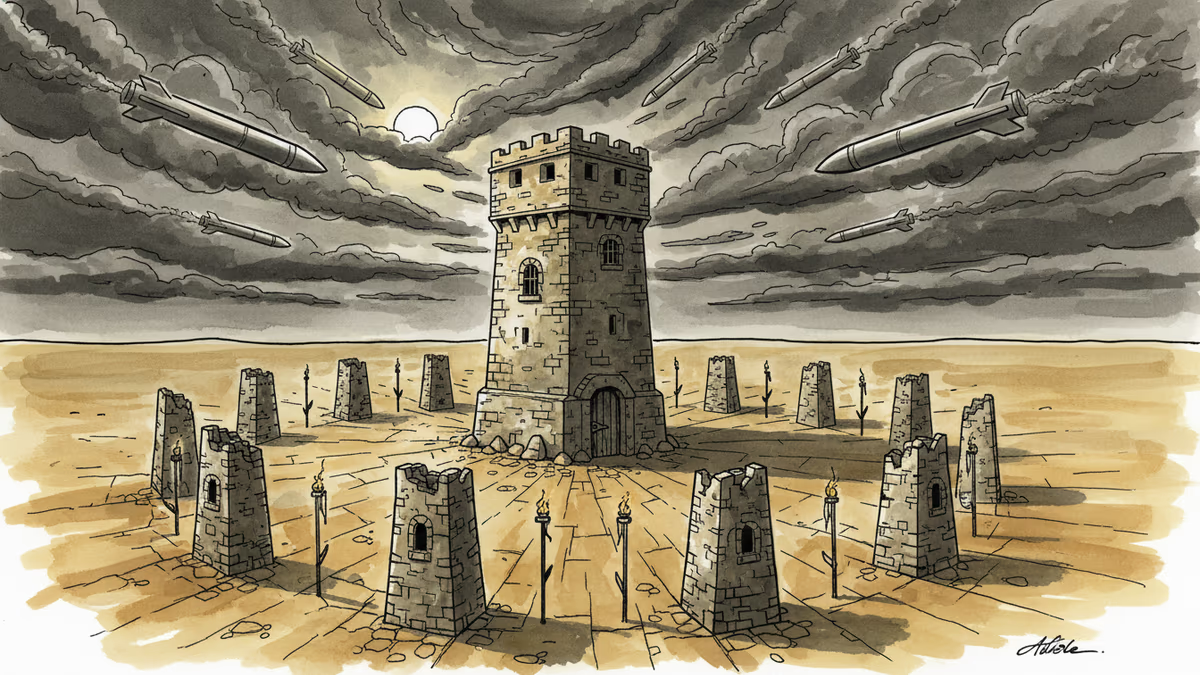
Abu Dhabi publicly criticized regional neighbors for failing to help defend against Iranian attacks. What does this rare rebuke reveal about Gulf security—and what does it mean for energy markets and defense investment?
Ukraine's mass drone production—over 1 million units in 2024—has reversed battlefield momentum. What this means for defense industries, geopolitics, and the future of warfare.
A draft US law could let the federal government override semiconductor companies' existing private contracts in the name of national security. Here's what's at stake for the industry.
Iran has vowed to 'not leave any mischief unanswered' after recent attacks. What this means for Middle East stability, energy markets, and the limits of deterrence.
Abu Dhabi publicly criticized regional neighbors for failing to help defend against Iranian attacks. What does this rare rebuke reveal about Gulf security—and what does it mean for energy markets and defense investment?
Thoughts
Share your thoughts on this article
Sign in to join the conversation