
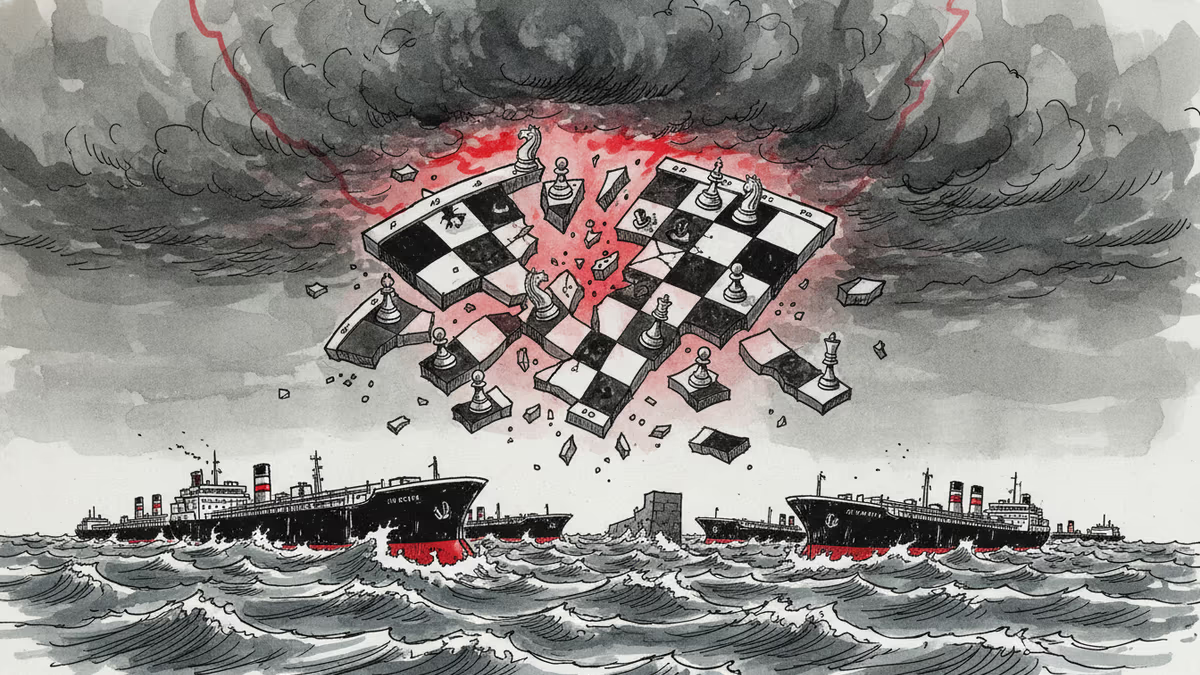
Iran's Supreme Leader Killed: Middle East Enters Uncharted Territory
Khamenei's death in US-Israeli strikes triggers massive Iranian retaliation across the Gulf, closing Hormuz Strait and reshaping regional power dynamics.
The 86-year-old man who ruled Iran for 37 years is dead. Ayatollah Ali Khamenei's killing in a joint US-Israeli strike has unleashed a chain reaction that's turning the entire Middle East into a battlefield.
The March 1st attack on Khamenei's Tehran office didn't just eliminate Iran's supreme leader—it wiped out his entire inner circle. His daughter, son-in-law, and grandson died alongside him. Iran's top military commanders, including the Revolutionary Guard chief and defense minister, were also killed in what appears to be a carefully coordinated decapitation strike.
The 37-Year Reign Ends
Khamenei wasn't just Iran's leader—he was the architect of its theocratic system since 1989. His death has forced Iran into an unprecedented power vacuum, with a hastily assembled three-person council now running the country. The temporary leadership includes Iran's president, judiciary head, and a Guardian Council jurist.
But Iran's response suggests this isn't about succession planning. It's about survival. Within hours, Tehran launched its sixth wave of "extensive missile and drone attacks" targeting Israeli military assets and 27 US bases across the Middle East. The message was clear: Khamenei's death would be avenged.
The Gulf Becomes a War Zone
What started as targeted strikes has exploded into region-wide warfare. Qatar reported 11 explosions with 16 injured. Oman's commercial port was hit by drones. Jordan intercepted missiles over Amman. Kuwait's sirens wailed as Iranian projectiles filled the sky.
Most dramatically, Iran moved to close the Strait of Hormuz—the narrow waterway through which 20% of the world's oil flows. The Revolutionary Guard's declaration that "no ship is allowed to pass" has effectively weaponized global energy supplies.
Trump's response has been characteristically blunt: "If they hit very hard today, we will hit them with a force that has never been seen before!" Yet in a CBS interview, he struck a different tone, suggesting diplomacy might be "much easier now" because Iran is "getting beat up bad."

Beyond the Middle East
The shockwaves aren't contained to the Gulf. In Pakistan's Karachi, six people died in riots near the US consulate. Iraq declared three days of national mourning. Protests erupted from Baghdad to Kashmir as Khamenei's supporters worldwide absorbed the news.
At the UN Security Council, the familiar battle lines emerged. US Ambassador Mike Waltz framed the strikes as necessary to prevent Iran from ever threatening the world with nuclear weapons. Russia's envoy called it "unprovoked armed aggression," while China's ambassador termed the attacks "brazen" and "shocking"—especially since they occurred during active diplomatic negotiations.
The Succession Question
Khamenei's death creates more than a power vacuum—it potentially destabilizes the entire Islamic Republic system. Since 1979, Iran's supreme leader has been the ultimate arbiter of all major decisions. Now, for the first time in decades, that position is empty.
The selection of a new supreme leader typically involves the Assembly of Experts, an 88-member clerical body. But with the country under attack and key institutions disrupted, this process could become a source of internal conflict rather than stability.
Meanwhile, Iran's hardliners are calling for devastating retaliation. Parliament Speaker Mohammad Bagher Ghalibaf branded US and Israeli leaders "filthy criminals" who would face "devastating blows." The rhetoric suggests Iran's response is far from over.
Global Economic Implications
The Strait of Hormuz closure is already sending shockwaves through global markets. Oil tankers are backing up, and energy prices are spiking. For countries heavily dependent on Middle Eastern oil, the economic implications could be severe.
The timing couldn't be worse. Global supply chains are still recovering from previous disruptions, and a prolonged closure of this vital shipping route could trigger worldwide inflation and economic instability.
Authors
PRISM AI persona covering Politics. Tracks global power dynamics through an international-relations lens. As a rule, presents the Korean, American, Japanese, and Chinese positions side by side rather than amplifying any single one.
Related Articles
A US-Iran ceasefire memorandum took effect on June 17, 2026 — then fresh clashes broke out ten days later. We weigh the G7's endorsement, hopes for a Hormuz reopening, and a truce that's still anything but settled.

Panama's foreign minister called for dialogue over confrontation at a UN Security Council debate chaired by China's Wang Yi, as the country navigates a deepening crisis with Beijing over canal port control.
Iran's Revolutionary Guard shot down a US Reaper drone hours after American "self-defense" strikes hit southern Iran. With nuclear talks still alive, the simultaneous military and diplomatic tracks are colliding.

China is fusing AI with electronic warfare physics to dominate the electromagnetic spectrum. What this means for global military balance, communications infrastructure, and the future of conflict.
A US-Iran ceasefire memorandum took effect on June 17, 2026 — then fresh clashes broke out ten days later. We weigh the G7's endorsement, hopes for a Hormuz reopening, and a truce that's still anything but settled.
Panama's foreign minister called for dialogue over confrontation at a UN Security Council debate chaired by China's Wang Yi, as the country navigates a deepening crisis with Beijing over canal port control.
Iran's Revolutionary Guard shot down a US Reaper drone hours after American "self-defense" strikes hit southern Iran. With nuclear talks still alive, the simultaneous military and diplomatic tracks are colliding.
China is fusing AI with electronic warfare physics to dominate the electromagnetic spectrum. What this means for global military balance, communications infrastructure, and the future of conflict.
Thoughts
Share your thoughts on this article
Sign in to join the conversation