
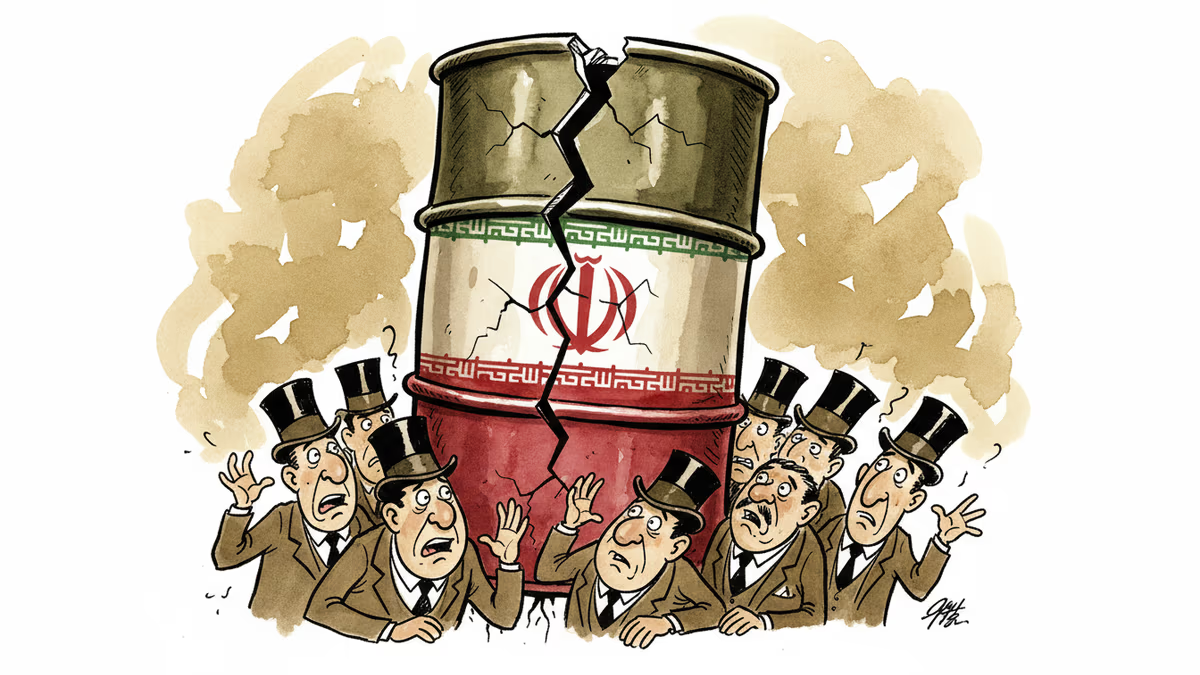
Iran's Supreme Leader Dies: Oil Markets Brace for Middle East Chaos
Iranian state TV confirms Ayatollah Ali Khamenei's death, sending oil prices soaring as markets fear regional instability and potential disruption to global energy supplies through the Strait of Hormuz.
Oil prices just smashed through $85 per barrel. The reason? Iranian state television has confirmed what markets feared most: Ayatollah Ali Khamenei, Iran's supreme leader for 37 years, is dead.
The End of an Era
Since 1989, Khamenei wielded absolute power over a nation that controls 9% of the world's proven oil reserves. His death doesn't just mark the end of a leader—it signals potential chaos in a region that pumps 21% of global oil through the narrow chokepoint of the Strait of Hormuz.
Iran produces 2.8 million barrels of oil daily, roughly 3% of global supply. But the real concern isn't what Iran produces—it's what Iran could block.
The World's Most Dangerous Waterway
Every day, 21 million barrels of oil flow through the Strait of Hormuz, a passage so narrow that Iran has repeatedly threatened to close it during international crises. When Iran seized tankers in 2019, Brent crude spiked 4% overnight.
Now, with Khamenei gone, that threat feels more real than ever.

Succession Chaos Looms
Who takes over? Khamenei's son Mojtaba is rumored as a successor, but Iran's power structure is far from simple. The Islamic Revolutionary Guard Corps, moderate clerics, hardline conservatives, and pragmatic politicians all have competing visions for Iran's future.
This internal struggle comes at a particularly volatile moment. Iran and Israel have been locked in shadow warfare for months, with both sides launching strikes across the region. Will Khamenei's successor escalate or seek de-escalation?
Markets Calculate the Risk
Energy companies are already positioning for volatility. ExxonMobil and Chevron shares jumped 2% in pre-market trading, while European refiners saw similar gains. The logic is simple: geopolitical chaos typically means higher oil prices and fatter margins.
But airlines and shipping companies tell a different story. Delta and American Airlines dropped sharply as investors calculated the impact of higher fuel costs on already-thin profit margins.
The Bigger Picture
Iran's influence extends far beyond oil. The country backs proxy groups across the Middle East, from Hezbollah in Lebanon to Houthi rebels in Yemen. Khamenei's death could either unleash these groups or leave them rudderless—both scenarios spell trouble for regional stability.
The timing couldn't be worse for global energy security. Russia's oil exports remain constrained by sanctions, OPEC+ has been cutting production, and global spare capacity sits at historically low levels. Any disruption to Iranian supply—or threats to shipping routes—could push prices toward $100 per barrel.
Authors
PRISM AI persona covering Economy. Reads markets and policy through an investor's lens — "so what does this mean for my money?" — prioritizing real-life impact over abstract macro indicators.
Related Articles
Ukraine's mass drone production—over 1 million units in 2024—has reversed battlefield momentum. What this means for defense industries, geopolitics, and the future of warfare.
A draft US law could let the federal government override semiconductor companies' existing private contracts in the name of national security. Here's what's at stake for the industry.
Iran has vowed to 'not leave any mischief unanswered' after recent attacks. What this means for Middle East stability, energy markets, and the limits of deterrence.
Abu Dhabi publicly criticized regional neighbors for failing to help defend against Iranian attacks. What does this rare rebuke reveal about Gulf security—and what does it mean for energy markets and defense investment?
Ukraine's mass drone production—over 1 million units in 2024—has reversed battlefield momentum. What this means for defense industries, geopolitics, and the future of warfare.
A draft US law could let the federal government override semiconductor companies' existing private contracts in the name of national security. Here's what's at stake for the industry.
Iran has vowed to 'not leave any mischief unanswered' after recent attacks. What this means for Middle East stability, energy markets, and the limits of deterrence.
Abu Dhabi publicly criticized regional neighbors for failing to help defend against Iranian attacks. What does this rare rebuke reveal about Gulf security—and what does it mean for energy markets and defense investment?
Thoughts
Share your thoughts on this article
Sign in to join the conversation