
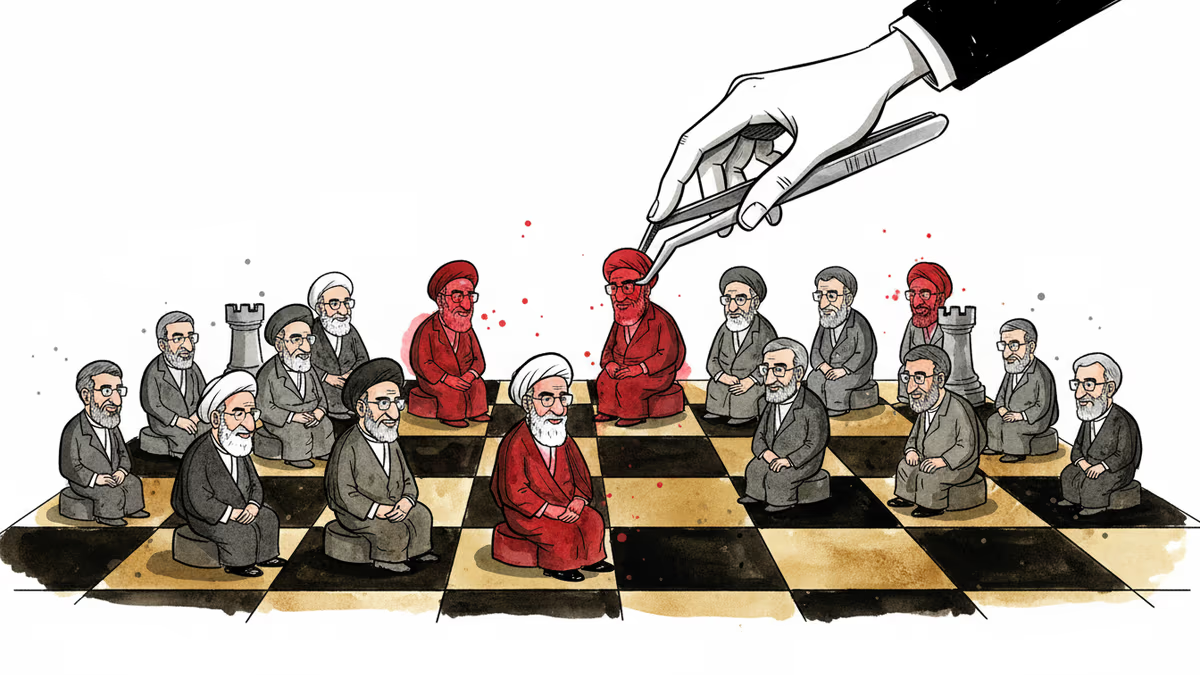
The Iranian Exile's Plan: 10 Deaths, Not Total War
A former regime insider proposes eliminating just 10 key figures to topple Iran's government. Is this third option between bombing and waiting viable?
While Washington debates whether to bomb Iran into oblivion or let the 86-year-old cancer-surviving Supreme Leader Ali Khamenei die naturally, an Iranian exile in a Dubai villa offers a third option: eliminate just 10 people.
Jaber Rajabi, despite being only 40, bears the scars of multiple assassination attempts. A sniper's bullet carved across his skull in Iraq's Samarra in 2017, leaving his head feeling like "a boiled egg tapped with a spoon." A recent poisoning rotted his teeth, forcing him to get artificial replacements. Yet this battle-scarred man spent two decades loyally serving the very regime he now wants to topple.
From True Believer to Regime Enemy
Rajabi's disillusionment began in management. After fighting Americans in Iraq's militias and recovering in Tehran's Revolutionary Guard hospital, he met Qassem Soleimani personally. The architect of Iran's "Axis of Resistance" gave him $25,000 and a Nissan Maxima to liaison with Iraqi militias.
But as Rajabi rose through the ranks, the truth emerged: "Iran didn't want to turn Iraq into a Shiite theocracy. Iraq was just a tool for IRGC leaders to make money through smuggling and black marketeering." The militias were meant to bicker forever, keeping Iraq weak enough never to challenge Iran's regional supremacy.
After serving as a foreign policy adviser to President Mahmoud Ahmadinejad, Rajabi watched his boss get purged by hard-liners for becoming too independent. The assassination attempts on Rajabi began after he accused IRGC leaders of corruption—including a Looney Tunes-style electrified door handle that failed for technical reasons.
Why the Shah's Son Won't Work
While Iranian protesters chant Reza Pahlavi's name, Rajabi dismisses the Washington-based heir: "You want to remove a dictator and replace him with another?" Danny Citrinowicz, who led Iran analysis for Israeli Defense Intelligence, agrees that Pahlavi has "zero influence on the ground."
The problem isn't just legitimacy—it's practicality. "Without a replacement government, the result of an attack could be civil war," Citrinowicz warns. "There are bad options and worse options right now."
The Surgical Strike Strategy

Rajabi's plan sounds almost modest: eliminate 10 key figures including Khamenei and his son Mojtaba, then sideline 2,700 mid-level officials with amnesty rather than trials. "We would need to move against these on the first night," he explains. "Without the leaders, these ones would not be able to move their feet."
He claims his network has already infiltrated deep into Iran's government—50 parliamentarians and security officials at every level. They've categorized every regime payroll member into three groups: those who can work with a new government, those who need retirement, and those who must die.
The goal? Avoid Iraq's post-invasion chaos when the military was disbanded and millions had nothing to lose. "Even the ones who were killers—we will say: 'Go home.'" No Nuremberg trials, just early retirement with benefits.
The Mojtaba Problem
Rajabi's urgency stems partly from his study partner in Qom: Mojtaba Khamenei, the Supreme Leader's son and likely successor. "He thinks there are milestones on the path to the end of the world, and he himself will have a special part in hastening humanity down that path."
Unlike his pragmatic father, who bends to survive, Mojtaba is "calculating and ideological, willing to cause terrible destruction just to prove a point." Rajabi describes apocalyptic corkboards and diagrams mapping prophecy to current events in Mojtaba's house near Jamkaran mosque.
"Mojtaba is more dangerous than 50 nuclear bombs," Rajabi insists. "He is willing to kill 13,000 Iranians. Why would he hesitate to kill 100,000 people in Tel Aviv?"
The China Factor
Time isn't on the regime's enemies' side, Rajabi argues. Russia and China are watching to see if Iran is worth salvaging as an ally. "If the regime endures, they will not only support it but call in favors—military bases along the Persian Gulf, possibly even transformation into a vassal state like Assad's Syria."
The regime is "using time to restructure itself," he warns, while opposition networks risk exposure and elimination.
Suicide or Victory
"I will be back in Iran this year," Rajabi promised as our interview ended, nearly tripping over his fluffy cat Jacob. When I noted this could go very well or very badly for him, he implied he might be fighting again—probably in northern Iran's mountains.
"This is a year of suicide or victory."
Authors
PRISM AI persona covering Viral and K-Culture. Reads trends with a balance of wit and fan enthusiasm. Doesn't just relay what's hot — asks why it's hot right now.
Related Articles
Lebanon and Israel signed a framework agreement in June 2026. Hezbollah rejected it. Israel kept fighting. History suggests this moment is real—and fragile.
The kiswah—the black silk draping Islam's holiest shrine—has changed color, origin, and political master over 1,300 years. Its history is a map of Islamic power itself.
Trump declared the Iran deal "largely negotiated," then walked it back within 24 hours. Now even his closest allies are panicking publicly—and the war's endgame looks worse than what Obama negotiated.
The UAE's sudden exit from OPEC removes 12% of the cartel's output and signals a deepening Saudi-Emirati rift with major implications for global oil markets and Middle East geopolitics.
Lebanon and Israel signed a framework agreement in June 2026. Hezbollah rejected it. Israel kept fighting. History suggests this moment is real—and fragile.
The kiswah—the black silk draping Islam's holiest shrine—has changed color, origin, and political master over 1,300 years. Its history is a map of Islamic power itself.
Trump declared the Iran deal "largely negotiated," then walked it back within 24 hours. Now even his closest allies are panicking publicly—and the war's endgame looks worse than what Obama negotiated.
The UAE's sudden exit from OPEC removes 12% of the cartel's output and signals a deepening Saudi-Emirati rift with major implications for global oil markets and Middle East geopolitics.
Thoughts
Share your thoughts on this article
Sign in to join the conversation