
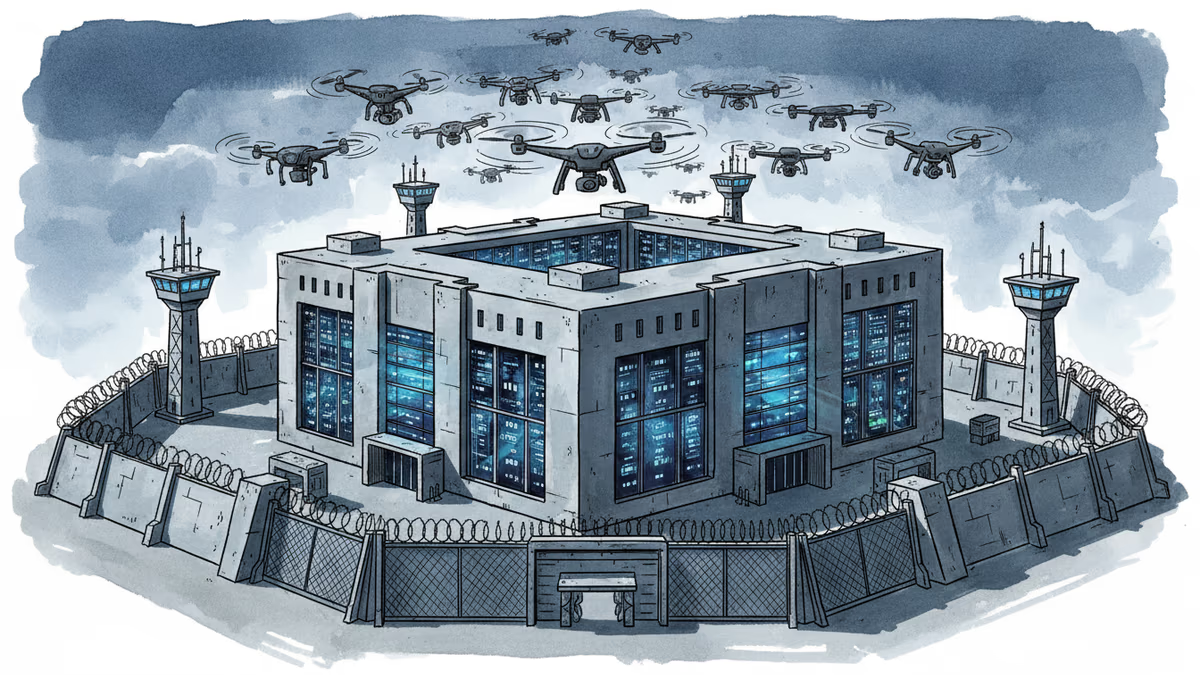
When Data Centers Become Military Targets
Iranian strikes on AWS facilities mark a new era where cloud infrastructure faces physical warfare. How should companies and governments adapt to this reality?
The $2 Billion Question Nobody Asked
When Iranian drones struck Amazon Web Services facilities across the Middle East, they didn't just damage servers—they shattered an assumption. For decades, tech companies worried about cyberattacks, natural disasters, and power outages. Physical military strikes? That wasn't on the risk matrix.
Now it is. The attacks hit three AWS sites across UAE and Bahrain, crippling everything from ride-hailing app Careem to payment service Alaan. It marked the first known military strike against American hyperscaler infrastructure, and suddenly, a new question dominates boardrooms: Should we defend data centers like military bases?
The Warning Signs Were There
Sam Winter-Levy from the Carnegie Endowment for International Peace saw this coming. Last July, he warned against building critical compute infrastructure in the Gulf region, citing escalating U.S.-Iran tensions in a Washington Post op-ed.
"Physical attacks are only going to become more common as AI becomes more significant," Winter-Levy told Rest of World. His logic is chilling: as more of the economy depends on these facilities, they become increasingly attractive targets.
The math is simple but sobering. Gulf countries have pledged trillions toward AI infrastructure. Every dollar invested makes these sites more valuable—and more vulnerable.

From Bunkers to Business Strategy
The industry's response reveals how seriously they're taking this threat. Companies are already housing servers in Cold War nuclear bunkers across the UK and Sweden. China's Tencent stores critical data in mountain caverns in Guizhou province.
But retrofitting existing facilities is expensive and complex. Air defense systems, reinforced concrete, distributed architectures—the costs add up quickly. And unlike cybersecurity, where software patches can provide instant protection, physical security requires massive infrastructure investments.
IDC's Ashish Nadkarni puts it bluntly: "Now suddenly, protecting data centers is like protecting top-security government offices."
The New Economics of Cloud Security
This shift will reshape the entire cloud industry. IDC predicts companies will demand "multi-AZ" deployments—storing data replicas across separate, geographically distributed centers. What was once a nice-to-have becomes essential.
For cloud providers, this means higher costs and complex logistics. For customers, it means higher prices and potentially slower services. The trade-off between efficiency and resilience just got a lot more expensive.
Governments courting tech investment now face a new challenge: How do you attract global companies while guaranteeing military-grade protection? The Gulf states' AI ambitions suddenly require defense budgets to match.
Authors
Related Articles

UK Visa Portal, a private immigration service mistaken for an official government site, has been exposing passport scans and selfies of over 100,000 applicants. The breach remains unpatched.
Okta CEO Todd McKinnon on why AI agents need identity management, the SaaSpocalypse threat, and why the kill switch might be the most important button in enterprise tech.
Iran and Israel are hacking civilian security cameras for military reconnaissance. How consumer surveillance devices became weapons of war.
A security researcher discovered he could access 7,000 DJI robot vacuums and peek into strangers' homes. This Valentine's Day revelation exposes the hidden privacy risks of our smart home obsession.
UK Visa Portal, a private immigration service mistaken for an official government site, has been exposing passport scans and selfies of over 100,000 applicants. The breach remains unpatched.
Okta CEO Todd McKinnon on why AI agents need identity management, the SaaSpocalypse threat, and why the kill switch might be the most important button in enterprise tech.
Iran and Israel are hacking civilian security cameras for military reconnaissance. How consumer surveillance devices became weapons of war.
A security researcher discovered he could access 7,000 DJI robot vacuums and peek into strangers' homes. This Valentine's Day revelation exposes the hidden privacy risks of our smart home obsession.
Thoughts
Share your thoughts on this article
Sign in to join the conversation