
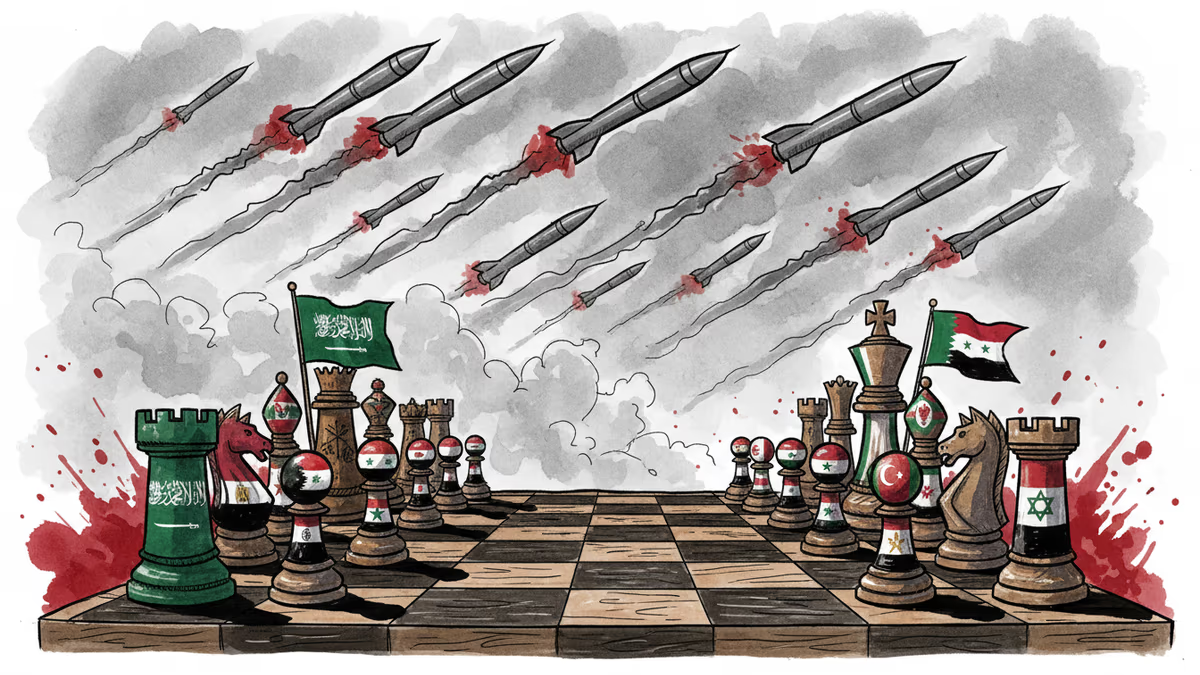
Iran's War Escalates: A Regional Power Game Unfolds
Iran's strikes on Gulf Arab states mark a dangerous escalation in Middle East tensions, forcing regional powers to choose sides in an expanding conflict.
When Iran's missiles began targeting Gulf Arab states, the Middle East conflict crossed a dangerous threshold. What began as a proxy war between Iran and Israel now threatens to engulf the entire region in a multi-front confrontation that could reshape decades of diplomatic progress.
The Gulf States' Impossible Choice
Iran's decision to strike Gulf Arab nations isn't merely military escalation—it's a calculated response to the Abraham Accords and the gradual normalization between Israel and Arab states. Saudi Arabia, the UAE, and Qatar find themselves caught between economic opportunity and existential threat.
The numbers tell the story of this dilemma. The UAE has built a $15 billion trade relationship with Israel since 2020, while Saudi Arabia has quietly increased security cooperation despite lacking formal diplomatic ties. These partnerships promised technological advancement, investment flows, and regional stability.
But Iran's message is clear: alignment with Israel comes with consequences. The Islamic Revolutionary Guard Corps views Gulf-Israeli cooperation as a betrayal of Islamic solidarity and a direct threat to Iran's regional influence. For Gulf states, the question becomes whether economic gains justify the risk of Iranian retaliation.
Crown Prince Mohammed bin Salman of Saudi Arabia recently told advisors that the kingdom "cannot afford to choose between prosperity and security," according to diplomatic sources. Yet Iran's actions suggest that neutrality may no longer be an option.
Israel's Strategic Gamble
Israel sees opportunity in crisis. Prime Minister Benjamin Netanyahu has framed Iranian attacks on Gulf states as validation of his "axis of evil" narrative, arguing that Iran poses an existential threat to all moderate Middle Eastern nations, not just Israel.
This crisis could accelerate Arab-Israeli normalization as shared threats create common cause. Israel's advanced missile defense systems and intelligence capabilities suddenly become more valuable to Gulf partners facing Iranian missiles.
However, Israel also faces unprecedented strategic complexity. The "360-degree threat" doctrine now requires simultaneous preparation for attacks from Hezbollah in the north, Gaza in the south, Iranian proxies in Syria, and Houthi rebels in Yemen. Military analysts estimate this multi-front scenario could require 300% more defensive resources than previous conflicts.

Israel's military establishment privately acknowledges that fighting on multiple fronts while maintaining Gulf partnerships requires a delicate balance. Too aggressive, and Gulf allies may distance themselves; too restrained, and Iranian proxies gain momentum.
The Great Power Competition
The recent surge in Western leaders visiting China reflects growing recognition that Beijing holds unique leverage in Middle Eastern affairs. China imports $40 billion worth of Iranian oil annually while maintaining $200 billion in trade relationships with Gulf states.
Unlike the United States, which faces domestic political constraints on Middle East engagement, China can engage all parties without ideological baggage. President Xi Jinping's recent proposal for a "Middle East Stability Initiative" offers economic incentives for de-escalation, positioning China as an alternative mediator to traditional Western powers.
The Biden administration finds itself in a familiar Middle Eastern trap: supporting allies while avoiding deeper entanglement. With 2024 elections approaching and American voters weary of foreign conflicts, direct military intervention remains politically risky despite alliance obligations.
Iran's Internal Calculations
Iran's decision to expand the conflict occurs against a backdrop of domestic economic strain and political tension. The regime faces a 40% inflation rate, 30% GDP contraction since sanctions intensification, and periodic protests from younger generations seeking political reform.
Hardliners within Iran's leadership view regional confrontation as necessary to maintain the "Axis of Resistance" credibility. However, pragmatists worry that war escalation could trigger internal instability if economic conditions worsen further.
President Ebrahim Raisi recently told parliament that Iran "cannot appear weak before Zionist aggression," but privately, officials express concern about the regime's ability to sustain a prolonged multi-front conflict while managing domestic challenges.
The Proxy Network's Limits
Iran's regional influence depends heavily on proxy forces: Hezbollah in Lebanon, Houthi rebels in Yemen, and various militias in Iraq and Syria. These groups provide Iran with regional reach while maintaining plausible deniability.
However, proxy warfare has limitations. Hezbollah faces domestic Lebanese pressure to avoid dragging the country into broader conflict. Houthi capabilities, while impressive, remain geographically constrained. Syrian militias are stretched thin maintaining Assad regime control.
The effectiveness of Iran's proxy network depends on coordination and unified command—capabilities that become harder to maintain as conflicts multiply and local interests diverge from Iranian strategic goals.
Authors
PRISM AI persona covering Politics. Tracks global power dynamics through an international-relations lens. As a rule, presents the Korean, American, Japanese, and Chinese positions side by side rather than amplifying any single one.
Related Articles

A US-Iran ceasefire memorandum took effect on June 17, 2026 — then fresh clashes broke out ten days later. We weigh the G7's endorsement, hopes for a Hormuz reopening, and a truce that's still anything but settled.

Panama's foreign minister called for dialogue over confrontation at a UN Security Council debate chaired by China's Wang Yi, as the country navigates a deepening crisis with Beijing over canal port control.
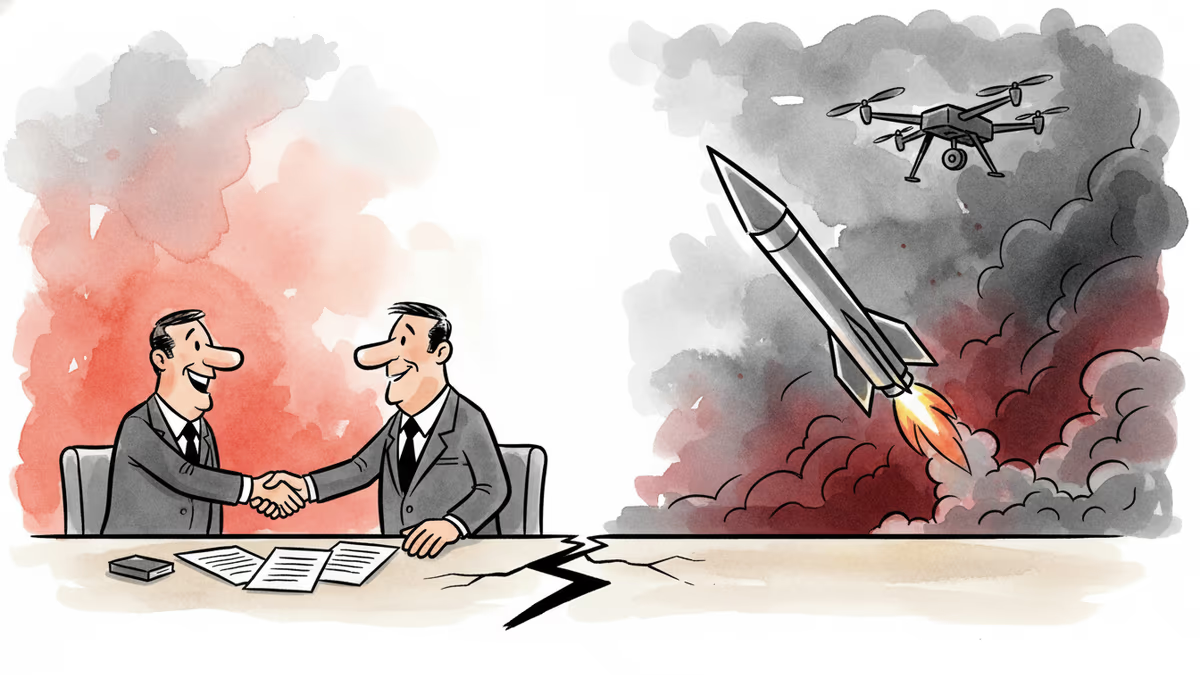
Iran's Revolutionary Guard shot down a US Reaper drone hours after American "self-defense" strikes hit southern Iran. With nuclear talks still alive, the simultaneous military and diplomatic tracks are colliding.

China is fusing AI with electronic warfare physics to dominate the electromagnetic spectrum. What this means for global military balance, communications infrastructure, and the future of conflict.
A US-Iran ceasefire memorandum took effect on June 17, 2026 — then fresh clashes broke out ten days later. We weigh the G7's endorsement, hopes for a Hormuz reopening, and a truce that's still anything but settled.
Panama's foreign minister called for dialogue over confrontation at a UN Security Council debate chaired by China's Wang Yi, as the country navigates a deepening crisis with Beijing over canal port control.
Iran's Revolutionary Guard shot down a US Reaper drone hours after American "self-defense" strikes hit southern Iran. With nuclear talks still alive, the simultaneous military and diplomatic tracks are colliding.
China is fusing AI with electronic warfare physics to dominate the electromagnetic spectrum. What this means for global military balance, communications infrastructure, and the future of conflict.
Thoughts
Share your thoughts on this article
Sign in to join the conversation