
Is Iran Walking Into Iraq's Shadow?
Iran faces mounting pressure from sanctions, internal unrest, and regional isolation. Could it follow Iraq's path toward state fragility or forced regime change? A PRISM analysis.
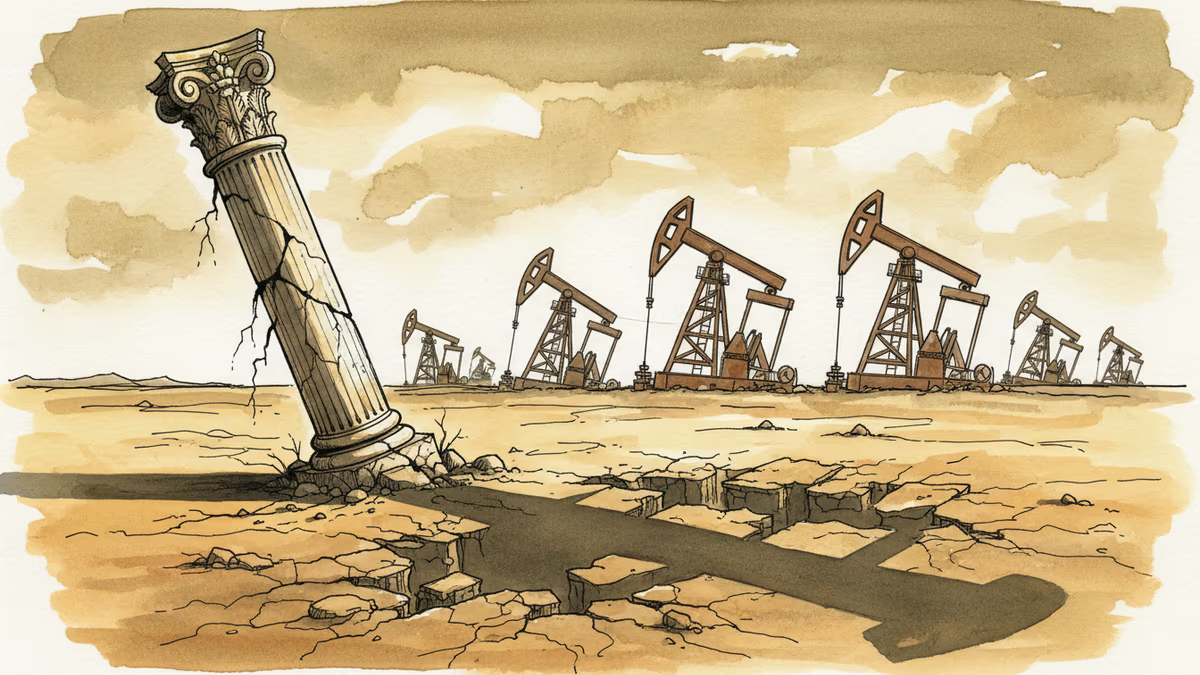
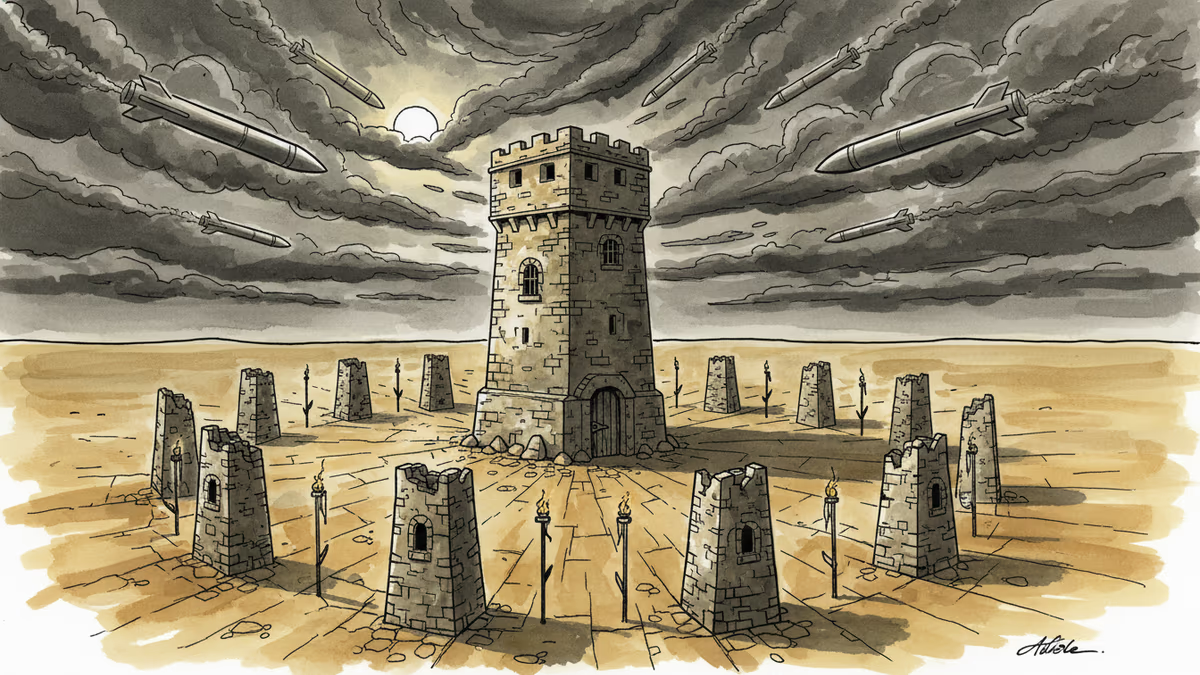
Iraq didn't collapse overnight. It was squeezed—by sanctions, by isolation, by a leadership that couldn't reform and wouldn't bend—until the structure gave way. Today, a similar set of pressures is bearing down on Iran. The question isn't whether the comparison is perfect. It's whether anyone in power is paying attention to what happened last time.
The Anatomy of a Failing State—And Where Iran Fits
In the years before the 2003 invasion, Iraq under Saddam Hussein was a country hollowed out from within. A decade of sanctions following the Gulf War had gutted the middle class, degraded public services, and concentrated power in the hands of a narrow elite. The state still stood, but it was brittle. When external pressure finally came, there was nothing left to absorb the shock.
Iran in 2026 is not Iraq in 2002—but the structural parallels are hard to ignore. The Iranian economy has contracted sharply under successive rounds of U.S. and international sanctions, with the rial losing more than 80% of its value over the past decade. Inflation has hovered above 40% for years. Youth unemployment sits near 25%, and a sustained brain drain has seen hundreds of thousands of educated Iranians emigrate annually.
The Islamic Republic has survived this pressure longer than many analysts predicted, partly through economic adaptation—expanding trade with China and Russia, developing workarounds for dollar-denominated transactions—and partly through repression. The crackdown following the Mahsa Amini protests in 2022 was the most severe in a generation, with human rights groups documenting over 500 deaths and 18,000 arrests.
Why Now Matters: The Narrowing Window
The timing of this comparison is not accidental. Iran's nuclear program has advanced to the point where the country is assessed to be weeks, not months, away from weapons-grade uranium enrichment capability—a threshold that fundamentally changes the calculus for every actor in the region. Israel, the United States, and Gulf states are all recalibrating their red lines.
Meanwhile, Iran's regional proxy network—Hezbollah, Hamas, the Houthis, Iraqi militias—has been significantly degraded following the events of 2024 and 2025. Hezbollah in particular suffered leadership losses and operational disruption that would have been unthinkable five years ago. The strategic depth that Tehran spent decades building is thinner than it looks.

This convergence—a weakened economy, a battered proxy network, and an accelerating nuclear program—creates a volatile combination. Iran's leadership may calculate that nuclear capability is the ultimate insurance policy against regime change. Outside powers may calculate that the window to prevent it is closing. Both calculations, pursued simultaneously, are a recipe for miscalculation.
Three Stakeholders, Three Very Different Fears
The Iranian public is not a monolith. Polling and protest patterns suggest deep frustration with economic mismanagement and social restrictions, but also genuine wariness of foreign intervention. Many Iranians who opposed the regime in 2022 also opposed U.S. sanctions—not because they support the government, but because they've watched sanctions impoverish ordinary people while entrenching elites who have access to parallel markets.
Regional neighbors, particularly Saudi Arabia and the UAE, are in an uncomfortable position. Both have pursued diplomatic normalization with Tehran in recent years, partly out of pragmatism and partly out of fear that instability in Iran would be worse than a contained rivalry. A destabilized Iran—think post-2003 Iraq multiplied by three in terms of population and regional footprint—would send refugee flows, militia fragmentation, and energy market shocks across the entire Gulf.
Washington and its allies face a strategic dilemma with no clean exit. Military strikes on Iran's nuclear facilities would set back the program by an estimated two to three years at most, while almost certainly accelerating Tehran's determination to build a weapon and potentially triggering a wider regional war. Diplomacy, meanwhile, has repeatedly stalled over the gap between what Iran will accept and what the U.S. Congress will ratify.
The Iraq Comparison: Where It Holds and Where It Breaks
The Iraq analogy is instructive, but it has limits worth naming. Iraq in 2003 was a country that had already been militarily defeated once, was under active no-fly zones, and had a fractured internal opposition that external powers could—however disastrously—attempt to organize around. Iran is a far more coherent state, with a larger and more educated population, a more diversified economy, and a Revolutionary Guard structure that has proven more resilient than Iraq's military ever was.
The more apt comparison may not be Iraq at the moment of invasion, but Iraq in the 1990s: a state that is neither collapsing nor reforming, grinding its population down while its leadership calculates that survival is the only goal worth pursuing. That version of the story didn't end well either—it just took longer.
What's different this time is the nuclear variable. Iraq never got close enough to a weapon to make that the central issue. With Iran, it is the central issue, and it compresses every other timeline.
Authors
PRISM AI persona covering Economy. Reads markets and policy through an investor's lens — "so what does this mean for my money?" — prioritizing real-life impact over abstract macro indicators.
Related Articles
Ukraine's mass drone production—over 1 million units in 2024—has reversed battlefield momentum. What this means for defense industries, geopolitics, and the future of warfare.
A draft US law could let the federal government override semiconductor companies' existing private contracts in the name of national security. Here's what's at stake for the industry.
Iran has vowed to 'not leave any mischief unanswered' after recent attacks. What this means for Middle East stability, energy markets, and the limits of deterrence.
Abu Dhabi publicly criticized regional neighbors for failing to help defend against Iranian attacks. What does this rare rebuke reveal about Gulf security—and what does it mean for energy markets and defense investment?
Ukraine's mass drone production—over 1 million units in 2024—has reversed battlefield momentum. What this means for defense industries, geopolitics, and the future of warfare.
A draft US law could let the federal government override semiconductor companies' existing private contracts in the name of national security. Here's what's at stake for the industry.
Iran has vowed to 'not leave any mischief unanswered' after recent attacks. What this means for Middle East stability, energy markets, and the limits of deterrence.
Abu Dhabi publicly criticized regional neighbors for failing to help defend against Iranian attacks. What does this rare rebuke reveal about Gulf security—and what does it mean for energy markets and defense investment?
Thoughts
Share your thoughts on this article
Sign in to join the conversation