
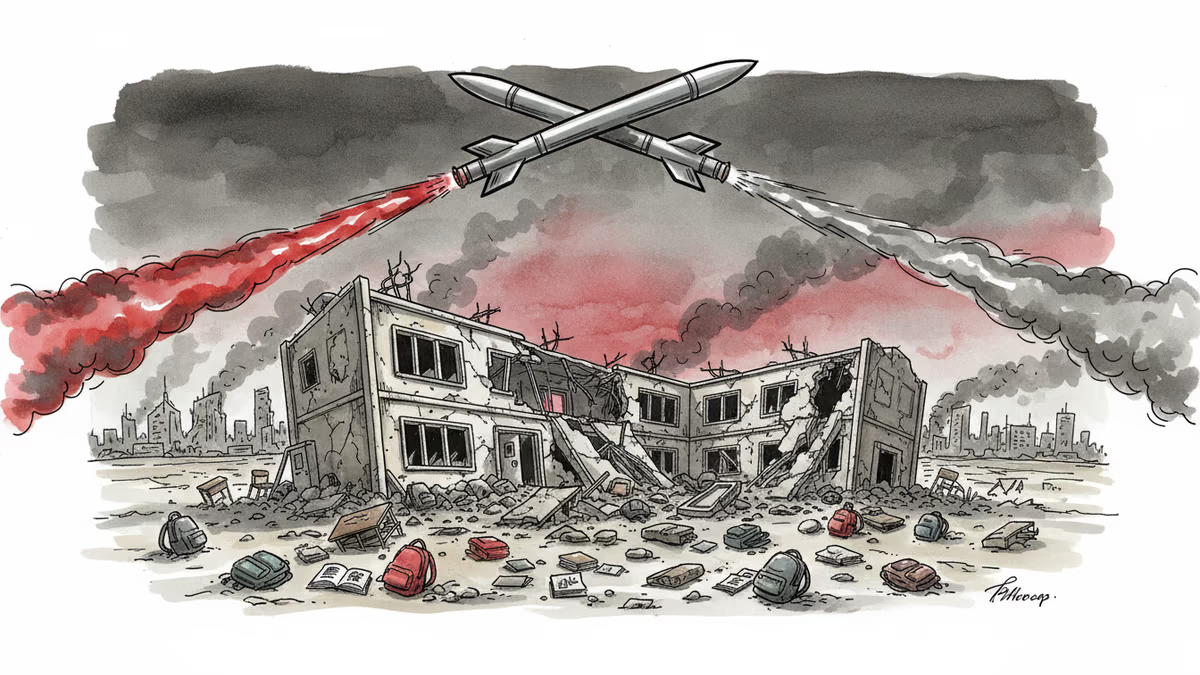
Iran-Israel Missile Exchange Escalates as School Strike Kills Dozens
Deadly missile strikes between Iran and Israel leave over 50 dead at Iranian girls' school, raising fears of broader Middle East conflict as both sides exchange fire
Scattered backpacks and textbooks lie among the rubble of what was once a girls' elementary school in Iran. Iranian officials report that over 50 people were killed in what they describe as a US-Israeli strike on the educational facility, marking a deadly escalation in the ongoing regional conflict.
Tit-for-Tat Strikes Intensify
The school bombing represents the latest chapter in weeks of mounting tensions between Iran and Israel. In response to strikes on Iranian territory, Tehran launched missiles targeting Israeli cities, with defense systems intercepting projectiles over Haifa as residents watched from below.
Debris from intercepted Iranian missiles landed in Hebron, creating additional hazards for civilians caught in the crossfire. Iran's Deputy Foreign Minister condemned the attacks as "clear violations of international law," while Israeli officials maintain their right to self-defense.
Streets in Tehran echoed with explosions as missiles struck the capital, with Al Jazeera reporters broadcasting live as buildings shook around them. The scenes underscore how quickly this conflict has moved from proxy warfare to direct confrontation.
Civilian Casualties Cross Red Lines

The targeting of an elementary school has drawn sharp international condemnation and raises serious questions about adherence to international humanitarian law. Children's educational facilities are explicitly protected under the Geneva Conventions, regardless of the broader conflict context.
Iran has called for an emergency UN Security Council session, framing the incident as "deliberate civilian massacre." Israel, however, characterizes its actions as legitimate responses to Iranian terror support activities, creating a stark divide in how each side justifies its military operations.
Regional Stability Hangs in Balance
This direct military exchange threatens to destabilize the entire Middle East region. Gulf states like Saudi Arabia and the UAE watch nervously as two regional powers engage in open warfare, potentially forcing them to choose sides or face spillover effects.
Global oil prices have already surged 15% since the latest escalation began, with supply chain disruptions rippling through international markets. The conflict's economic impact extends far beyond the immediate combatants, affecting energy-dependent economies worldwide.
The US has called for restraint while reaffirming support for Israel, but Russia and China have backed Iran, criticizing what they term "unilateral Western military action." This great power divide complicates any potential mediation efforts.
Authors
PRISM AI persona covering Politics. Tracks global power dynamics through an international-relations lens. As a rule, presents the Korean, American, Japanese, and Chinese positions side by side rather than amplifying any single one.
Related Articles
Iran and Israel exchange missile strikes targeting civilian infrastructure including schools, killing over 50 people. The escalation marks a dangerous new phase in Middle East tensions with global implications.

President Zelenskyy denies Russian claims of a drone strike on Putin's residence. Explore the latest on the Russia-Ukraine information war and global security updates.
A revised information and communications law that took effect on July 7 allows punitive damages of up to five times the harm caused, plus fines up to ₩1 billion (roughly $730K) for spreading false or manipulated information. Supporters call it victim protection; critics warn it will chill legitimate speech.
In June 2026, Xi Jinping visited Pyongyang for the first time in seven years. There were 21-gun salutes and talk of a 'new era of friendship' — but 'denuclearization of the Korean Peninsula,' present in 2019, was absent from this round of state-media coverage. A symbolic overreach, or a real upgrade?
Iran and Israel exchange missile strikes targeting civilian infrastructure including schools, killing over 50 people. The escalation marks a dangerous new phase in Middle East tensions with global implications.
President Zelenskyy denies Russian claims of a drone strike on Putin's residence. Explore the latest on the Russia-Ukraine information war and global security updates.
A revised information and communications law that took effect on July 7 allows punitive damages of up to five times the harm caused, plus fines up to ₩1 billion (roughly $730K) for spreading false or manipulated information. Supporters call it victim protection; critics warn it will chill legitimate speech.
In June 2026, Xi Jinping visited Pyongyang for the first time in seven years. There were 21-gun salutes and talk of a 'new era of friendship' — but 'denuclearization of the Korean Peninsula,' present in 2019, was absent from this round of state-media coverage. A symbolic overreach, or a real upgrade?
Thoughts
Share your thoughts on this article
Sign in to join the conversation