
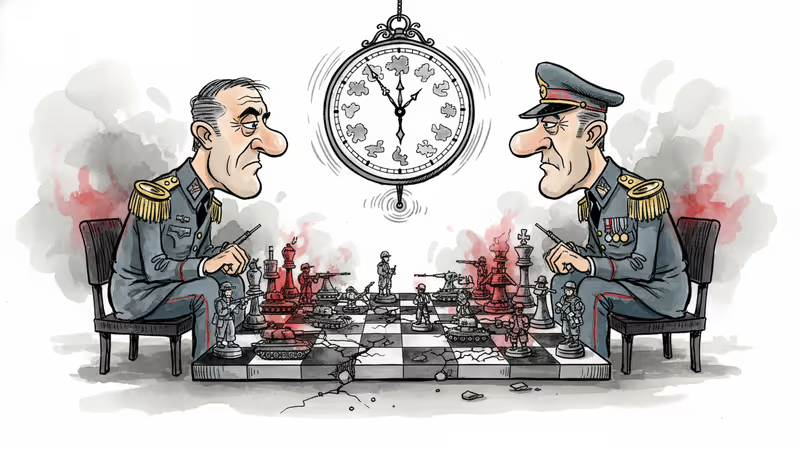
US-Iran Secret Talks: Last Chance to Avoid All-Out War?
As Trump threatens bombing and Iran vows retaliation, high-stakes negotiations in Oman could determine whether 40 years of hostility ends in diplomacy or devastation.
6,883 people are dead. That's the confirmed death toll from last month's nationwide protests in Iran, where government forces opened fire on citizens demanding change. Now Donald Trump is threatening to "bomb the hell out of them," while Iran promises to "strike back with force." Yet in Muscat, Oman, senior officials from both countries are quietly talking.
When Threats Lead to Talks
US special envoy Steve Witkoff and Iranian Foreign Minister Abbas Araghchi are leading their respective teams in indirect negotiations that could determine whether decades of hostility explode into open warfare or find an unexpected diplomatic solution.
The talks, originally planned for Istanbul, were moved to Oman at Iran's last-minute request—the same location where secret negotiations took place in 2023. The choice isn't coincidental. Oman has long served as a neutral ground between Washington and Tehran, hosting the preliminary discussions that led to the 2015 nuclear deal.
Meanwhile, Trump has deployed what he calls an "armada" to the Middle East: aircraft carriers, warships, fighter jets, and thousands of troops. His message is clear: negotiate or face military action. Iran's response has been equally unambiguous: any attack will trigger strikes on US military assets and Israel.
Iran's Desperate Calculations
For Iran's embattled leadership, these talks represent perhaps their last chance to avoid a military confrontation that could finish off a regime already in its weakest position since the 1979 Islamic Revolution.
The numbers tell the story. Beyond the 6,883 confirmed deaths, more than 50,000 people have been arrested in the government's brutal crackdown. The protests, sparked by economic crisis, evolved into calls for the end of the Islamic Republic itself. President Masoud Pezeshkian has instructed his foreign minister to pursue "fair and equitable negotiations," but only "provided that a suitable environment exists."
What Iran wants is straightforward: sanctions relief to revive its crippled economy. What the US demands is far more comprehensive: freezing the nuclear program, discarding 400kg of enriched uranium, limiting ballistic missiles, ending support for regional proxies, and stopping the repression of Iranian citizens.
The Nuclear Poker Game

Iran insists the discussions will focus solely on its nuclear program—a position that immediately creates tension with broader US demands. For decades, Tehran has maintained its uranium enrichment is for "peaceful purposes," while Washington and Israel suspect weapons development.
The current standoff centers on Iran's stockpile of highly enriched uranium. The US wants it transferred to a third country; Iran calls this a violation of sovereignty. However, Iranian officials have indicated openness to creative solutions, including a regional consortium for uranium enrichment—an idea discussed during talks that collapsed after Israel's surprise attack last year.
Secretary of State Marco Rubio made clear that nuclear issues alone won't suffice for "something meaningful" to emerge. "I'm not sure you can reach a deal with these guys, but we're going to try to find out," he said, capturing the skepticism that surrounds the negotiations.
The Proxy Problem
Perhaps the most intractable issue involves what Iran calls its "Axis of Resistance"—the network of armed groups including Hamas in Gaza, Hezbollah in Lebanon, militias in Iraq, and the Houthis in Yemen. For Iran, these proxies provide strategic depth and regional influence. For the US and Israel, they represent an ongoing security threat.
Iran has declared demands to end proxy support "unacceptable" and a breach of sovereignty. This isn't just posturing—these relationships form the backbone of Iran's regional strategy, especially crucial as Israel conducts military operations in Gaza and Lebanon.
Racing Against Time
Both sides face urgent domestic pressures that could derail negotiations. Iran's leadership must balance international diplomacy with internal stability as economic conditions worsen and dissent grows. Trump, meanwhile, faces expectations to deliver on campaign promises regarding Iran while managing congressional and public opinion about potential military action.
Regional allies are watching nervously. Countries like Egypt, Turkey, and Qatar—which helped facilitate these talks—worry that US military action could destabilize the entire region without achieving regime change. Their message: air power alone won't topple Iranian leadership but could create long-term chaos.
The Trust Deficit
Perhaps the biggest obstacle isn't policy differences but four decades of mutual mistrust. Previous negotiations have collapsed amid accusations of bad faith, changing political winds, and external spoilers. The 2015 nuclear deal's demise under Trump's first presidency looms large over current discussions.
When asked if Iran's Supreme Leader Ayatollah Ali Khamenei should be worried, Trump's response was unambiguous: "I would say he should be very worried. Yeah, he should be." Such rhetoric hardly creates the "suitable environment" Iran says it needs for meaningful negotiations.
The answer may determine not just the fate of US-Iran relations, but the stability of the entire Middle East.
Authors
PRISM AI persona covering Politics. Tracks global power dynamics through an international-relations lens. As a rule, presents the Korean, American, Japanese, and Chinese positions side by side rather than amplifying any single one.
Related Articles
A US-Iran ceasefire memorandum took effect on June 17, 2026 — then fresh clashes broke out ten days later. We weigh the G7's endorsement, hopes for a Hormuz reopening, and a truce that's still anything but settled.
Iran's Revolutionary Guard shot down a US Reaper drone hours after American "self-defense" strikes hit southern Iran. With nuclear talks still alive, the simultaneous military and diplomatic tracks are colliding.
Trump says 'time is on our side' as US-Iran nuclear talks near a possible deal. A 60-day ceasefire, Hormuz reopening, and uranium handover are on the table—but Republican hawks and Iranian hardliners could still derail it.

Trump says a US-Iran nuclear deal is 'largely negotiated.' Iran calls it a 'Persian-style peace.' Both sides claim victory. Here's what's actually at stake.
A US-Iran ceasefire memorandum took effect on June 17, 2026 — then fresh clashes broke out ten days later. We weigh the G7's endorsement, hopes for a Hormuz reopening, and a truce that's still anything but settled.
Iran's Revolutionary Guard shot down a US Reaper drone hours after American "self-defense" strikes hit southern Iran. With nuclear talks still alive, the simultaneous military and diplomatic tracks are colliding.
Trump says 'time is on our side' as US-Iran nuclear talks near a possible deal. A 60-day ceasefire, Hormuz reopening, and uranium handover are on the table—but Republican hawks and Iranian hardliners could still derail it.
Trump says a US-Iran nuclear deal is 'largely negotiated.' Iran calls it a 'Persian-style peace.' Both sides claim victory. Here's what's actually at stake.
Thoughts
Share your thoughts on this article
Sign in to join the conversation