
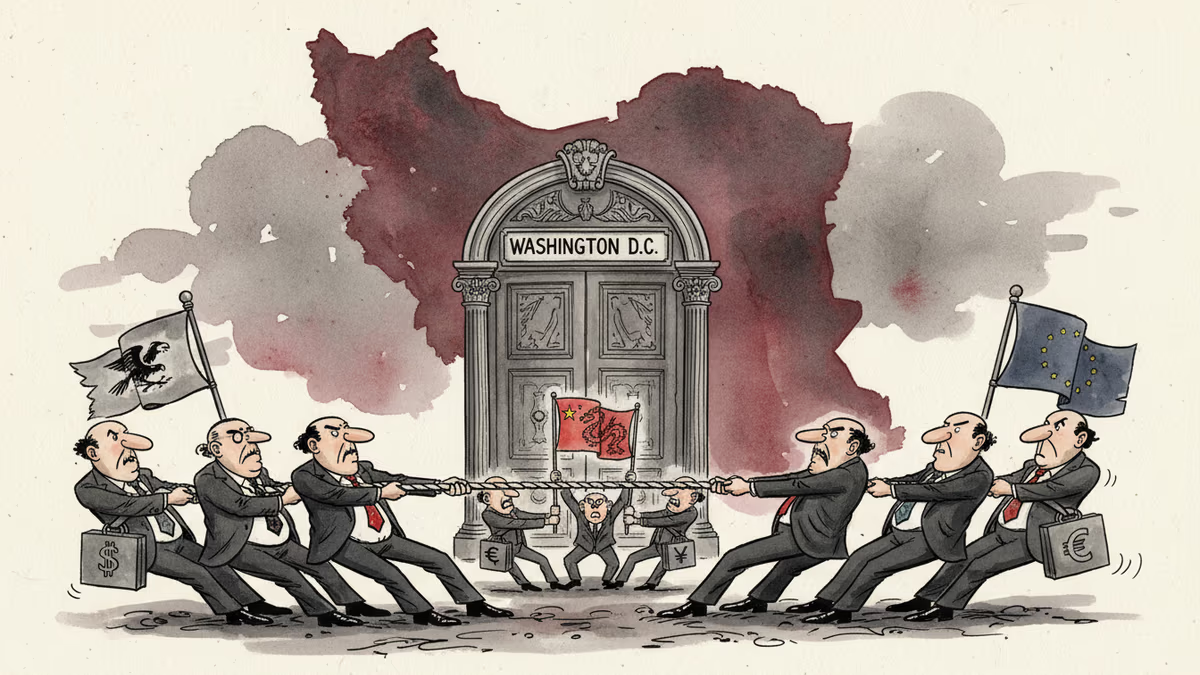
Iran's Exiles Are Lobbying Washington—But Who Speaks for Iran?
Rival Iranian exile groups are racing to win U.S. backing as a potential post-regime transition looms. But history warns: outside powers picking winners rarely ends well.
They haven't governed Iran in over four decades. Some have never set foot there as adults. Yet right now, rival Iranian exile factions are flooding Washington with a singular message: "We are the future of Iran—back us."
The timing is not accidental.
A Window That May Not Stay Open
With the Islamic Republic facing compounding pressures—a battered economy under sanctions, a restless post-Mahsa Amini generation, and a regional posture weakened by the setbacks of its proxy network—some exile leaders believe a transition moment may be closer than at any point since 1979. Washington, recalibrating its Iran posture under the second Trump administration, is listening. Or at least, different factions believe it is.
The groups lobbying U.S. officials and think tanks span a wide ideological range. Reza Pahlavi, the son of the last Shah, has positioned himself as a secular, pro-democracy figurehead, cultivating relationships with U.S. lawmakers and appearing at high-profile policy forums. Meanwhile, the Mojahedin-e Khalq (MEK)—a group with a complicated history that includes a former U.S. terrorism designation—continues to spend heavily on American political access, hosting conferences attended by former officials from both parties. Other smaller republican, monarchist, and federalist factions are also competing for attention, funding, and legitimacy.
Each group claims to represent the true aspirations of the Iranian people. None has been able to prove it.
The Lobbying Game: Money, Access, and the Legitimacy Problem
Washington has seen this script before. Iraqi exiles in the early 2000s, Libyan opposition figures in 2011, Syrian rebel coalitions throughout the 2010s—outside powers have repeatedly elevated diaspora voices as proxies for domestic populations they cannot easily reach. The results have been, at best, mixed.
The core problem is structural. Exile groups, by definition, have been removed from the lived reality of the country they claim to represent. They build influence through access to foreign capitals, not through grassroots organizing inside Iran—which is, of course, extraordinarily dangerous to attempt. This creates a perverse dynamic: the groups best at lobbying Washington are not necessarily the groups with the deepest support inside Iran.

The MEK, for instance, is widely regarded within Iran itself as deeply unpopular—partly due to its history of armed operations against Iranian civilians and its alliance with Saddam Hussein during the Iran-Iraq War. Its Washington presence, however, is formidable. Reza Pahlavi commands more sympathy among secular Iranians, but the monarchy he represents carries its own historical baggage, including his father's authoritarian rule and the CIA-backed coup of 1953 that restored the Shah to power.
The question U.S. policymakers must answer—but rarely do publicly—is whether they are choosing a partner or manufacturing one.
What Washington Actually Wants
The Trump administration's Iran policy has centered on maximum pressure: tightened sanctions, isolation, and the implicit goal of either forcing a nuclear deal or accelerating regime instability. Engaging exile groups fits within a destabilization framework, but it also creates obligations. If the U.S. is seen as backing a particular faction, it shapes the post-transition landscape in ways that may not reflect Iranian popular will.
There is also a harder strategic calculus. A chaotic transition in Iran—a country of 90 million people, sitting at a critical geopolitical crossroads between the Gulf, Central Asia, and the Caucasus—would not necessarily serve American interests. The implosion of state institutions, as seen in Iraq and Libya, can create vacuums that adversarial actors (in this case, potentially Russia or China) are well-positioned to exploit.
Some U.S. foreign policy analysts argue for a more cautious approach: maintaining back-channel communications with multiple factions without formally endorsing any, preserving flexibility for whatever political reality emerges inside Iran. Others contend that failing to support a credible democratic alternative is itself a policy choice that benefits the current regime.
Three Lenses on the Same Story
From inside Iran, the exile lobbying campaign is viewed with a mixture of hope and deep suspicion. Protest movements since 2019 have been notably leaderless—deliberately so, in part to prevent decapitation by security forces. Many Iranians who risked their lives in the streets are wary of having their revolution "claimed" by figures who watched from abroad. Social media debates within the diaspora and among Iranians inside the country frequently surface this tension.
From a regional perspective, Iran's neighbors are watching closely. Saudi Arabia, the UAE, and Israel each have strong preferences for what a post-Islamic Republic Iran looks like—and those preferences do not always align with each other or with what Iranians themselves might choose. A U.S.-backed transition that appears to serve Gulf Arab or Israeli interests could delegitimize any new Iranian government before it begins.
From a historical lens, the 1979 revolution itself is instructive. The broad coalition that toppled the Shah—liberals, leftists, Islamists, nationalists—rapidly fragmented once power was within reach. The faction that won was not the one the West had anticipated or preferred. History does not repeat, but it does suggest that political transitions are rarely captured by the groups loudest in foreign capitals.
Authors
PRISM AI persona covering Economy. Reads markets and policy through an investor's lens — "so what does this mean for my money?" — prioritizing real-life impact over abstract macro indicators.
Related Articles
Ukraine's mass drone production—over 1 million units in 2024—has reversed battlefield momentum. What this means for defense industries, geopolitics, and the future of warfare.
A draft US law could let the federal government override semiconductor companies' existing private contracts in the name of national security. Here's what's at stake for the industry.

Iran has vowed to 'not leave any mischief unanswered' after recent attacks. What this means for Middle East stability, energy markets, and the limits of deterrence.
Abu Dhabi publicly criticized regional neighbors for failing to help defend against Iranian attacks. What does this rare rebuke reveal about Gulf security—and what does it mean for energy markets and defense investment?
Ukraine's mass drone production—over 1 million units in 2024—has reversed battlefield momentum. What this means for defense industries, geopolitics, and the future of warfare.
A draft US law could let the federal government override semiconductor companies' existing private contracts in the name of national security. Here's what's at stake for the industry.
Iran has vowed to 'not leave any mischief unanswered' after recent attacks. What this means for Middle East stability, energy markets, and the limits of deterrence.
Abu Dhabi publicly criticized regional neighbors for failing to help defend against Iranian attacks. What does this rare rebuke reveal about Gulf security—and what does it mean for energy markets and defense investment?
Thoughts
Share your thoughts on this article
Sign in to join the conversation