
Investors Hunt for Champions as China Tech Self-Sufficiency 5-Year Plan Looms
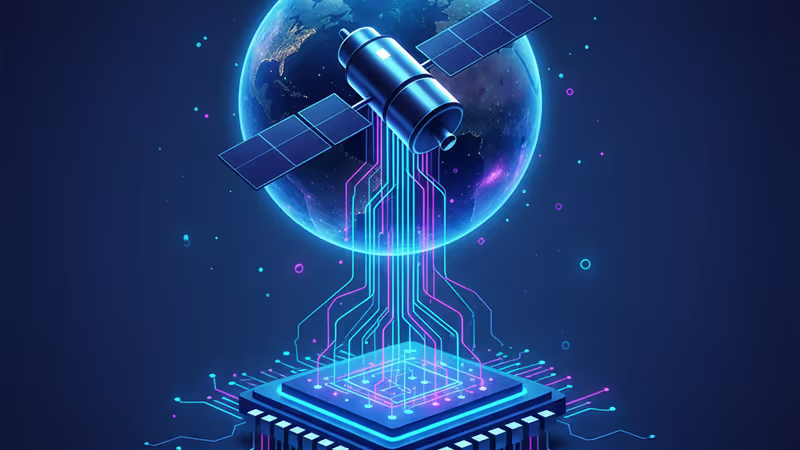
Investors focus on satellite chips and BCI as the China tech self-sufficiency 5-year plan approaches in March 2026, targeting next-gen tech champions.
The hunt for China's next tech titans is heating up despite the looming shadow of an economic slowdown. According to Reuters, global investors are placing massive bets on niche sectors like satellite chips and brain-computer interfaces, betting that state-driven innovation will outweigh macroeconomic headwinds. The momentum is building ahead of a critical policy milestone that will define the nation's industrial path for the next half-decade.
Betting on the China Tech Self-Sufficiency 5-Year Plan
Beijing's upcoming 15th Five-Year Plan, set to be finalized in March 2026, is expected to redouble efforts toward total technological independence. This policy tailwind has already triggered a rally in stocks related to satellite chips and brain-computer interfaces (BCI). Investors aren't just looking for growth; they're looking for survival-critical technologies that can withstand intensifying geopolitical pressure and export controls from nations like Japan.

AI Rivalry and Market Debuts
The AI sector remains a primary battleground. Zhipu AI, a prominent domestic rival to OpenAI, recently made its Hong Kong debut with a valuation of $558 million. This successful capital raise signals robust appetite for Chinese AI firms that can offer localized alternatives to Western technologies. As China tightens dual-use export controls, the value of domestic supply chain champions has never been higher.
Authors
Related Articles

Lucra Sports CEO Dylan Robbins landed Cathie Wood's ARK Invest as a Series B lead without building AI. The story behind his unconventional fundraising playbook.

SolarSquare is raising $55-60M at a $450-500M valuation, more than doubling its worth in 18 months. Here's what's driving investor conviction in India's residential solar market.

Indian venture capital has quietly displaced Silicon Valley in its own backyard. Only one American VC made India's top 10 investor list last year. Here's why that matters beyond India.
Cerebras Systems IPO yields a $5.3 billion return for Benchmark. Explore the 8.5-year journey from a reluctant first meeting to challenging Nvidia's AI dominance.
Lucra Sports CEO Dylan Robbins landed Cathie Wood's ARK Invest as a Series B lead without building AI. The story behind his unconventional fundraising playbook.
SolarSquare is raising $55-60M at a $450-500M valuation, more than doubling its worth in 18 months. Here's what's driving investor conviction in India's residential solar market.
Indian venture capital has quietly displaced Silicon Valley in its own backyard. Only one American VC made India's top 10 investor list last year. Here's why that matters beyond India.
Cerebras Systems IPO yields a $5.3 billion return for Benchmark. Explore the 8.5-year journey from a reluctant first meeting to challenging Nvidia's AI dominance.
Thoughts
Share your thoughts on this article
Sign in to join the conversation