
Intel Finally Breaks Its 5-Year Compromise Cycle
Intel's Core Ultra Series 3 'Panther Lake' processors end years of trade-offs between performance, battery life, and graphics. What does this mean for the laptop market?
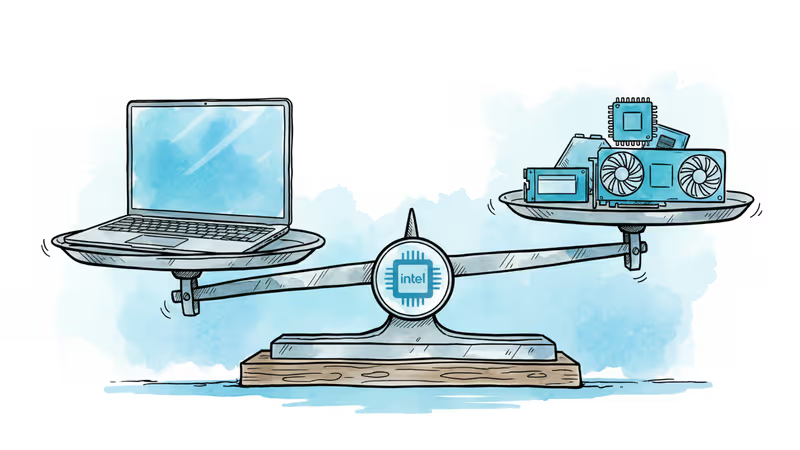
For five years, buying an Intel laptop meant making a choice you shouldn't have to make. Want better performance? Say goodbye to battery life. Need all-day power? Accept weaker graphics. Intel's new Core Ultra Series 3 processors, codenamed Panther Lake, promise to end this frustrating era of trade-offs.
The Zigzag Years
Intel's recent processor history reads like a case study in engineering compromises. The 12th and 13th-generation Core chips delivered impressive CPU performance gains but came with a significant battery life penalty. The first Core Ultra chips (Meteor Lake) improved graphics but couldn't match older chips' CPU performance.
Last year's Core Ultra 200V series (Lunar Lake) offered solid battery life and graphics but weaker CPU performance, while the more powerful 200H chips (Arrow Lake) boosted CPU performance but sacrificed GPU capabilities and features. Each generation seemed to rob Peter to pay Paul.
The End of Compromise
Panther Lake appears to break this cycle. Early reports suggest Intel has finally achieved what seemed impossible: meaningful improvements across CPU performance, power efficiency, and graphics capabilities without major trade-offs. While detailed benchmarks aren't available yet, industry observers are calling it Intel's first "no-compromise" processor in years.
This isn't just about technical specifications. For five years, Intel laptop buyers have been forced into artificial choices. Gamers sacrificed portability for performance. Mobile professionals gave up processing power for battery life. Content creators juggled between adequate performance and thermal management. Panther Lake could eliminate many of these painful decisions.

Market Implications
The timing couldn't be more critical. AMD has spent recent years capitalizing on Intel's compromises, gaining significant market share by offering more balanced solutions. Now Intel has a real counter-punch, potentially reshuffling the competitive landscape.
For laptop manufacturers, this creates new opportunities. Companies like Dell, HP, and Lenovo have been constrained by Intel's limitations, often having to choose between different chip variants for different product lines. A more balanced processor could enable entirely new product categories—think ultra-thin laptops with serious gaming capabilities or workstations with genuine all-day battery life.
Consumer Impact
The most immediate beneficiaries are users who've been stuck in Intel's compromise matrix. Students who need both productivity performance and portability. Creative professionals who want powerful rendering without being tethered to outlets. Business travelers who need reliable performance across varied workloads.
But there's a broader question: will this actually simplify purchasing decisions? Or will it just raise the performance bar across all categories, creating new forms of choice paralysis? When every laptop can do everything reasonably well, how do you choose?
The Broader Tech Cycle
Intel's journey illustrates something fundamental about technology development. Progress isn't always linear. Sometimes you need to step back to leap forward. The company's willingness to endure years of criticism while working toward a more complete solution shows a different kind of innovation strategy—one focused on holistic improvement rather than incremental gains in isolated metrics.
This approach contrasts sharply with the "move fast and break things" mentality that dominates much of tech. Intel moved slowly and fixed things, but the question remains: was the wait worth it?
Authors
Related Articles

Intel's revived New Mexico fab is betting on advanced chip packaging to challenge TSMC and capture AI market share. Here's why this quiet technology could matter more than the chips themselves.

A material humans have shaped for thousands of years is about to become the backbone of next-gen AI chips. Here's why the semiconductor industry is betting on glass—and what's at stake.

Intel's Core Ultra 200S Plus (Arrow Lake Refresh) adds cores and bumps clocks, promising 15% better gaming. But the real question is: compared to what? Here's what enthusiasts need to know.

Dell ditches discrete graphics entirely in the new XPS 14, betting on Intel's integrated GPU to match RTX 4050 performance. Is this the future of laptops or a risky experiment?
Intel's revived New Mexico fab is betting on advanced chip packaging to challenge TSMC and capture AI market share. Here's why this quiet technology could matter more than the chips themselves.
A material humans have shaped for thousands of years is about to become the backbone of next-gen AI chips. Here's why the semiconductor industry is betting on glass—and what's at stake.
Intel's Core Ultra 200S Plus (Arrow Lake Refresh) adds cores and bumps clocks, promising 15% better gaming. But the real question is: compared to what? Here's what enthusiasts need to know.
Dell ditches discrete graphics entirely in the new XPS 14, betting on Intel's integrated GPU to match RTX 4050 performance. Is this the future of laptops or a risky experiment?
Thoughts
Share your thoughts on this article
Sign in to join the conversation