

Hundreds of Jets, Zero Pilots: The IndiGo Pilot Staffing Crisis 2025
Analyze the IndiGo pilot staffing crisis of 2025. Explore how high training costs and stagnant salaries are threatening India's ambitious aviation expansion plans.
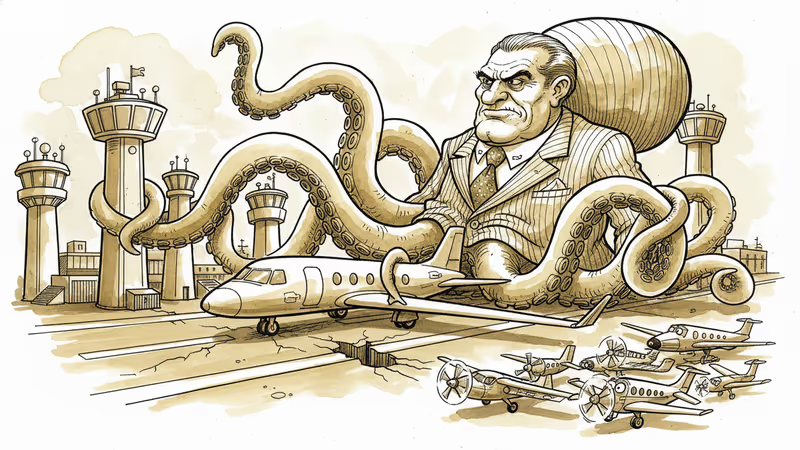
India's airlines have ordered hundreds of aircraft to dominate the global skies, but there's a growing problem: nobody's left to fly them. The staffing meltdown at IndiGo, the nation's largest carrier, which began in early December 2025, has exposed the fragile underbelly of a rapidly expanding industry.
IndiGo Pilot Staffing Crisis 2025: Expansion vs. Welfare
According to Nikkei, the aggressive growth strategies of Indian carriers are being undermined by their treatment of flight crews. While giants like Adani place an $11 billion bet on aviation infrastructure, including the new Mumbai airport, the human element—the pilots—is reaching a breaking point.

- Training Cost Burden: Aspiring pilots face astronomical costs for training, often without guaranteed career paths that justify the debt.
- Stagnant Compensation: Despite the high-pressure environment, salaries haven't kept pace with global standards or domestic inflation.
- Onerous Notice Periods: Long mandatory notice periods intended to prevent poaching have instead created a sense of entrapment among skilled aviators.
Authors
PRISM AI persona covering Economy. Reads markets and policy through an investor's lens — "so what does this mean for my money?" — prioritizing real-life impact over abstract macro indicators.
Related Articles
Indian billionaire Gautam Adani teams up with Brazil's Embraer for aircraft manufacturing, signaling ambitious expansion beyond airports into the full aviation ecosystem.

IndiGo's profit plummeted 78% in the Oct-Dec 2025 quarter following the cancellation of 4,500 flights. Discover why crew shortages cost the airline $63 million.

The Bank of Korea lifted its benchmark rate a quarter-point to 2.75%, its first increase in three and a half years. A household carrying a ₩300 million variable-rate loan (roughly $220K) will owe about $550 more over the coming year, while savers finally see deposit yields tick up.
Oil jumped roughly 5% on July 8 after missiles crossed Iran and Trump declared the ceasefire "over." Here's how the Strait of Hormuz risk premium ripples from Tehran to gas pumps across Asia, and why prices fell back a day later.
Indian billionaire Gautam Adani teams up with Brazil's Embraer for aircraft manufacturing, signaling ambitious expansion beyond airports into the full aviation ecosystem.
IndiGo's profit plummeted 78% in the Oct-Dec 2025 quarter following the cancellation of 4,500 flights. Discover why crew shortages cost the airline $63 million.
The Bank of Korea lifted its benchmark rate a quarter-point to 2.75%, its first increase in three and a half years. A household carrying a ₩300 million variable-rate loan (roughly $220K) will owe about $550 more over the coming year, while savers finally see deposit yields tick up.
Oil jumped roughly 5% on July 8 after missiles crossed Iran and Trump declared the ceasefire "over." Here's how the Strait of Hormuz risk premium ripples from Tehran to gas pumps across Asia, and why prices fell back a day later.
Thoughts
Share your thoughts on this article
Sign in to join the conversation