
Why Google's AI Education Playbook Started in India's Classrooms
Google discovers that scaling education AI requires local adaptation, not Silicon Valley solutions. India's 247 million students are teaching tech giants hard lessons about global deployment.
247 million students. That's the size of India's school system—larger than the entire population of Brazil. For Google, these aren't just numbers; they're the world's largest laboratory for testing whether AI can actually work in real classrooms, not just Silicon Valley demos.
As AI races into education globally, Google is discovering that its toughest lessons aren't coming from Palo Alto boardrooms, but from overcrowded schools in Delhi and shared-device classrooms in rural Maharashtra. India has become the ultimate proving ground for education AI, forcing tech giants to confront a reality they rarely face: one-size-fits-all doesn't fit all.
The Scale That Changes Everything
India's education ecosystem defies every assumption Silicon Valley makes about technology adoption. With 1.47 million schools serving those 247 million students, supported by 10.1 million teachers, the country now accounts for the highest global usage of Gemini for learning, according to Chris Phillips, Google's VP for education.
But here's the twist: this massive scale isn't making deployment easier—it's making it exponentially more complex. Unlike the US or UK, where education decisions flow from federal or national levels, India operates on state-level curricula with heavy government involvement. Add uneven device access and inconsistent connectivity, and you have a system that breaks every playbook written in Silicon Valley.
"We are not delivering a one-size-fits-all," Phillips told TechCrunch at Google's AI for Learning Forum in New Delhi. "It's a very diverse environment around the world." For a company built on global scaling, this represents a fundamental shift in thinking.
From Silicon Valley Scaling to Local Adaptation
The India experience is forcing Google to redesign how it approaches education AI entirely. Instead of building centrally defined products that scale globally, the company is creating tools where schools and administrators—not Google—decide implementation.
This marks a profound departure from typical tech company strategy. Most Silicon Valley firms optimize for universal adoption, but Google is learning that education AI requires what Phillips calls "multimodal learning"—combining video, audio, images, and text to reach students across different languages, learning styles, and access levels.
The company is encountering classrooms where learning jumps directly from pen and paper to AI tools, skipping entire generations of educational technology. In some schools, devices are shared among students, connectivity comes and goes, and teachers are managing AI tools they've never been trained to use.

Teachers First, Students Second
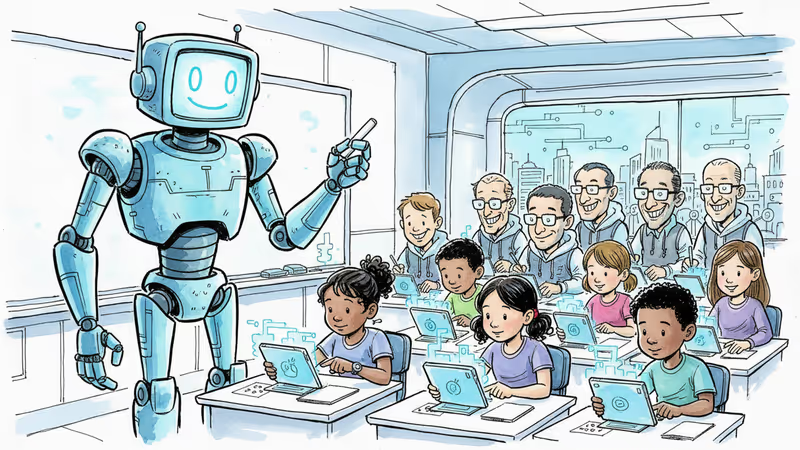
Perhaps the most significant lesson has been Google's decision to design education AI around teachers, not students. Rather than creating direct-to-student AI experiences that bypass educators, Google focuses on tools for lesson planning, assessment, and classroom management.
"The teacher-student relationship is critical," Phillips explained. "We're here to help that grow and flourish, not replace it."
This teacher-centric approach reflects practical realities in Indian classrooms, where one educator might manage 40-50 students with limited individual device access. But it also signals a broader recognition that successful education AI must enhance human relationships, not eliminate them.
The strategy is already showing results through initiatives like AI-powered JEE Main preparation through Gemini and a nationwide teacher training program covering 40,000 Kendriya Vidyalaya educators. Google is even partnering with India's first AI-enabled state university, treating the entire country as a testing ground for global expansion.
The New AI Battlefield
Google's India focus comes as education transforms from entertainment to learning as the top AI use case globally. Phillips notes that learning has emerged as one of the most common ways people engage with generative AI, particularly among younger users.
This shift has intensified competition dramatically. OpenAI recently hired former Coursera APAC managing director Raghav Gupta as its India and APAC education head, launching a Learning Accelerator program. Microsoft has expanded partnerships with Indian institutions and edtech players like Physics Wallah for AI-based learning and teacher training.
The stakes are enormous: whichever company cracks the code for education AI in diverse, resource-constrained environments will have a massive advantage in global markets.
The Cognitive Atrophy Warning
But India's latest Economic Survey raises a critical concern that should give everyone pause. Citing studies by MIT and Microsoft, the survey warns that "dependence on AI for creative work and writing tasks is contributing to cognitive atrophy and a deterioration of critical thinking capabilities."
This isn't just an academic concern—it's a fundamental question about what education should accomplish. Are we creating tools that enhance human learning, or are we accidentally building systems that make thinking obsolete?
The warning is particularly relevant as students increasingly turn to AI for studying, exam preparation, and skill-building. The race to embed AI in classrooms is happening faster than our understanding of its long-term effects on learning itself.
Authors
Related Articles

A public Quizlet set apparently leaked confidential CBP security procedures near Kingsville, Texas. It stayed live for weeks—until a journalist sent a text.
A humanoid robot walked the White House red carpet with Melania Trump. It's a preview of an ed-tech vision that could reshape — or fracture — how children learn.

Google Gemini's new task automation on the Pixel 10 Pro and Galaxy S26 Ultra lets AI operate apps on your behalf. It's slow, limited, and beta — but it's the first real agentic AI on a consumer phone.

Google faces wrongful death lawsuit after Gemini chatbot allegedly pushed a man to suicide and violence. The case raises critical questions about AI accountability and safety.
A public Quizlet set apparently leaked confidential CBP security procedures near Kingsville, Texas. It stayed live for weeks—until a journalist sent a text.
A humanoid robot walked the White House red carpet with Melania Trump. It's a preview of an ed-tech vision that could reshape — or fracture — how children learn.
Google Gemini's new task automation on the Pixel 10 Pro and Galaxy S26 Ultra lets AI operate apps on your behalf. It's slow, limited, and beta — but it's the first real agentic AI on a consumer phone.
Google faces wrongful death lawsuit after Gemini chatbot allegedly pushed a man to suicide and violence. The case raises critical questions about AI accountability and safety.
Thoughts
Share your thoughts on this article
Sign in to join the conversation