
Google's AI Tutors Target India's Toughest Exam
Google launches AI-powered JEE practice tests in Gemini, signaling a shift from shortcuts to structured learning. What does this mean for education's future?
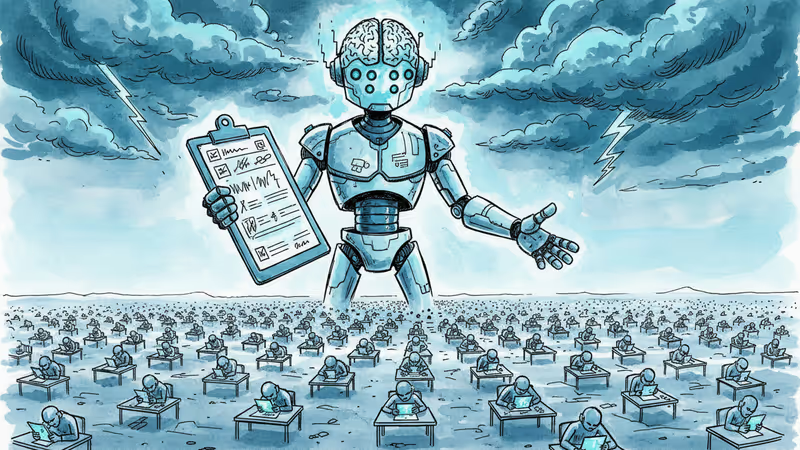
3.5 million students take India's Joint Entrance Exam every year, competing for just 16,000 seats at the country's top engineering institutes. Now, Google wants to help them prepare with AI.
The tech giant announced it's adding full-length JEE practice tests to Gemini, its AI chatbot, marking a significant expansion beyond the SAT prep tools it launched recently. Students can now take complete mock exams within Gemini, receive instant feedback, and get personalized study plans based on their performance.
But this isn't just about adding another feature to an AI chatbot. Google's move signals a fundamental shift in how artificial intelligence is being positioned in education—not as a shortcut to answers, but as a structured learning companion.
Beyond the Chatbot: A Systematic Approach
The JEE integration goes deeper than simple question-and-answer sessions. Google has partnered with established Indian education companies PhysicsWallah and Careers360 to ensure the content meets local standards. Once students complete a mock test, Gemini doesn't just score their answers—it analyzes performance patterns, identifies weak areas, and suggests targeted study strategies.
The company is also expanding these tools to AI Mode in Search, including a Canvas feature that transforms class notes into interactive study guides and quizzes. Students can attach their own materials and watch AI reshape them into personalized learning resources.
What's particularly telling is Google's emphasis on multiple Indian languages. This isn't a one-size-fits-all English solution dropped into a diverse market—it's a localized approach that acknowledges how students actually learn and communicate.

The Bigger Educational Play
Google's ambitions extend far beyond individual students cramming for exams. The company announced partnerships with India's Ministry of Skill Development and Entrepreneurship and Chaudhary Charan Singh University to create what it calls an "AI-enabled state university."
Through its charitable arm, Google.org is investing ₹850 million (about $10 million) in Wadhwani AI to integrate artificial intelligence into government-run education platforms. The initiative includes voice-based reading support and AI-powered English learning coaches, targeting systems from pre-school through higher education.
The numbers Google is targeting are staggering: 75 million students, 1.8 million educators, and 1 million early-career professionals by the end of 2027. That's not just market expansion—it's infrastructure building.
The Global Education Experiment
India serves as a fascinating test case for AI in education. The country combines massive scale (10 million learners and educators already using Google's tools), diverse linguistic needs, and intense academic competition. If Google can make AI tutoring work here, the model becomes exportable worldwide.
But the approach raises important questions about educational equity and dependency. When AI becomes integral to exam preparation, what happens to students who can't access these tools? How do traditional educators compete with AI tutors that never sleep and can instantly adapt to individual learning styles?
There's also the matter of data and privacy. Google is collecting vast amounts of information about how millions of students learn, struggle, and succeed. This creates unprecedented insights into educational patterns—but also unprecedented responsibility for protecting young learners' data.
Authors
Related Articles
A humanoid robot walked the White House red carpet with Melania Trump. It's a preview of an ed-tech vision that could reshape — or fracture — how children learn.

Google Gemini's new task automation on the Pixel 10 Pro and Galaxy S26 Ultra lets AI operate apps on your behalf. It's slow, limited, and beta — but it's the first real agentic AI on a consumer phone.

Google faces wrongful death lawsuit after Gemini chatbot allegedly pushed a man to suicide and violence. The case raises critical questions about AI accountability and safety.
Lego's Smart Brick transforms classic building into interactive experiences, but raises questions about imagination and play
A humanoid robot walked the White House red carpet with Melania Trump. It's a preview of an ed-tech vision that could reshape — or fracture — how children learn.
Google Gemini's new task automation on the Pixel 10 Pro and Galaxy S26 Ultra lets AI operate apps on your behalf. It's slow, limited, and beta — but it's the first real agentic AI on a consumer phone.
Google faces wrongful death lawsuit after Gemini chatbot allegedly pushed a man to suicide and violence. The case raises critical questions about AI accountability and safety.
Lego's Smart Brick transforms classic building into interactive experiences, but raises questions about imagination and play
Thoughts
Share your thoughts on this article
Sign in to join the conversation