
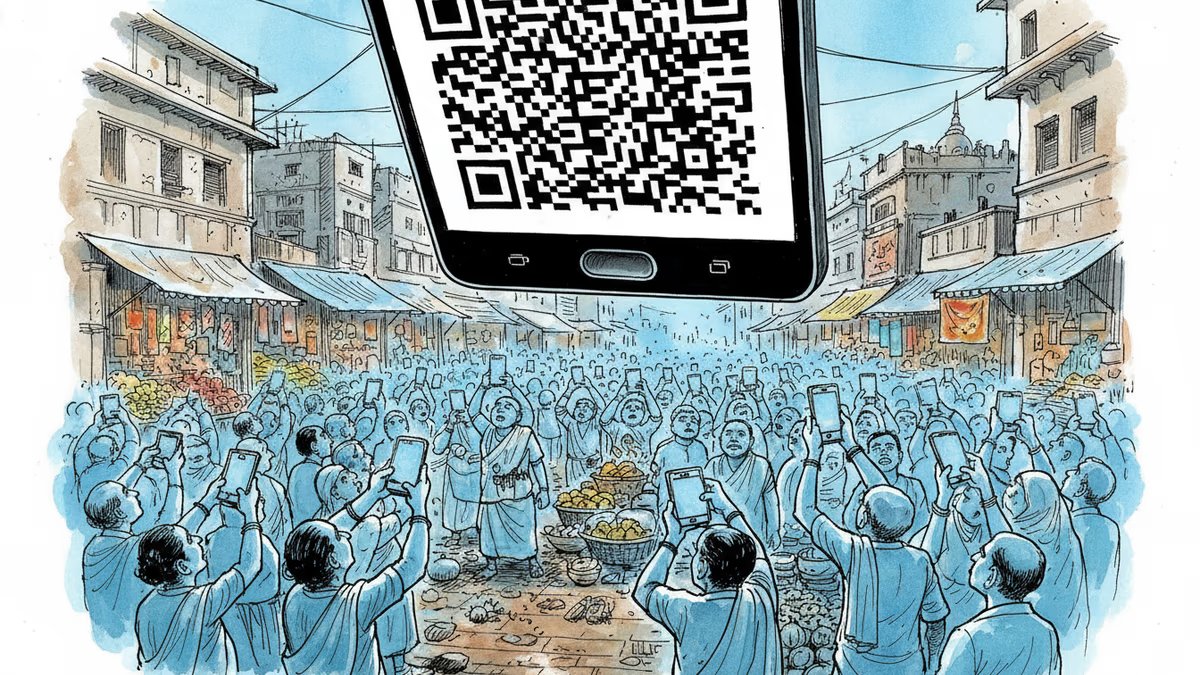
When 1.4 Billion Digital IDs Move Into Daily Life
India's Aadhaar system expands with new app and offline verification, raising questions about privacy, consent, and the future of digital identity at scale.
2.5 billion authentication transactions every month. That's the scale at which India's Aadhaar system operates—and now it's moving from the background into the foreground of daily life.
The world's largest digital identity system just got a major expansion. In late January, India's Unique Identification Authority (UIDAI) launched a new Aadhaar app with offline verification capabilities, allowing people to prove their identity without real-time database checks. Instead of sharing full birth dates, users can now selectively share information like "over 18 years old."
The numbers tell the story of rapid adoption. Combined monthly installs of Aadhaar-related apps jumped from close to 2 million in October to nearly 9 million in December, with the new app quickly overtaking the older mAadhaar version.
From Backend to Everyday Interface
This isn't just a technical upgrade—it's a fundamental shift in how digital identity operates. Aadhaar is moving from a largely invisible verification tool to a visible layer of daily interaction. Hotels, workplaces, housing societies, and even police departments are integrating the system.
The Ahmedabad City Crime Branch became India's first police unit to integrate Aadhaar-based offline verification with their guest-monitoring platform for hotels. UIDAI is also positioning the app as a "digital visiting card" for meetings and networking.
Integration with digital wallets is accelerating too. After Samsung Wallet, Google Wallet integration is coming, with Apple Wallet discussions underway.
The Privacy Paradox
Government officials frame this as empowerment. They argue offline verification gives users more control over their data while replacing risky photocopies and manual ID checks. The selective sharing feature addresses long-standing concerns about oversharing personal information.

Privacy advocates see a different picture. Raman Jit Singh Chima from Access Now questions the timing: "The fact that this has gone ahead at this point seems to indicate a preference to continue the expansion of Aadhaar, even if it is unclear in terms of the further risks."
The concern isn't just technical—it's structural. India's Data Protection Board hasn't been established yet, leaving expansion to proceed without independent oversight.
Civil rights groups worry about "Aadhaar creep." Despite a 2018 Supreme Court judgment barring private sector use of Aadhaar, the offline system could normalize its use across social and economic life. When hotels or delivery services request verification, how voluntary is consent really?
Global Implications
India's approach is being watched closely by governments worldwide. The promise of population-scale identity verification is attractive, but the implementation raises fundamental questions about digital governance.
The selective data sharing model offers a potential middle ground between privacy and verification needs. However, critics point to persistent problems: database inaccuracies, security lapses, and poor redress mechanisms that disproportionately affect vulnerable populations.
A 2022 report by India's Comptroller and Auditor General found UIDAI had failed to meet certain compliance standards—issues that remain unresolved as the system expands.
The Consent Question
Perhaps the most critical issue is consent in practice versus theory. While the new app provides technical controls over data sharing, real-world power dynamics often make refusal difficult. Can a delivery worker realistically decline verification requests? Can hotel guests choose alternative identification methods?
Shruti Narayan and John Simte from the Rethink Aadhaar campaign argue that consent becomes "illusory" when digital identity verification becomes the default expectation across services.
Authors
Related Articles

SolarSquare is raising $55-60M at a $450-500M valuation, more than doubling its worth in 18 months. Here's what's driving investor conviction in India's residential solar market.
Indian venture capital has quietly displaced Silicon Valley in its own backyard. Only one American VC made India's top 10 investor list last year. Here's why that matters beyond India.

Tinder now rewards users who scan their irises at a World orb with free in-app boosts. As AI agents flood dating apps, 'being human' is becoming a verified status — and a business model.
Wisconsin Governor Tony Evers vetoed an age verification bill for adult sites, citing privacy concerns. With 25+ states going the other way, the debate cuts to the heart of online freedom vs. child protection.
SolarSquare is raising $55-60M at a $450-500M valuation, more than doubling its worth in 18 months. Here's what's driving investor conviction in India's residential solar market.
Indian venture capital has quietly displaced Silicon Valley in its own backyard. Only one American VC made India's top 10 investor list last year. Here's why that matters beyond India.
Tinder now rewards users who scan their irises at a World orb with free in-app boosts. As AI agents flood dating apps, 'being human' is becoming a verified status — and a business model.
Wisconsin Governor Tony Evers vetoed an age verification bill for adult sites, citing privacy concerns. With 25+ states going the other way, the debate cuts to the heart of online freedom vs. child protection.
Thoughts
Share your thoughts on this article
Sign in to join the conversation