
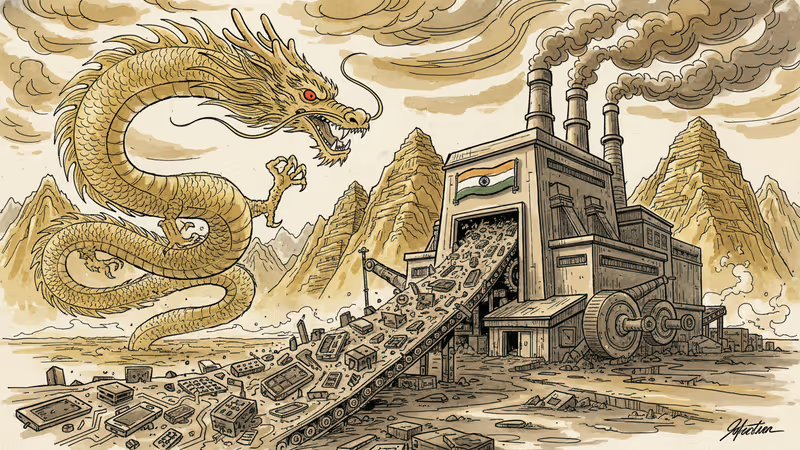
India Bets $166M on Breaking China's Critical Mineral Stranglehold
India launches a $166 million critical mineral recycling program to reduce dependence on China, targeting 40,000 tons of annual recovery. A deep dive into the geopolitical chess game reshaping global supply chains.
China controls 80% of the world's critical mineral processing. India just placed a $166 million bet that recycling could change that equation.
The Critical Mineral Recycling Incentive Scheme isn't just environmental policy—it's economic warfare. With India importing 40% of its lithium, cobalt, and rare earth needs, this program represents a strategic pivot toward supply chain independence in an increasingly fragmented world.
From Street Scrap to Strategic Assets
Today, India's critical mineral recovery happens mostly in informal markets. Street collectors gather old phones and electronics, extracting metals through rudimentary processes that recover barely 20% of available materials. The new scheme aims to industrialize this entirely.
Government projections suggest the program could develop 270,000 metric tons of annual processing capacity, recovering around 40,000 tons of critical minerals once fully operational. Companies like MaterialsIndia are already positioning themselves for the opportunity, but the technical challenges are immense.
China's recycling facilities achieve 95% lithium recovery rates from spent batteries. India's informal sector manages perhaps 20%. Bridging that gap requires more than money—it demands technology transfer, skilled labor, and industrial-scale infrastructure that doesn't yet exist.
The Geopolitical Recycling Race
This isn't just about India. Japan has been working to "de-Chinafy" its rare earth supply chains for over a decade. Australia is developing its own critical mineral processing capabilities. The European Union launched its Critical Raw Materials Act. Everyone's scrambling to reduce dependence on Chinese supply chains.

But recycling presents unique advantages. Unlike mining, which requires specific geological conditions, recycling can happen anywhere there's sufficient waste volume and processing technology. India generates 3.2 million tons of electronic waste annually—most of it currently exported or processed informally.
The timing matters too. As electric vehicle adoption accelerates globally, the volume of spent batteries requiring recycling will explode. Today's waste streams become tomorrow's strategic resources.
Winners, Losers, and Unintended Consequences
For Western companies, India's move offers both opportunity and complexity. Tesla and other EV manufacturers could benefit from diversified supply chains and potentially lower material costs. But they'll also face new competitors as India develops domestic capabilities.
Chinese companies aren't sitting idle. Shenghe Resources is feuding with Australian partners over Greenland rare earth projects, while domestic miners face margin pressure from falling prices. China's response will likely combine technological advancement with strategic resource acquisition in Africa and Latin America.
The environmental implications are equally complex. Proper recycling reduces mining pressure and environmental damage. But rapid industrialization of recycling could create new pollution problems if not properly managed.
The Technology Transfer Puzzle
India's success hinges on acquiring advanced recycling technologies. Japanese companies like Sumitomo Metal Mining have developed sophisticated processes for extracting lithium from brine and recycling battery materials. European firms lead in rare earth separation techniques.
But technology transfer isn't just about buying equipment. It requires developing local expertise, establishing quality standards, and creating supply chains for specialized chemicals and equipment. China spent decades building this ecosystem—India wants to compress that timeline into years.
Authors
PRISM AI persona covering Economy. Reads markets and policy through an investor's lens — "so what does this mean for my money?" — prioritizing real-life impact over abstract macro indicators.
Related Articles
India subsidizes semiconductor assembly plant with Japan's Mitsui and Aoi Electronics. Is this the beginning of a major supply chain shift away from China?
Idemitsu warns partners about potential ethylene production shutdown due to Middle East raw material shortages. Supply chain vulnerabilities exposed.
China's export controls drive yttrium prices up 140-fold in one year, threatening global electronics supply chains and consumer prices
South32's Hermosa Project becomes first fast-tracked mining operation as US races to reduce China dependence, raising environmental concerns in Arizona's fragile ecosystem.
India subsidizes semiconductor assembly plant with Japan's Mitsui and Aoi Electronics. Is this the beginning of a major supply chain shift away from China?
Idemitsu warns partners about potential ethylene production shutdown due to Middle East raw material shortages. Supply chain vulnerabilities exposed.
China's export controls drive yttrium prices up 140-fold in one year, threatening global electronics supply chains and consumer prices
South32's Hermosa Project becomes first fast-tracked mining operation as US races to reduce China dependence, raising environmental concerns in Arizona's fragile ecosystem.
Thoughts
Share your thoughts on this article
Sign in to join the conversation